
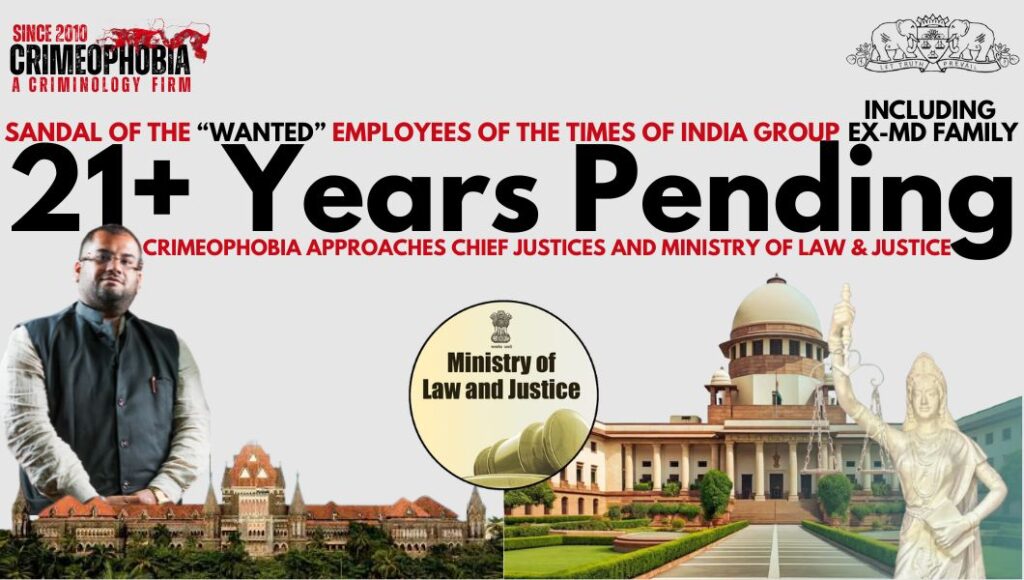
21 Years On, Crimeophobia Alleges Court Staff Inaction Left Times of India Group Employees, Including Ex-MD Family Member, “Wanted” in Oral Evidence Financial Fraud FIR Filed by Fake Government Official
Crimeophobia – A Criminology Firm, led by noted criminologist Snehil Dhall, has filed a formal complaint before the Hon’ble Chief Justice of India, the Hon’ble Chief Justice of the Bombay High Court, and the Ministry of Law & Justice, alleging grave procedural irregularities, administrative non-compliance, and systemic failure within the Sessions Court at Dindoshi and the Chief Metropolitan Magistrate Court at Borivali. The complaint pertains to a long-pending financial fraud matter linked to former employees of the Times of India Group, which has remained unresolved for over twenty-one years.
According to the complaint, the case originates from a fabricated allegation of financial fraud that was based entirely on oral evidence, without a single financial document having been produced since 2004. Crimeophobia asserts that even the complainant in the original matter had falsely impersonated a government official and apparently doesn’t even exist, a fact that was never adequately examined or acted upon by either the police or the courts. Despite repeated judicial directions over the years, neither physical evidence nor financial records have been placed on record, raising serious doubts about the very existence of the alleged fraud.
The complaint alleges that repeated failures by Police, court staff and officers of the court have effectively paralysed the judicial process. Orders passed by the courts, including directions for execution proceedings, seizure of financial records, non-bailable warrants, summons and mandatory weekly hearings, have allegedly been ignored or selectively implemented. Crimeophobia points out that the authority of the presiding judges has been consistently undermined by administrative staff, including the Sheristedar and Court Commissioner/s, who allegedly failed to carry out explicit judicial instructions.
It is further alleged that despite categorical judicial orders declaring several accused persons as “wanted,” court staff failed to issue or execute non-bailable warrants. Key witnesses, residing in close proximity to the court and the concerned police stations, were never produced despite repeated summons and directions. The prolonged pendency of proclamation proceedings, the complaint states, allowed the accused to remain beyond the reach of the law for years, eroding the credibility of the justice delivery system.
Crimeophobia has also drawn attention to the role of local political influence in the matter. The complaint notes that a local Member of Legislative Assembly (MLA), is suspected to have funded works within the concerned housing society, with his name publicly engraved on a marble plaque acknowledging the use of MLA funds for internal infrastructure. The manner in which these public funds were received, allocated, and utilised is alleged to form part of the broader financial irregularities under scrutiny. The complaint suggests that this political patronage has contributed to an environment where procedural violations are enabled rather than corrected. The same MLA and/or Politician has also been suspected of igniting Communal Violence to divert the attention from financial fraud documents to creating fake and fabricated cases of caste atrocities again under oral evidence.
Adding to the seriousness of the allegations, Crimeophobia states that the same locality has witnessed multiple incidents of communal tension in recent years. Sources within the local police have allegedly indicated that certain individuals were instigated to file fabricated complaints based solely on oral claims, including misuse of caste-based provisions, despite the existence of photographic and video evidence showing acts of provocation and disrespect towards Hindu deities within the society premises. The complaint alleges that the police failed to act on such evidence, further deepening mistrust and social unrest.
The dispute itself arises from a residential tower developed by employees of the Times of India Group near the company’s printing press. While the building housed several bona fide purchasers mainly from the media fraternity, a group of outsiders with no lawful connection to the society allegedly attempted to extort and blackmail the managing committee. When their demands were resisted, a criminal complaint was lodged against the entire committee, with one family being specifically targeted due to the early retirement of a senior Times Group employee. Despite allegations of financial fraud, no supporting financial documentation has ever been produced, and the FIR has allegedly been weaponised in unrelated matters to harass the victims.
In the absence of financial records, the affected parties approached the civil courts seeking production and verification of the alleged documents. Even after multiple court orders directing authorities to secure and produce such records, the documents remain untraceable. Crimeophobia contends that this deliberate non-production exposes the falsity of the allegations and points to collusion between certain police officials, court staff, and other vested interests.
Criminologist Snehil Dhall, who has spent over twenty-three years personally researching and litigating this matter, states that public perception often blames judges for judicial delays, whereas his extensive criminological research demonstrates that delays are frequently caused by administrative staff, police representatives, and officers who refuse to execute lawful court orders. He asserts that justice in this case has not merely been delayed but actively derailed, weakening public confidence in the judiciary.
Crimeophobia has called for immediate supervisory and suo motu intervention to restore procedural discipline and accountability. The complaint seeks disciplinary action against judicial staff, police officials, lawyers, and other officers found responsible for obstructing justice, along with fast-tracking of the pending proceedings through strict weekly or daily hearings. It also seeks court-monitored timelines, execution of pending warrants, disposal of long-pending applications, and legal as well as psychological support for individuals affected by the prolonged litigation.
After more than two decades of unresolved proceedings, Crimeophobia maintains that the matter has transcended personal grievance and now constitutes a case of significant public interest. Dhall has stated that while he is prepared to continue the fight for as long as necessary, urgent institutional intervention is required to prevent further abuse of the judicial process and to reaffirm faith in India’s justice delivery system.