
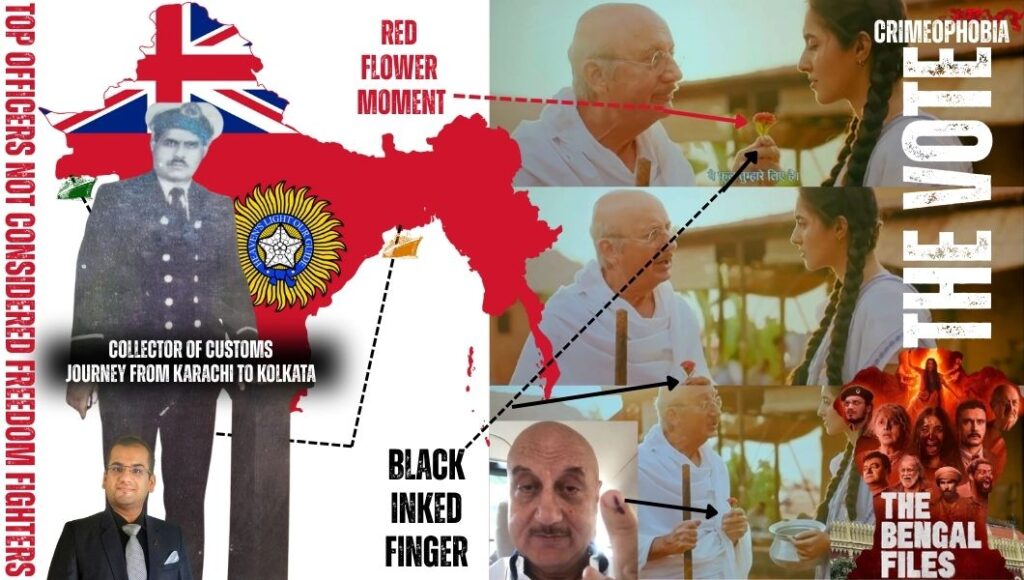
“A forgotten legacy revived: Bengal Files shows Reel Gandhi with an inked finger, sparking memories for Criminologist of his great-grandfather, a Collector of Customs who chose India over Pakistan when Sanatani British Top Officers weren’t called Freedom Fighters. A story of Partition, patriotism, and a Sanatan Republic that could have been.”
Bengal Files: Reel Gandhi’s Voter-Inked Finger with Red Flower Moment Recalls Collector of Customs’ Journey from Karachi to Kolkata for S. Dhall Family
Bureau: The release of The Bengal Files has stirred intense debate about history, leadership, and Partition. Among its many powerful sequences, one stands out with unexpected resonance—a cinematic oversight where actor Anupam Kher, portraying Mahatma Gandhi, while handing a red flower to a young girl, appears with the black ink line on his finger, as if he had cast a vote. Though an unintentional lapse, for criminologist Snehil Dhall, this single frame awakened deeply personal memories of his great-grandfather, Late Hon. Sawantmal Dhall, who served as Collector of Customs in Karachi and later moved to Kolkata during the British Raj.
The thought lingers: if Gandhi had indeed voted, would the history of India have shifted? Could India, instead of becoming a secular republic under Jawaharlal Nehru, have declared itself the Sanatan Republic of Hindustan, much like Pakistan became the Islamic Republic? For the S. Dhall family, this cinematic moment intertwines directly with the fateful migration of their great patriarch.
A Collector at the Crossroads of Partition from Karachi to Kolkata: Late Hon. Sawantmal Dhall’s position as Collector of Customs placed him at the heart of one of the Empire’s busiest ports. His duties likely included regulating maritime trade, collecting duties, and curbing smuggling—functions vital not just for imperial order but also for economic stability in turbulent times. When Partition loomed while the movie’s red flower moment with black inked finger was highlighted, he made a defining move: relocating his S.Dhall family by British ship from Karachi to Kolkata.
Whether this was a personal decision or an official transfer remains uncertain, but his foresight is undeniable. Unlike many officials who stayed in Pakistan, he chose India, ensuring stability for his S. Dhall family and quietly expressing patriotism within the confines of his duty. Today, Pakistan continues with the colonial-era title “Collector of Customs,” while India has redefined the post as “Principal Commissioner of Customs” under the Central Board of Indirect Taxes and Customs. Yet the core mandate—combatting smuggling, regulating borders, and safeguarding national interests—remains unchanged across generations.
A Karmic Continuity: For criminologist Snehil Dhall, founder of Crimeophobia, the parallels are not only historical but karmic:
“There is no confirmation or record that my great-grandfather ever visited the United Kingdom. But when I went there to study, it felt like a karmic cycle. His duties as Collector of Customs were rooted in preventing smuggling and protecting borders. Decades later, I found myself working on the United Nations Convention against Transnational Organized Crime (UNTOC), which carries the same spirit at a global scale.”
UNTOC, adopted in 2000, addresses trafficking, smuggling of migrants, and illicit arms trade—precisely the same spectrum of crimes that Collectors of Customs once confronted at imperial ports like Karachi. Snehil himself unintentionally echoed his great-grandfather’s path. He first moved to the UK to pursue Honours in International Relations. In his first semester, he even witnessed the United Nations General Assembly in New York but soon realized the UN ecosystem did not align with his vision. He switched to Honours in Criminology, charting his independent course.
During his years in Britain, he obtained long-term membership at the British Library, home to archival documents of colonial officials. There he searched for traces of Late Hon. Sawantmal Dhall’s service, but the archives remained silent. The family’s oral history preserved only one enduring fact: during Partition, he moved the family from Karachi to Kolkata by ship. When Snehil turned to his grandfather for answers, he found silence cloaked in philosophy. “There is no India or Pakistan, only Bharat,” his grandfather would insist, refusing to share Partition stories while believing in Akhand Bharat. Thus, most attempts to uncover documented history failed, but personal memories, faint stories, and preserved photographs remained.
Memories of “Bappu” and “Bauji”: Some memories are warm—sharing a bedroom with his great-grandfather, playing RoadRash on an early desktop computer, and absorbing the quiet discipline of an elder statesman. Others are piercing—like his final moments:
“I was asleep when the family was leaving for the last rituals. They forgot to wake me. By the time they realized, the ambulance had already left, almost a half-kilometre away. Someone stopped it, and from our sixth-floor apartment, I was made to run through a crowded road to see his face one last time before cremation, as per Hindu rituals. That memory continues to live with me.” — Criminologist Snehil Dhall
For Snehil, The Bengal Files has revived all these reflections. The film’s dialogue—“Bapu was Wrong”—clashes with his conviction: “My Bauji was Right—in moving to India from Pakistan at the right time.” The unintentional cinematic detail of Gandhi’s “vote mark” becomes a metaphor. It compels him to wonder whether his great-grandfather’s decision to move to India was shaped by the same belief—that India might emerge as the Sanatan Republic of Hindustan, mirroring Pakistan’s Islamic identity. But history took a different course, and India became the secular Republic of India.
A Legacy Beyond Titles: While British Raj officials like Late Hon. Sawantmal Dhall cannot be called Freedom Fighters, their decisions nonetheless helped shape India. By performing their duties with integrity, they laid the groundwork for governance and enforcement in the independent nation that followed, especially during Bengal’s most difficult times. Today, through Crimeophobia and his work with UNTOC, Snehil carries this legacy in a transnational form. Just as his great-grandfather once policed the seas of Karachi, he now works to police the global networks of organised crime, striving to implement UNTOC in India, already signed between the Government of India and the United Nations.
As films like The Bengal Files remind the nation of contested histories, the S. Dhall story underscores the importance of preserving family legacies. Beyond slogans and official records, it is in these choices—of a Collector who chose India over Pakistan, and of a criminologist who chose enforcement over diplomacy—that the true continuity of history is found. The entire S. Dhall family extends condolences to the victims of Bengal, as shown in the movie The Bengal Files, while continuing their search for historical records of the work done by Late Hon. Sawantmal Dhall.