
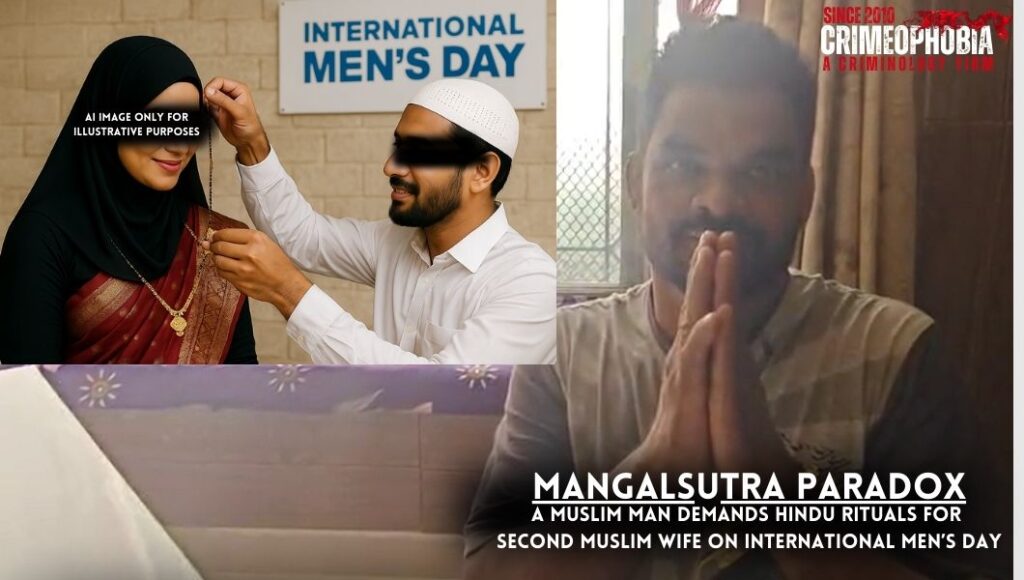
Crimeophobia amazed with Mangalsutra Paradox of a Muslim Man demands Hindu Rituals for Second Muslim Wife on International Men’s Day
“Criminologist Snehil Dhall speaks to an Indian Muslim man rejecting a second-marriage proposal because he demanded a Muslim woman to wear a mangalsutra, a symbol of Hindu marital status.”
Written by Vedika Muni, Psychology Student and Crimeophobia Intern; Published by Crimeophobia
Mumbai: A conversation between Criminologist Snehil Dhall, the founder of Crimeophobia and Mohd Samsuddin Sai Mohammed has opened a pandora’s box; provoking new perspectives. Sai Mohammed is not a typing error but it is the actual name of this man’s father (In Hinduism, the name Sai is referred to a saint or guru. For example, Sai Baba of Shirdi is a famous and highly revered saint in Hinduism). Coincidentally, this unfolds on the International Men’s Day and just as the Bollywood movie Haq was released, highlighting Muslim Women’s rights, an ordinary Muslim man insists on extraordinary religious ritual conditions at a match-making meet.
The paradox begins with a man, a carpenter turned interior designer and businessman, who is looking for his second-wife. Under Muslim laws, a second marriage is not unusual, neither illegal nor socially shaking. The unusual-ness of this case appears when the man demands that his prospective second wife, a Muslim herself, to wear a mangalsutra and apply sindoor along with a hijab which she was not wearing at the time of match-making meet.
Both the mangalsutra, a sacred necklace worn routinely, and the sindoor (vermillion powder), have been a part of Indian Hindu culture for centuries, acting as symbols of marriage for Hindu women. Worn across the different castes and socioeconomic strata of the Hindu communities, both signify a wife’s commitment and devotion to her husband. However, the man’s demands do not arise due to patriarchal ideologies but rather due to the bad experience from his first marriage which left him and his children searching for emotional stability. Yet here stands a Muslim man demanding these Hindu marital symbols while also requiring the hijab, and refusing marriage when the prospect does not agree with his beliefs. This combination is so culturally contradictory that it borders the line of theatrical absurdity. This is not a social experiment, nor satire, nor a Bollywood movie.
As stated by the man himself, a video confession carried out voluntarily, in conversation with Criminologist Snehil Dhall, now serves as the evidentiary backbone for this report. In the video, he calmly describes his reasoning, “It is such a symbol of a woman, that in the presence of any unmarried men, a married woman will be there showing that she is married, this Mangal Sutra is her symbol, vermillion is her symbol, whether Hindu or Muslim.” (Translated in English from Hindi/Urdu as spoken by the man in the video)
His argument is not theological. It is not traditional. It is not even a personal law. It is visibility. For him, this visibility is a non-negotiable symbol. He believes the manglasutra to be a part of Indian Culture rather than it being exclusively Hindu. He believes that a woman’s marital status must be seen, arguing that it protects women from unwanted, wandering, predatory male gaze, as well as provides a sense of conscious satisfaction that other men would refrain from flirting with his wife, that there is a symbolic, tangible representation of his marriage, though such assurances rarely align with reality. Regardless, for him, the mangalsutra and sindoor serves his purpose of expressing marital commitment in a way that he feels is better than anything his own religion can provide.
Today, some Indian Christians and Muslims also adorn these symbols, often as a result of religious conversions, opting to stay connected to their roots in Hinduism and regional traditions. The man’s, however, extends his reasoning. In his video, he emphasizes these symbols to be a part of Indian Culture, and thus must be worn, regardless of religious beliefs. A declaration that merges religion into culture, and culture into personal preferences.
Meanwhile, at the global level, many Muslim-majority countries have moved away from the hijab, highlighting that the hijab itself does not serve as a mandate for women belonging to the religion. In India, however, the hijab is a topic of major legal and cultural debates, framed as an issue of fundamental personal liberty. At the same time, some Hindu women are also choosing to not wear the mangalsutra or sindoor. And yet, the man demands both Hindu and Muslim ritualistic symbols for a woman entering into a marriage with him.
Bollywood has spent decades portraying and amplifying women demanding their rights; their haq. In a cultural inversion, here is a man demanding his haq. He presents himself as someone asserting his rights as a man; a sentiment that emerges with ongoing public conversations where discussions often tiptoe around the complexities of men’s expectations in relationships. This is not advocacy for men’s rights; rather, it is a cultural observation.
The contradictions extend to a legal stage as well. His first marriage at around the age of 17 would be legally classified as child marriage, yet he invokes “culture” to justify symbolic expectations in his second marriage. Muslim personal norms do not require a mangalsutra. What does it mean when a marital symbol from one religion becomes a condition for marriage within another? At what point do a man’s personal expectations begin to override the woman’s own religious identity? Where, in a case like this, is the boundary between cultural adoption, male-driven preference, and cultural coercion?
And can symbols really determine marital eligibility in 2025? Our goal here is not to answer, but to simply raise the questions the video itself sparks. Questions that arise as we hear Mohd Samsuddin Sai Mohammed state to Criminologist Snehil Dhall on various other Ram-Rahim debatable conversations. Previously, Criminologist Snehil Dhall and Crimeophobia Team has also dealt with a report in which an individual labelled himself as a Muslim Pandit, self-proclaiming himself as the Caretaker of an Ancient Hindu Temple in Mumbai. His wife is believed to be a Tribal Hindu Girl which locals believe is part of Love Jihad (a term coined by Christian Communities).
This case of Mohd Samsuddin Sai Mohammed ultimately shows how a single symbol can decide a marriage, becoming a point where cultural expectation and religious identity intersect sharply enough to shape the choices that people make.