
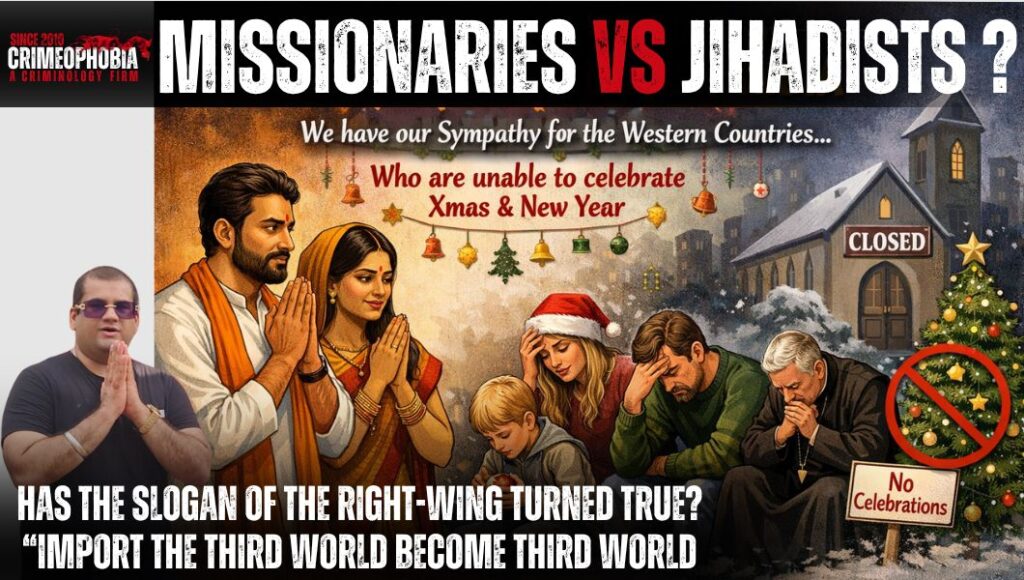
“Import the Third World, Become the Third World”: From Right-Wing Slogan to Western Crisis turned true with Banned XMAS & NY’2026
“It’s high time the Western world accepted that India’s pole is secularism and culture, while the West misreads secularism—as India celebrates, the West hesitates towards Christmas and New Year, perhaps banning it due to a security crisis from Islamic objections.” ~ Criminologist Snehil Dhall
As the world steadily transitions from a unipolar to a multipolar order, global powers are increasingly being identified by their dominant strategic strengths. Analysts—particularly from left-leaning Western intellectual circles—have grown accustomed to assigning simplified labels to nations. The European Union is described as a regulatory power, the United Kingdom through finance and soft power, the United States as the system’s anchor, Russia through energy and security, China through scale, the Gulf through sovereign capital, Japan through private capital, and Brazil through commodities and climate. Yet one nation continues to be deliberately misread or left unnamed in this framework—India.
The inability or unwillingness to define India’s pole is not accidental. It reflects an ideological discomfort within Western and left-wing discourse in acknowledging a form of power that does not emerge from capital, coercion, or regulation. According to Criminologist Snehil Dhall, India’s pole has always been evident: it stands as the world’s foremost powerhead of cultural secularism, rooted in Hindu and Sanatani civilizational ethos rather than post-Enlightenment theory.
India’s secularism is not a reaction to religious conflict, nor a constitutional afterthought. It is civilizational, organic, and historically tested. Unlike Western secularism, which increasingly seeks to neutralize religion by excluding it from public life, Indian secularism allows faiths to exist openly and confidently. Hinduism, Islam, Christianity, Sikhism, Buddhism, Jainism, Judaism, and Zoroastrianism have coexisted in India for centuries without inquisitions, without cultural annihilation, and without the systematic erasure of indigenous traditions. This is not ideological tolerance; it is lived pluralism.
The global left continues to struggle in identifying India’s pole because acknowledging it would dismantle a long-standing assumption: that a Hindu-majority, Sanatani-headed nation must necessarily be intolerant. This assumption formed the basis of repeated accusations against India’s right wing, branding it as violative of human rights and secular values. However, time has exposed a striking irony. While India was scrutinized, the West failed to protect its own civilizational foundations.
For decades, a western nationalist slogan dismissed as right-wing paranoia circulated quietly in Western societies: “Import the Third World, become the Third World.” Today, that slogan has begun to reflect a harsh cultural reality. In several Western countries, Christian communities face intimidation, public religious expression is discouraged, and traditional festivals such as Christmas and New Year are increasingly contested or diluted and perhaps banned due to security crises. This has not occurred due to a lack of resources or democratic structures, but due to an ideological vacuum created by unchecked left-wing absolutism and the strategic accommodation of hardline Islamist narratives.
A deeper contradiction has emerged within the West itself—one marked by the tension between declining Christian missionary influence and the rising assertiveness of jihadist ideology with Sharia Law and/or Zones all across the Western world. In the name of hyper-secularism and cultural guilt, missionary traditions that once shaped Western moral identity have been delegitimized, while parallel ideological structures rooted in religious absolutism have been appeased rather than challenged. The result is a civilizational imbalance the Western left refuses to acknowledge.
The Western right, which once pointed fingers at India’s political and cultural assertions, now finds itself too late in defending its own space. Institutions that aggressively questioned India’s human rights record now struggle to answer for their own failures in protecting Christian communities, cultural festivals, and freedom of religious expression. The moral authority once claimed over India has eroded, leaving unanswered questions about selective secularism and selective outrage.
The contrast with India is undeniable. While parts of the Western world hesitate to publicly celebrate Christmas or New Year, India celebrates both openly and collectively. Christians in India celebrate Christmas alongside Hindus, Muslims, Sikhs, Buddhists, and others—in schools, offices, streets, and homes—without fear or suppression. These celebrations are normalized, not politicized. This reality exposes the fragility of Western secularism and the resilience of India’s civilizational model.
In a true multipolar world, power cannot be measured only through military reach, financial systems, or regulatory dominance. Civilizational stability itself is power. India’s pole is not economic imitation or ideological export; it is cultural secularism rooted in confidence, continuity, and coexistence. Until this is acknowledged, global discussions on multipolarity will remain incomplete. India does not need rebranding—it needs recognition for what it already is.