
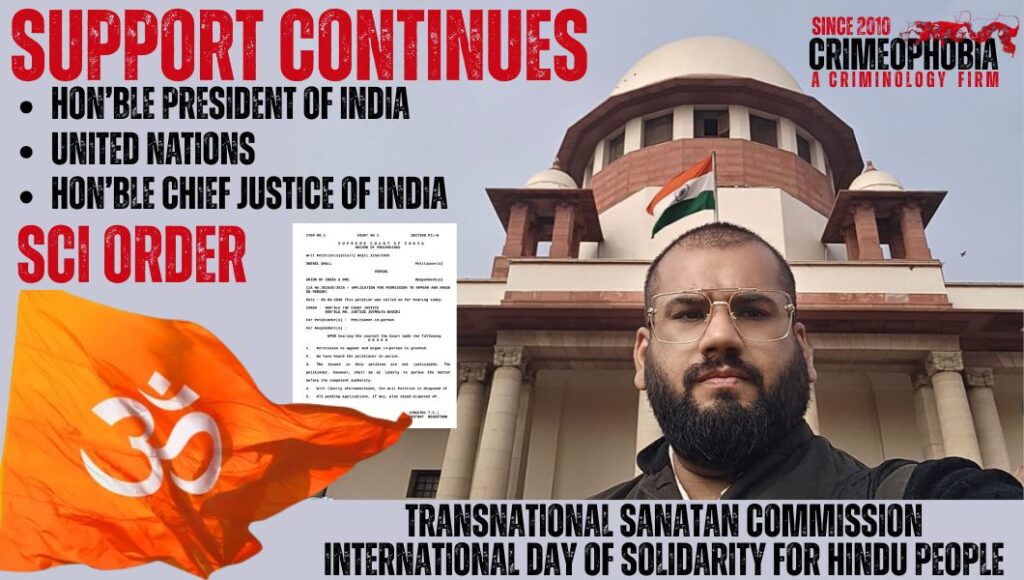
India’s Supreme Court Keeps Global Sanatan Heritage Cause Alive, Grants Strategic Liberty to Criminologist Snehil Dhall
Published: 05/01/2026; Author: Bureau Desk
“The Hon’ble Chief Justice of the Bombay High Court initially appreciated the arguments advanced; however, after reserving the matter for five days, the petition was dismissed with costs in accordance with judicial process. Subsequently, I received support at the level of the Hon’ble Chief Justice of India through an Order of the Supreme Court of India, with prior respective supporting letters from the Hon’ble President of India and the United Nations—an honour and an institutional affirmation of the sustained, evidence-based work of the Crimeophobia team. This progression from constitutional dialogue to structured institution-building will now be advanced through engagement with religious institutions, civil society leaders, and Sanatani communities globally, to pursue endorsement letters and administrative support from the Ministry of Home Affairs for establishing a ‘Transnational Sanatan Commission’ within the Indian constitutional and United Nations framework, and for advocating the recognition of an ‘International Day for Solidarity of Hindu People,’ grounded in cultural preservation, human rights, and civilizational continuity.” ~ Criminologist Snehil Dhall
New Delhi: In a development of far-reaching civilizational, legal, and geopolitical significance, the Hon’ble Supreme Court of India has formally disposed of a writ petition seeking the establishment of a “Transnational Sanatan Commission”, while explicitly preserving the petitioner’s right to pursue the initiative before competent authorities—a move widely seen as keeping the core cause alive and institutionally actionable.
The petition was argued personally and in person by Founder of Crimeophobia, Criminologist Snehil Dhall before the Chief Justice of India after the Hon’ble Supreme Court of India granted permission for the same, marking a rare instance where a petitioner advanced a global heritage-protection framework directly at the highest constitutional forum of the world’s largest democracy.
While the Court recorded that the issues raised were “not justiciable” at this stage, it simultaneously granted unambiguous liberty to the petitioner to take the matter forward before executive, administrative, and international authorities—an outcome legal observers interpret as a procedural repositioning, not a rejection. All pending applications were accordingly disposed of.
A civilizational petition beyond borders, faith, and conventional litigation
Dhall’s petition sought the creation of a Transnational Sanatan Commission—a proposed international institutional mechanism to protect Hindu communities, ancient temples, cave shrines, submerged heritage, and religious infrastructure across borders, particularly where domestic protections have failed or where transnational crime networks operate with impunity.
Anchored in British-era archival records, the petition referenced the historic “Bombay Cave Temple Commission”, arguing that the body was never formally dissolved and that its original mandate—heritage protection—remains legally and morally unfinished. Dhall proposed its reconstitution in a modern, transnational form, aligned with contemporary international law and the United Nations framework.
The petition further placed on record official communications involving the Hon’ble President of India, as well as documented correspondence with the United Nations, raising an extraordinary constitutional question: When civilizational heritage faces organised, transnational threats, which institution bears the duty to act?
From High Court dismissal to Supreme Court recognition
The Supreme Court proceedings followed the Bombay High Court’s 2024 dismissal of an earlier petition, which was labelled “omnibus.” Dhall had countered that organised crime targeting heritage, land, temples, and religious institutions is by definition omnibus, cutting across corruption, money laundering, trafficking, and state-level failures—precisely the crimes contemplated under the United Nations Convention Against Transnational Organised Crime (UNTOC).
In the present petition, Dhall had sought:
- Implementation of notices issued by the Hon’ble President of India
- Institutional endorsement for engagement with the United Nations
- Recognition of 14 August as the “International Day for Solidarity of Hindu People”
- Interim protection of temple-linked funds held by government bodies and trusts, pending transfer to a neutral, transnational mechanism
Supreme Court order: restraint with recognition
While declining to adjudicate on merits at this stage, the Supreme Court did not negate the substance of the issues raised. Instead, it formally acknowledged the petitioner’s right to pursue them through appropriate institutional channels.
Explaining the legal weight of the order, Advocate Mareesh Pravir Sahay, Advocate-on-Record at the Supreme Court of India, stated:
“I have seen the order passed by the Honourable Supreme Court in the Public Interest Litigation filed by Criminologist Snehil Dhall. The matter was listed before the Bench of the Honourable Chief Justice of India. The Honourable Court has granted liberty to the petitioner to approach the competent authorities with respect to the various issues raised by him in his petition. As per the Court, the competent authorities may be approached first. Therefore, the Court has observed that the matter may not be maintainable before the Honourable Court at this point of time. However, noticing the apparent merit in the issues raised, liberty has been granted to the petitioner to approach the competent authorities. Mr. Dhall would now be well advised to approach all the authorities and parties who were made respondents in the petition and submit representations. The competent authorities will then have to take cognizance of the matter and act upon it. If they fail or refuse to act, the petitioner would be at liberty to approach the Honourable Supreme Court again.”
The Court’s order explicitly records:
- Permission to appear and argue in person was granted
- The petitioner was heard in person
- Issues were held to be not justiciable at this stage
- Liberty was granted to pursue remedies before competent authorities
- The writ petition and all pending applications were disposed of
Why this matters globally
Legal analysts and heritage-policy observers note that the Supreme Court’s order, far from closing the door, creates a strategic roadmap—one that pushes the issue into executive, diplomatic, and international arenas where transnational heritage protection is actually operationalised.
With documented references to:
- Constitutional authorities
- Colonial-era heritage commissions
- United Nations correspondence
- UNTOC-linked organised crime frameworks
…the initiative now stands positioned for global institutional engagement, including with UN bodies, international heritage organisations, and cross-border legal mechanisms.
What comes next
Supporters view the development as the judicial legitimisation of a civilizational cause, while critics acknowledge it as an unprecedented legal experiment that has already crossed the threshold of India’s highest court. For criminologist Snehil Dhall and his team, the order marks not an end, but a formal green signal—to escalate the matter across ministries, international institutions, and global forums, with the option to return to the Supreme Court should state or institutional inaction persist. In an era where cultural erasure, heritage crimes, and religious persecution increasingly transcend national boundaries, the question raised by this case now resonates far beyond India: Who protects civilisation when borders fail—and institutions hesitate?
Civil Writ Petition (PIL) 1155/2025: Snehil Dhall Vs. Union of India & Ors. Coram: Hon’ble Chief Justice and Hon’ble Mr. Justice Joymalya Bagchi; Order dated 05/01/2026
One Response