
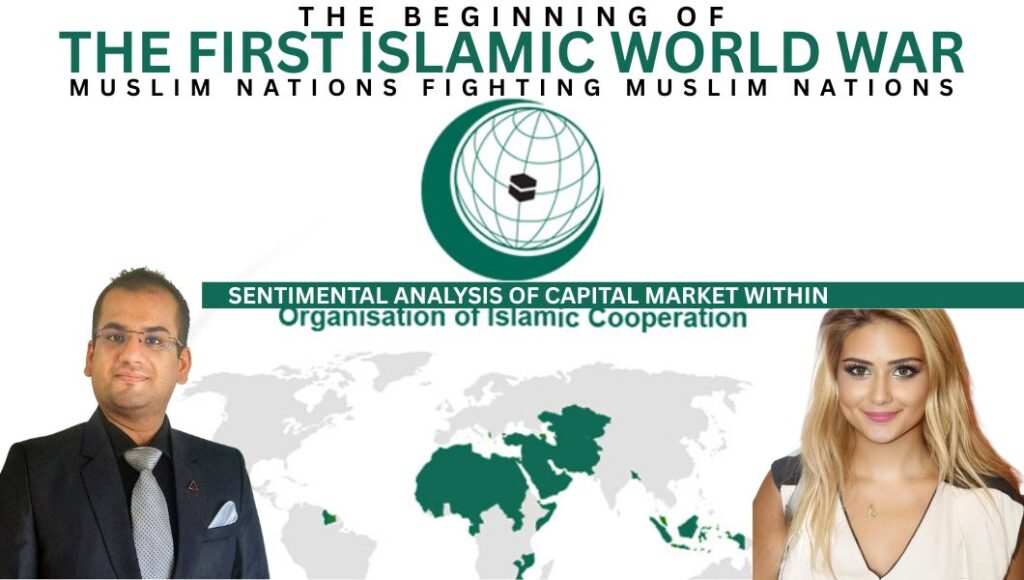
Crimeophobia Warns of Capital Shock Across OIC Markets after beginning of the First Islamic World War
Author: Bureau | Trade Hind-Se (Finance & Law Division of Crimeophobia)
Mumbai: The Finance & Law vertical of Trade Hind-Se, established by Crimeophobia, has released a high-impact geopolitical sentiment analytical report describing the current intra-bloc conflicts among Muslim-majority nations as the “First Islamic World War”—a term used not to denote scale alone, but to signify the historic rupture of Muslim nations confronting one another simultaneously across regions. The entire sentimental capital-market analysis has been authored by Criminologist Snehil Dhall, acting as the primary Sentimental Analyst for Crime & War affecting financial systems. Dhall’s framework evaluates how ideological fractures within the Organisation of Islamic Cooperation (OIC) are influencing investor psychology, sovereign risk perception, and long-term capital alignment across Islamic economies.
According to Dhall, for decades markets interpreted West Asian tensions through a predictable binary lens: Muslim solidarity versus non-Muslim intervention. That narrative anchored diplomatic responses, influenced oil risk premiums, shaped defence allocations, and even affected ESG-based capital decisions. However, the emerging theatre—marked by confrontations involving Iran, instability in Afghanistan, internal fractures in Pakistan, and rising Gulf rivalries under the shadow of the United States—has disrupted that foundational sentiment. Dhall argues that when Muslim nations are visibly fighting Muslim nations, the moral-political premise of unified Islamic brotherhood weakens. Markets are no longer pricing risk as “Islamic bloc versus West,” but as fragmented sovereign actors operating without guaranteed collective defence assurances. “If ideological unity erodes,” Dhall notes in the report, “capital cohesion follows. The OIC was perceived as a moral bloc; markets now test whether it functions as a strategic bloc.” This would also affect the peace rally across the globe which has been fighting under the narrative of Islamophobia in which every non-Muslim were targeted specially the Christians, Jews, Hindus and many other religions.
From a criminological-economic perspective, Dhall outlines structural consequences. Islamic Banking, Bond markets and sukuk investors (Sharia-compliant investment) may begin differentiating sharply between stable and unstable Islamic economies rather than viewing them under a collective solidarity premium, potentially increasing borrowing costs for politically volatile states. Oil and energy sentiment volatility remains immediate, as Iran’s calibrated targeting of U.S.-linked installations signals awareness of asymmetric military limits; while avoiding direct unsustainable confrontation, such actions elevate short-term oil volatility and inflate political risk premiums across the Gulf. Dhall also emphasises that extremist recruitment and propaganda ecosystems rely on clear ideological binaries, and when Muslim states are in open friction with one another, the narrative coherence required for mobilisation weakens, potentially redirecting networks toward financial crime, cyber-funding, and decentralised operations.
Rita Chahwan—Editor-in-Chief of Al-Khabar, Founder of the Middle-East Anti-Human Trafficking Research Centre, and Board Advisor to Crimeophobia—adds a regional dimension rooted in her Lebanese background. Chahwan argues that the unity of Islamic nations is increasingly strained between what she describes as “original Muslim populations” and more recent converts who, in certain regions, have adopted sharply orthodox interpretations without parallel socio-economic grounding. According to her, this ideological divergence is no longer theological alone—it is financial, strategic, and demographic. “The divide within the Islamic world today is not merely theological,” Chahwan states. “It is financial, strategic, and demographic. Identity is being asserted without economic symmetry.”
Chahwan further observes that Iran’s recent posturing has inadvertently spotlighted the scale of American military and economic presence across Islamic nations—an infrastructure network that many populations had normalized over decades. “Luxury skylines, logistical corridors, advanced ports, and security umbrellas exist because of complex global interdependence,” Chahwan notes. “Yet the same external presence is condemned elsewhere as anti-Muslim intervention.” According to her, this contradiction creates volatility not just in oil futures but in the broader political risk premium attached to Gulf economies. “Markets understand dependence better than politics does. When ideology clashes with economic reality, capital chooses stability.”
Much like India balances its own spectrum between modern constitutional progressives and deeply rooted orthodox communities, the Islamic world too is navigating an internal divide between reform-driven modernists and tradition-oriented orthodox factions, including ideological strands historically influenced by movements such as the Ikhwan. Across the Middle East, there is a growing assertion of sovereign identity that resists what many perceive as the unwanted dominance or imposition of Washington’s strategic and regulatory architecture in regional affairs. This resistance is not expressed only through military or diplomatic channels but also through financial recalibration, particularly in response to frameworks enforced by bodies such as the Office of Foreign Assets Control (OFAC), whose sanctions regimes shape cross-border dollar liquidity, and the Financial Action Task Force (FATF), whose compliance standards influence banking credibility and sovereign risk ratings. Strategic observers argue that while these mechanisms were designed to combat terror financing and illicit flows, they are increasingly viewed in some quarters as instruments of geopolitical leverage. In this context, parts of the Middle East appear determined to follow a path similar to India’s assertion of strategic autonomy—seeking engagement without submission and cooperation without ideological imposition. Rita further contend that the era of unquestioned American primacy has already waned, with emerging multipolar dynamics reshaping influence, and segments of the European Union demonstrating reduced appetite for automatic alignment with U.S.-led interventions. The result is a complex geopolitical transition in which regulatory power, ideological influence, and financial sovereignty are being renegotiated simultaneously.
The report does not definitively declare the dissolution of the Organisation of Islamic Cooperation but frames the present moment as its most significant stress test since inception. If member nations fail to align during direct or proxy conflicts, the aspirational concept of a NATO-like unified Islamic defence posture may lose strategic credibility in global financial markets. Dhall & Chahwan collectively concludes that the “First Islamic World War” is less about territorial conquest and more about narrative collapse. Capital markets, he argues, function as silent referendums on geopolitical coherence. “When Muslim nations fight Muslim nations,” Dhall writes, “the ideological premium dissolves. What remains is pure risk calculation. And capital has no religion—it only follows stability.”