
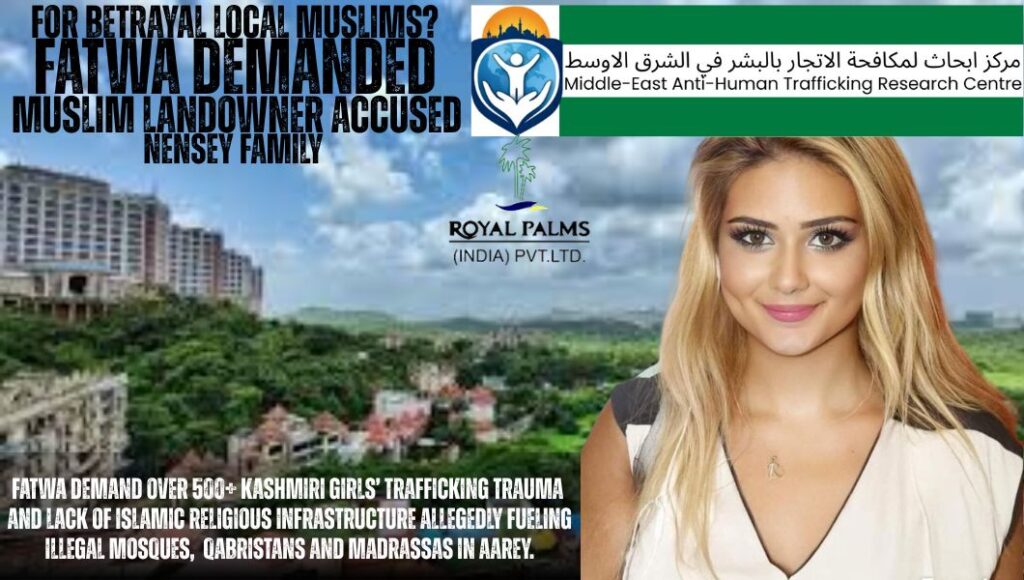
Betrayal of Local Muslims? Fatwa Demand as Royal Palms creating 500+ J&K girls in trafficking trauma while the continue to provide no Islamic religious infra in 240 acres
International Desk: Bureau ; Published on 08/03/2026
Mumbai: The controversy surrounding Royal Palms Estate in Aarey Milk Colony has intensified after Rita Chahwan, founder of the Middle-East Anti-Human Trafficking Research Centre, formally submitted complaints to several Islamic authorities in India seeking ethical intervention and the possible issuance of a Fatwa against the estate’s landlord family, commonly referred to as the Nensey family. Chahwan’s representation has been addressed to prominent Muslim organizations including the All India Muslim Personal Law Board, Jamiat Ulema-e-Hind, Jamaat-e-Islami Hind, All India Milli Council, All India Imams Organization, Islamic Fiqh Academy India, Muslim Majlis-e-Mushawarat including All India Fatwa Board and The Islamic Fatwa Council.
The letter urges Islamic scholars to examine the matter under ethical principles of justice, protection of women, and accountability in the use of land and wealth. The primary cause has been of the major injustice and trauma faced by more than 500 Kashmiri Girls in Hotels owned by Royal Palms & Nensey family along with the harassment caused to both Muslims and Hindu communities since Royal Palms doesn’t even allot an inch of land for any of the Islamic religious communities due to which the poorer Islamic communities have been allegedly fueling illegal Mosques, Qabristans and Madrassas in Aarey which is world’s major hub for highest wildlife population in middle of the city
500+ Kashmiri Girls’ Incident Raises Alarm
The representation draws attention to an earlier incident involving hundreds of students from Jammu and Kashmir who were accommodated at a hotel within Royal Palms during an educational tour. According to reports published by The Times of India, around 800 students travelling on the Gyanodaya Express educational tour reached Mumbai, and nearly 500 female students were housed in a Royal Palms hotel in Goregaon. Students complained of unclean rooms, stained bedsheets and foul smells, which made them feel unsafe. Faculty members accompanying the group said the students became alarmed after reading online reviews mentioning a sex racket previously busted at the hotel. During dinner arrangements, lights were reportedly switched off for nearly 20–25 minutes, which students believed was done to remove certain suspicious guests.
The situation escalated when a hotel employee allegedly tried recording students during an argument; when the phone was seized, students reportedly found nude photographs stored on the device, further heightening fears. Many of the girls reportedly requested mattresses to sleep in corridors because they did not feel safe in the rooms but were refused, leaving several unable to sleep through the night. Following the incident, the Indian Railway Catering and Tourism Corporation initiated an inquiry into the accommodation arrangements.
Crimeophobia’s Earlier Complaints in Aarey
Chahwan’s latest representation also refers to earlier investigations and video reports conducted by the Crimeophobia team concerning activities around Royal Palms and the Aarey region. According to the complaint, Crimeophobia had previously raised concerns regarding unauthorized religious structures, including alleged illegal mosques, qabristans and madrassas in parts of Aarey. One such video report reportedly documented a Muslim individual claiming to be the self-proclaimed caretaker of an ancient Hindu temple, sparking debates around encroachment and land governance in the region.
Metro Car Shed Debate and Environmental Politics
Commenting on the wider context of the Aarey controversy, Criminologist Snehil Dhall said that as per ground & insight sources and media reports the Royal Palms estate had also been discussed in earlier environmental debates linked to the Mumbai Metro Line 3 car shed issue. According to internal sources, environmental groups and NGOs, notably Vanashakti, were also contacted by Royal Palms Nensey family around 2015–2016 to propose the Metro Line 3 car shed should be located on private land at Royal Palms in Goregaon instead of forest land within Aarey Milk Colony, in order to prevent large-scale tree felling in the area.
“The proposal to use private land at Royal Palms as an alternative to the Aarey car shed was raised during the environmental debates nearly a decade ago,” Dhall said. “However, the state government did not accept the proposal at the time.” Dhall further claimed that, according to residential organisations like Leopard Group have reported, the Royal Palms owner is now allegedly aligning with elements linked to the Shiv Sena (Uddhav Balasaheb Thackeray), which he suggested may be contributing to emerging conflicts around the Aarey region. It is alleged that Shiv Sena (UBT) have inclined towards being a Muslim leadership based party which used to be referred as Hindu community based party due to investors like Nensey family of Royal Palms.
Experts Warn of Emerging Social Conflict
Dhall described the unfolding situation as potentially indicative of a deeper pattern of organized criminal dynamics. “What we are witnessing is a slow unfolding of a complex organized-crime ecosystem where land governance, political interests and exploitation allegations intersect,” he said. Anti-human trafficking experts associated with the case, including Rita Chahwan, have also raised concerns about what they describe as a troubling social dynamic where Muslims may allegedly be harassing other Muslims while internal community pressures discourage victims from speaking out.
According to Chahwan’s representation, this phenomenon may be influenced by the cultural emphasis on preserving communal unity or “Muslim brotherhood,” which can sometimes result in victims remaining silent about abuse or exploitation within their own community. Chahwan’s complaint states that her appeal to Islamic scholars represents one of the first attempts by anti-trafficking experts to seek religious intervention against a Muslim landowner accused of causing harm to Muslim women and local communities.
Call for Ethical Accountability
Chahwan emphasized that the Fatwa request is not intended to incite communal tensions but rather to seek ethical accountability through established Islamic jurisprudential processes if credible wrongdoing is established. The representation calls for independent investigations into alleged trafficking indicators, hospitality operations within Royal Palms, and compliance with environmental and land-use regulations. As of now, none of the Islamic organizations addressed in the letter have publicly responded. The matter, however, has once again brought the spotlight on Royal Palms Estate and the broader debates surrounding land governance, environmental protection, and alleged exploitation in the Aarey region of Mumbai.