
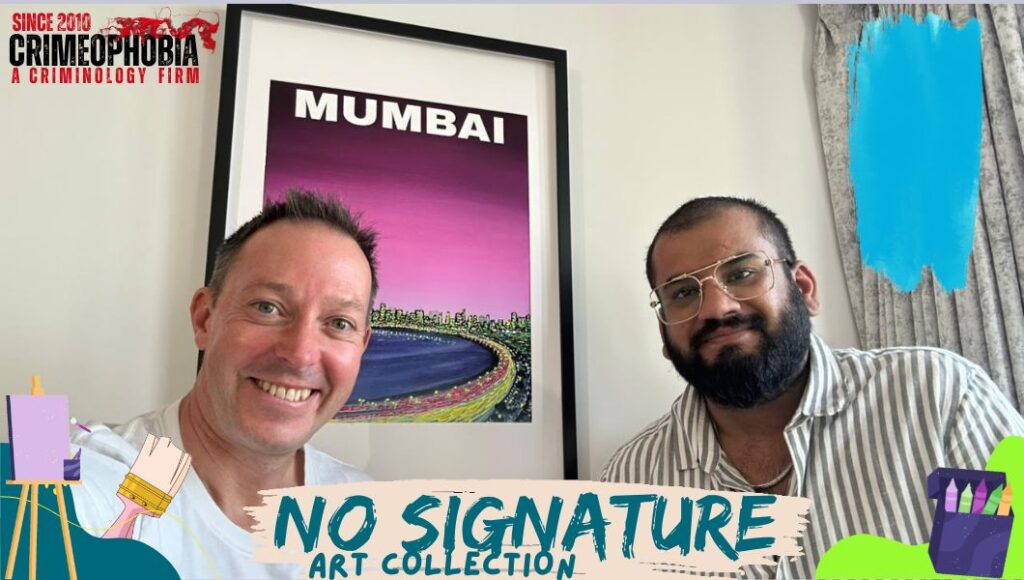
Next to Trump Tower, “Rob Doesn’t Rob”: The Irony of Gallery 69 and No Signature Art (The Film)
By Staff Correspondent
“Observing Gallery 69, I understood that this is No Signature Art. Rob works with carpentry tools on scrap wood, reclaiming what is discarded rather than stealing it—hence, ‘Rob doesn’t Rob.’ Beside Trump Tower, against Mumbai’s skyline, his process mirrors criminology itself: chaos reorganised into meaning, waste transformed into evidence of creation.” – Criminologist Snehil Dhall
YouTube Video Link: https://youtu.be/jNDcYR4TjII
Mumbai: On the 69th floor of a high-rise residence standing beside Trump Tower, far above the hum and density of Mumbai’s streets, artist Rob Hales has created a deeply personal space he calls “Gallery 69.” It is here—suspended between the city’s past and its vertical present—that his No Signature Art Collection has been documented in a film presented by Criminologist Snehil Dhall.
From this elevation, Mumbai reveals itself not merely as a skyline, but as a layered historical narrative. The city’s evolution—its colonial architecture, industrial expansions, post-independence housing clusters, and modern glass-and-steel towers—can be read across the horizon. The view functions as both setting and subtext, lending the film an unspoken continuity between the art inside and the metropolis outside.
Hales’ residence, precisely located next to Trump Tower, is not conceived as a conventional gallery space. Instead, it reflects the ethos of the work it contains: informal, evolving, and resistant to institutional polish. The name Gallery 69 is both literal and symbolic—anchored in altitude, yet suggestive of a vantage point that allows reflection, distance, and clarity.
At the heart of Hales’ practice lies a deliberate rejection of traditional canvases. His paintings are created almost exclusively on scrap wooden materials, fragments that have been discarded, weathered, or deemed unusable. The artist refers to these materials as acts of “recycle or repurposing,” positioning his work within a broader dialogue on sustainability, value, and transformation.
The creative process itself is intentionally paradoxical. Hales describes his methodology as “organised with unorganised,” a phrase that captures the tension between chaos and control. The initial stages of each work embrace randomness—irregular surfaces, splintered textures, and unpredictable grains—before gradually yielding to form, balance, and narrative coherence. The paintings emerge not by erasing disorder, but by working through it.
This philosophy is given narrative shape in the film through a conceptual framework titled “Rob Doesn’t Rob,” articulated by Criminologist Snehil Dhall. The phrase operates as a layered metaphor. While the artist “takes” abandoned materials, the act is not one of appropriation but of restoration. What is removed from neglect is returned with meaning; what is considered waste is repositioned as expression.
Dhall’s engagement with the work extends beyond documentation. Through dialogue and interpretation, he offers a structured reading of Hales’ process—one that, according to the artist himself, led to a profound moment of self-realisation. Hales openly acknowledges that Dhall’s articulation of his approach helped him better understand and define his own artistic language, highlighting the often-overlooked role of the observer in shaping creative consciousness.
The film moves fluidly between finished artworks and the lived environment in which they are created. Viewers are introduced to various paintings from the No Signature Art Collection, each distinct in texture and form, yet unified by material origin and process. Interwoven with these visuals is an intimate lifestyle narrative, offering glimpses into the rhythms, routines, and spatial logic of the artist’s daily life.
Equally striking is Hales’ use of unusual tools and equipment, many of which mirror the unconventional nature of his canvases. These implements—rarely associated with traditional fine art—underscore a practice rooted in experimentation and physical engagement rather than formal orthodoxy.
Throughout the film, the absence of a signature becomes a statement in itself. The No Signature Art Collection resists personal branding in favour of material truth and process-driven identity. The work asks viewers to focus less on authorship and more on transformation—on what it means to create order from fragments and intention from the overlooked.
In Gallery 69, art is not isolated from its surroundings. It is shaped by altitude, by city, by discarded matter, and by reflective dialogue. The film ultimately positions Hales’ work as a quiet counterpoint to the relentless momentum of Mumbai itself—a reminder that meaning can be built slowly, deliberately, and from what others choose to leave behind.