
Bureau Report
New Delhi: In a bold and unprecedented legal initiative blending history, faith, and constitutional law, Criminologist Snehil Dhall, founder of Crimeophobia – A Criminology Firm and Founding Trustee of the Ministry of Happiness, has filed a fresh petition before the Hon’ble Supreme Court of India seeking the establishment of a “Transnational Sanatan Commission.” The proposed body aims to protect, preserve, and promote Hindu communities, heritage, and infrastructure not only within India but across the globe, under the framework of the United Nations.
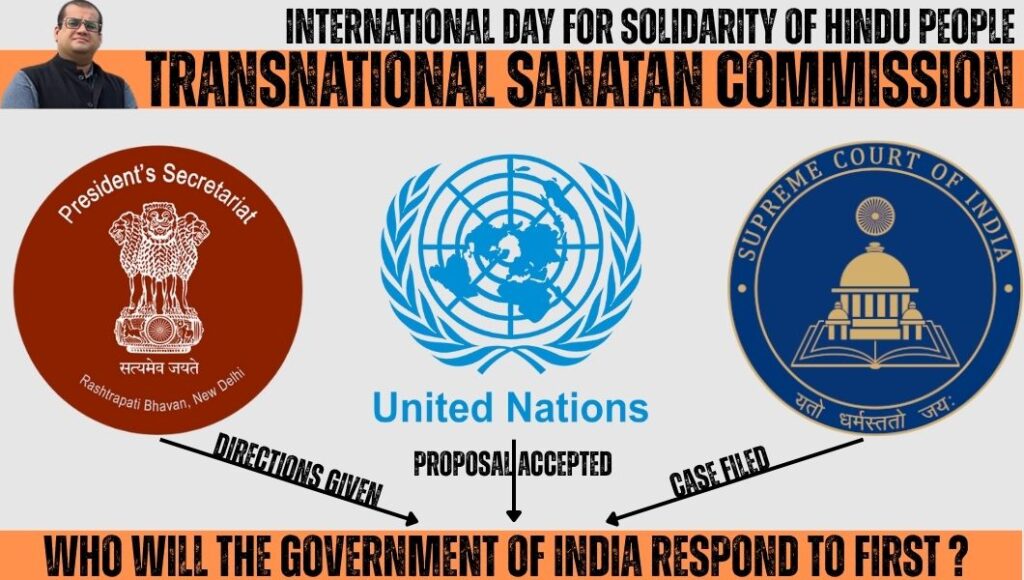
The petition, backed by official letters and directives from the Hon’ble President of India and supported by documented correspondence with the United Nations, raises a rare constitutional question — whether the Government of India will first respond to the President, the supreme constitutional authority, or to the Supreme Court, the apex judicial body. Dhall’s plea is supported by British-era archival evidence referring to the “Bombay Cave Temple Commission,” which he now seeks to reconstitute as the “Transnational Sanatan Commission.” He asserts that since the British originally established this commission for Akhand Bharat (Undivided India), the modern version must function with a transnational framework to protect Sanatani footprints globally.
This petition follows the Bombay High Court’s 2024 dismissal of Dhall’s earlier filing, which was termed “omnibus.” Dhall had argued before the Chief Justice that “organised crimes are themselves omnibus in nature,” emphasizing that corruption, heritage destruction, and systemic mismanagement affecting Hindu institutions demand holistic judicial consideration among other organised crime stated in the petition linked to UNTOC. To avoid misinterpretation, Dhall now seeks Supreme Court directions to the Government to implement three notices issued by the Hon’ble President of India for legal action in the matter and also issue endorsement letters for the United Nations, while the UN have already accepted a proposal for the Commission, and declare 14th August as the “International Day for Solidarity of Hindu People.” An interim prayer requests freezing all temple-related funds held by government departments (Central/State/Union Territory) and trusts, to be deposited with the Supreme Court and later redirected to the proposed Commission.
A central theme of Dhall’s case is the revival of the “Bombay Cave Temple Commission.” He claims it was never officially dissolved in a document, but other records of the commission were destroyed “in the name of white ants” on Indian soil. Through years of research, he reportedly recovered rare documents mainly from foreign archives and a few from Indian archives to reconstruct its existence. Dhall argues the Commission predated the Waqf Board by nearly a century, proving Hindu heritage governance existed even before colonial interventions.
Dhall’s previous plea at the Bombay High Court had connected this heritage protection framework with India’s obligations under the United Nations Convention Against Transnational Organised Crime (UNTOC), linking issues such as money laundering, human trafficking, arms smuggling, and environmental crimes — exemplified through Mumbai’s Aarey Colony case study. Legal experts note that this initiative transcends religion, representing a civilizational assertion rooted in constitutional rights and cultural preservation. With the case being filed at the Supreme Court, Dhall’s petition signifies a historic legal and diplomatic turning point for Sanatan heritage protection — on land, underwater, and undersoil — now resonating in both New Delhi and at the United Nations.
For further information: office@crimeophobia.com; ministryofhappiness.india@gmail.com
Offerings in temples be utilized for Sanatan Dharam cause
This is an excellent initiative. We all must do our bit. This need therefore be supported. Build Bharat.
Very necessary initiative…. already should have been done by the government in the past..true secularism means all religions are equal, so let’s make it so.