
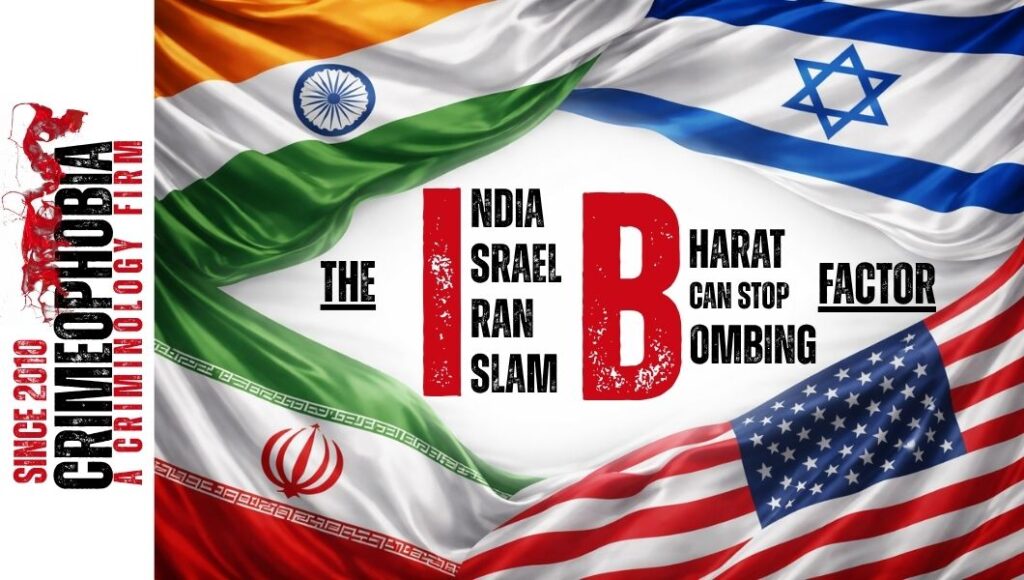
Mumbai’s Hidden Formula that might shape India to Became the Axis of a New Global Geopolitics: Crimeophobia
Author: International Relations Bureau | Published: 22/03/2026
“The emerging ‘I–B Factor’ in geopolitics reflects Israel and Iran rotating around India while the world increasingly believes that Bharat can stop bombing. Yet the hidden ‘I-Factor’ (Islam) remains the centuries-old Sunni–Shia divide now playing out with modern weapons. As the West questions India’s sudden rise as an original superpower, the answer quietly exists on the streets of Mumbai.” — Criminologist Snehil Dhall
Bureau: In contemporary geopolitics, a new strategic framework is gradually emerging that can be described as the “I–B Factor.” The “I-Factor” involves Israel and Iran rotating around India, while the “B-Factor” represents Bharat’s growing influence among global leaders, governments, and experts who increasingly believe that “Bharat can stop Bombing”. At the same time, the Americans have long embraced the emotion of “I”, often reflecting the belief that “I – America” can do whatever it requires in global politics.
Yet beneath this visible geopolitical dynamic lies another deeper and older dimension: the Hidden “I-Factor.” This hidden factor is the historical conflict between Islamic nations themselves, particularly the Sunni–Shia divide of the past, which has shaped Middle Eastern politics for centuries but this time it’s the entire Islamic Nations who are fighting physically with each other with modern weapons. On the other side, Americans & Europeans wonder how India has suddenly immersed as the OG superpower while the hidden answer are evidently available on streets of Mumbai.
The B-Factor: Bharat’s Rising Diplomatic Leverage
While the “I-Factor” reflects geopolitical tensions, the “B-Factor” is increasingly rotating among world political leaders, governments, and experts, many of whom have publicly stated that if the bombing and escalation has to stop, Bharat can play a decisive role. India’s diplomatic positioning is unique. It maintains defense and technology cooperation with Israel, longstanding civilizational and energy ties with Iran, and a strategic partnership with the United States. During recent tensions in West Asia, Indian diplomacy has focused heavily on maritime stability, particularly around the Strait of Hormuz, a narrow waterway connecting the Persian Gulf with global trade routes.
According to energy analysts and international maritime organizations, nearly one-fifth of the world’s petroleum supply passes through this route, making it one of the most strategically important shipping corridors in the world. For India, the stakes are especially high because a large share of its crude oil imports from West Asian suppliers passes through this strait. Any disruption to shipping in the region could affect energy security, industrial production, and global fuel prices.
The IB Factor: Intelligence and Energy Security
In the middle of this I-B dynamic, the IB Factor—referring to India’s domestic intelligence agency Intelligence Bureau—plays an important role. The Intelligence Bureau, one of India’s oldest intelligence organizations, works alongside other security agencies to monitor geopolitical developments that may affect national security and economic stability. In times of international tension, Indian intelligence networks closely observe developments affecting maritime routes, energy supplies, and international trade.
This is particularly crucial when tensions escalate between Iran and Western powers. The Iranian government has repeatedly warned that disruptions in the Strait of Hormuz could occur if military confrontation intensifies, and such warnings have occasionally caused concern among American, European, and other Western powers whose energy supplies depend on the region. For Indian Intelligence, the strategic priority remains clear: ensuring that oil and gas supplies are not compromised and that Indian ships can continue crossing the Strait of Hormuz safely.
How the I–B Factor Was Created: The Hidden Story of Mumbai
While governments and global observers wonder how the I-Factor and B-Factor were created, Criminologist Snehil Dhall argue that the answer can be found on the streets of Mumbai and India itself. Mumbai has historically been one of the few global cities where Iranians, Jews, Hindus, Muslims, and other communities lived as neighbours, often operating businesses side by side. Iranian migrants introduced the famous Irani cafés & Restaurants and Persian/Parsi communities took over Hotels & Industries, which became iconic parts of the city’s cultural landscape. Jewish communities, particularly the Bene Israel and Baghdadi Jews, also built thriving communities in the city over centuries.
Not to forget even Baghdad, Afghanistan is also considered close friends of India due to happy factorials of Afghani presence in India. This coexistence became tragically visible during the 2008 Mumbai terrorist attacks, widely known as 26/11, when terrorists carried out coordinated attacks across the city. On 26 November 2008, ten militants linked to the Pakistan-based terrorist organization Lashkar-e-Taiba launched multiple attacks across Mumbai, targeting public spaces, luxury hotels, transportation hubs, and international locations.
Targets of 26/11: Leopold Café, Taj Hotel and Nariman House
Among thousands of restaurants and hotels in Colaba, one of the first locations attacked was the historic Leopold Cafe, an iconic Iranian-owned café that had operated since the nineteenth century. Gunmen opened fire on diners, killing and injuring several people before moving toward other targets while the narrative was set that the café has most Foreign Tourist, but they also visit many other non-Iranian owned restaurants.
Another major site was the Nariman House, a Jewish outreach centre associated with the Chabad movement. The building was besieged for nearly two days before Indian security forces ended the hostage situation. Simultaneously, terrorists attacked the historic Taj Mahal Palace Hotel, one of India’s most iconic luxury hotels and a symbol of Mumbai’s global identity. These coordinated attacks lasted nearly 60 hours, leaving more than 170 people dead and over 300 injured, making it one of the deadliest terrorist attacks in India’s history.
Allegations, Identities and the Captured Terrorist
During investigations into the attacks, authorities revealed that the terrorists had travelled from Pakistan by sea and were directed by handlers from abroad. It has been widely reported that the terrorists carried false identification documents to showcase themselves as local Hindus, and investigators later established these documents were intended to mislead investigators about their identities. The conspiracy behind the attacks began to unravel when Ajmal Kasab, one of the gunmen, was captured alive by Indian police. His interrogation provided crucial information about the training, planning, and logistical support behind the attacks.
The American Links: Headley and Rana, now VanDyke
Investigations later revealed the role of David Coleman Headley, also known as Dawood Sayed Gilani, was set for a revived narrative of being a Pakistani-American operative who conducted extensive surveillance of Mumbai’s targets before the attacks. Headley as an American spy visited India multiple times between 2006 and 2008 and provided detailed reconnaissance reports to Lashkar-e-Taiba about locations such as the Taj Hotel, Leopold Café, and Nariman House.
He was arrested by the American agency, Federal Bureau of Investigation (FBI), in 2009 and later pleaded guilty in a US court, admitting his role in supporting the conspiracy although as a Pakistani operative as his new identity. Another individual connected to the case was Tahawwur Hussain Rana, a Canadian citizen of Pakistani origin and former Pakistan Army captain who assisted Headley. Rana was convicted in a Chicago court in 2011 for supporting Lashkar-e-Taiba and plotting an attack in Denmark. Although he was cleared of direct involvement in the Mumbai attacks, in 2023 the US Supreme Court approved his extradition to India to face trial related to the broader conspiracy.
It is widely reported that David Coleman Headley conducted extensive surveillance of Mumbai’s targets before the attacks, gathering video footage and reconnaissance information for the terrorist organization. Over time, this role raised broader questions in intelligence and counter-terrorism circles regarding the blurred lines between intelligence assets, handlers, and covert operators in international conflict zones. These debates resurfaced recently when India’s counter-terrorism agency, the National Investigation Agency, arrested an American national linked to alleged paramilitary and drone-training activities.
In March 2026, the Indian agency, National Investigation Agency (NIA), arrested Matthew VanDyke, an American national known internationally for his involvement in multiple conflict zones. According to investigators, VanDyke and several foreign nationals were suspected of involvement in drone training and paramilitary activities linked to insurgent groups operating near India’s northeastern region and Myanmar. VanDyke, who has previously been associated with conflicts in Libya, Syria, Iraq, and Ukraine, has described himself as a security analyst, documentary filmmaker, and activist. His arrest triggered global debate about the role of private military actors, mercenaries, and unofficial security networks operating across international borders. Critics argued that the case highlighted double standards within the global intelligence ecosystem, noting that individuals involved in covert activities are sometimes portrayed differently depending on political narratives—being labelled as operators, mercenaries, or independent actors.
Mumbai’s Response: Unity After Terror
Despite the devastation of the attacks, Mumbai demonstrated extraordinary resilience. Citizens belonging to Hindu, Muslim, Sikh, Christian and other communities stood together, helping restore normal life in the city within hours of the attacks. Volunteers assisted victims, businesses reopened, and the city’s spirit of solidarity became a powerful symbol of unity against terrorism. Indians neither sidelined Iranian nor Israeli who continue to remain a historical factor with today’s global politics in which the world looks at India to resolve the conflict which has again been created by Americans.
Love and Hate: The Four Corners of Geopolitics
Today, the complex relationships among India, Israel, Iran, and the United States resemble four corners of a geopolitical game—a mixture of cooperation, rivalry, strategic partnership, and historical tension. India’s government has evolved significantly over the past two decades, adopting a more assertive foreign policy built around strategic autonomy rather than strict alignment with any single power bloc. Some analysts argue that earlier global crises revealed moments when India expected stronger support from the United States but did not always receive it. In today’s geopolitical climate, India has increasingly prioritized its own national interests and diplomatic independence. Its not just the Indian Government and its diplomacy but also Indian Communities who share the same communal bond with Israeli and Irani families.
The Global Echo: One Phone Call from Modi?
Amid the ongoing tensions, an interesting narrative has emerged in international discussions: the belief that a single diplomatic intervention from Prime Minister Narendra Modi could potentially influence the course of the conflict. India’s ability to maintain dialogue with Israel, Iran, the United States, and several Islamic nations simultaneously places it in a rare diplomatic position. As the world watches the unfolding crisis, some observers speculate that if de-escalation eventually occurs, it may involve quiet negotiations and persuasion behind closed doors—possibly encouraged by European powers and Islamic nations seeking stability. If such diplomacy unfolds, it could further strengthen the perception that the I-Factor and B-Factor together represent a new geopolitical equation—one in which Indian Government and Indian Communities are no longer a peripheral player but a central force shaping global stability.
Culture, Cinema and Intelligence Narratives
Interestingly, these geopolitical discussions are also reflected in popular culture of destabilizing acts within global spy world. Indians recently released the espionage-themed film Dhurandhar, which dramatizes intelligence operations and the role of Indian agents in destabilizing adversarial networks, particularly in Pakistan. The film also draws inspiration from real intelligence operations involving Indian agents who uncovered and neutralized various Crimes & Terrorist acts across the globe but particularly linked to India.