
Crimeophobia’s Micro-Nano Global Journey with Transgender Persons & LGBTQ+ Communities and the Emerging Battle for the “Marginalized within the Marginalized”: The Forgotten Trans Men
Author: International Desk Bureau | Published 02/04/2026
“I urge everyone to give a basic politeness by giving a big shout-out by saying #BroWeSupportTransMen. This is perhaps the first time that we are compelled to publicly speak about Crimeophobia’s global engagement with Transgender persons and LGBTQ+ communities with a note of serious concern. For nearly two decades our work has remained silent, principled, and focused on empowerment and acceptance. However, the present situation reflects a disturbing shift where the struggle is no longer confined to Transgender persons and dominant genders, but has regrettably deteriorated into an internal conflict between TransWomen and TransMen themselves. What is far more troubling from an institutional perspective is that such a dispute had occurred during an official event of the National Human Rights Commission in 2025 and was allowed to escalate without responsible mediation which led to exclusion of TransMen from the present Transgender persons Bill in 2026. A statutory human-rights body is expected to uphold decorum, neutrality, and conflict resolution—not permit situations that undermine the dignity of the very communities it is mandated to protect. If such an episode has even indirectly contributed to the omission of Trans Men in the Transgender Persons (Protection of Rights) Amendment Bill, 2026, it represents a serious institutional and legislative failure.” ~ Criminologist Snehil Dhall
New Delhi: As unusual as it may sound, the team that drafted the Transgender Persons (Protection of Rights) Amendment Bill, 2026 in India appears to have inadvertently overlooked the specific recognition and concerns of Trans Men. If such an omission remains unaddressed, a section of the transgender persons community may continue to remain underrepresented within policy frameworks, particularly as legislative amendments often involve complex and prolonged processes. Crimeophobia’s engagement with the broader transgender persons and LGBTQ+ discourse began almost two decades ago, with consistent efforts aimed at empowering the community through education, legal awareness, and advocacy for their rightful presence within mainstream social structures. Throughout this period, we have remained committed to promoting informed dialogue and legal sensitivity regarding transgender persons and LGBTQ+ rights.
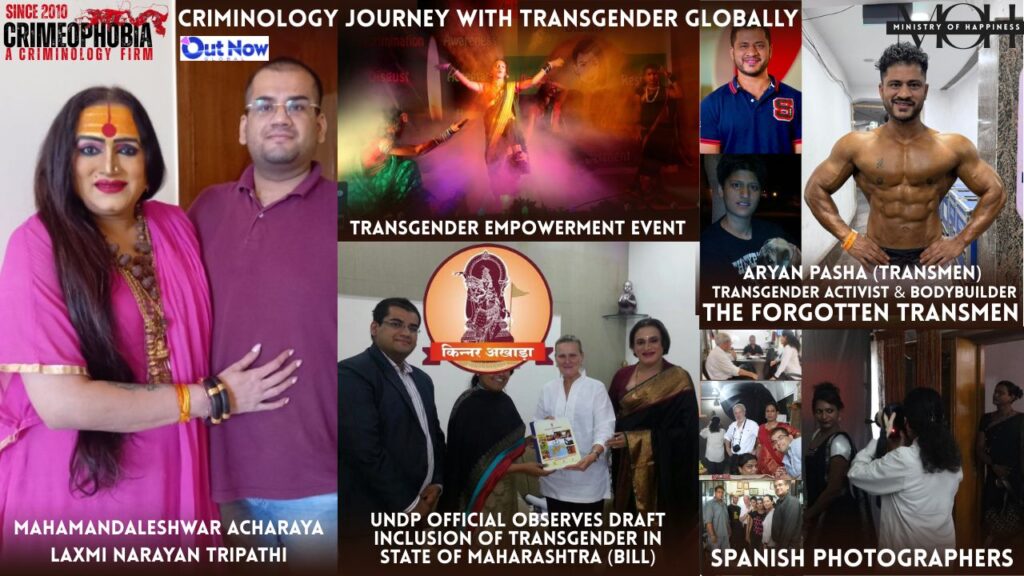
Despite being a heterosexual male, Crimeophobia’s Founder became one of the first individuals globally to support LGBTQ+ inclusion initiatives in an advisory capacity for the mainstream corporate sector and others. From global research to having Soul-Sisters & brothers from Transgender communities became the normal lifestyle which he got his family to accommodate first and then other dominant genders. His involvement was formally acknowledged when he served as a consultant for India in the global research initiatives of Out Now Global, an international organization known for its studies on LGBTQ+ inclusion in corporate and social environments since 1992 within several countries. This probono collaboration between Criminologist Snehil Dhall and Out Now Global was publicly announced during the World Travel Market in London in 2010, where global media highlighted the appointment of an India-based consultant supporting research on LGBTQ+ inclusion within multinational corporations and broader social ecosystems.
While the initial phase involved global research on LGBT inclusion, the second phase gained indigenous momentum after the Founder (Dhall) returned to India. At that stage, crucial support came from his long-standing associate and “soul sister,” who is now recognized as Mahamandaleshwar Acharya Laxmi Narayan Tripathi, Founder of Kinnar Akhada and one of the world’s most prominent Transgender persons rights activists. A significant institutional moment in this journey occurred in 2013, when a meeting was held at the official residence of the then Women and Child Development Minister of Maharashtra State, in the physical presence of Lise Grande, who was serving as the Resident Coordinator of the United Nations Development Programme in India at the time.
During this meeting, members of the transgender persons community were formally acknowledged within the context of a draft legislative framework being discussed in the State of Maharashtra. The moment was symbolically captured in a photograph in which the Hon’ble Minister, Laxmi Narayan Tripathi, and Criminologist Snehil Dhall appeared together with the draft bill, marking an early state-level recognition of transgender persons’ concerns within policy discussions. It was also during this same interaction that a separate conversation took place between Ms. Lise Grande and Snehil Dhall regarding the broader international framework of the United Nations Office on Drugs and Crime and the implementation of the United Nations Convention against Transnational Organized Crime (UNTOC) in India. The discussion marked the beginning of an ongoing effort by the Crimeophobia team to advocate for stronger institutional attention toward the implementation of UNTOC mechanisms within India, particularly in relation to organized crime, trafficking, and transnational criminal networks. Unfortunately, after Ms. Grande left India, the UNDP seem compromised towards Pakistan with endless support for UNTOC implementation in Pakistan and no support for India’s implementation due to which Dhall filed a formal case with the Hon’ble Supreme Court of India that continues to date.
Whereas, on the other hand, eventually on April 15, 2014, the Supreme Court of India passed a landmark judgment in National Legal Services Authority (NALSA) v. Union of India, officially recognizing Transgender persons as a “Third Gender.” This verdict affirmed that gender identity is a matter of self-identification and that transgender individuals possess the same fundamental rights under the Constitution as men and women. The journey further evolved with the historic inclusion and recognition of the transgender persons (Kinnar) community within the traditional religious hierarchy of Sanatan Dharma, through the establishment and recognition of the Kinnar Akhada within the Akhada system. This development symbolized an important intersection of cultural, religious, and social recognition for transgender persons. While Mahamandaleshwar Acharya Laxmi Narayan Tripathi has been the spearhead for most activities in India, she ensured that, as Hijra Guru-Maa, her Chela (disciple/daughter) were empowered with a voice within mainstream India, global platforms, and within their religious presence.
While the broader struggle for dignity and rights has primarily been led by members of the transgender persons community themselves, the role of allies—particularly from dominant gender groups—has been to stand in solidarity without hesitation, promote awareness, and support families navigating questions around gender identity and acceptance. Crimeophobia’s Founder considers this responsibility to extend not only within his own family but also within wider social circles where education and understanding were urgently needed. He also hosted several social gathers and parties and one such lunch at his personal residence has also been for Manvendra Singh Gohil ‘Bhaisa’ (the title Bhaisa is often used in Rajput families to respectfully refer to an elder brother), who has been considered the first openly gay prince in the world, and is known for being one of India’s foremost LGBT activists along with Mahamandaleshwar Acharya Laxmi Narayan Tripathi.
Even when international photographer’s visit to India, they expressed interest in conducting a photoshoot featuring members of the Indian Transgender persons community, the entire coordination and logistical support were facilitated by Crimeophobia Team. On that occasion, nearly 15–20 members of the community were brought together by another respected Transgender persons, Guru Gauri Sawant, around the year 2012. She later became widely known through the Bollywood film Taali, which portrayed her life and starred Sushmita Sen (Ex-Miss Universe & Actor). However, in the middle of the photoshoot, the Spanish photographer abruptly demanded verification of the identity of every transgender participant. Considering the nature and tone of this demand to be inappropriate and unparliamentary, we strongly opposed it since Gauri couldn’t articulate educating the Foreign Nations at the time due to which now legislative legalities are established. The photoshoot was immediately halted, and other transgender Gurus were informed and requested to withdraw any further cooperation or support to the photographer. Our stand was taken to safeguard the dignity and respect of the community.
However, this issue surfaced once again in 2025, when a Transgender group called “Yes, We Exist” posted on 8 September 2025 about an incident in which Gauri Sawant initiated a confrontation against TransMen during an event arranged by the National Human Rights Commission (NHRC), Government of India. As a TransWoman, Gauri Sawant allegedly not only argued but also verbally abused TransMen regarding their existence instead of educating NHRC. She allegedly created an outrage, due to which the CEO of NHRC displayed his own anger due to embarrassment during the event and mocked Transgender persons at large for fighting among themselves in the middle of the event instead of upholding his institutional responsibility to resolve the dispute. According to sources, it appears that this controversy and internal conflict may have contributed to the absence of TransMen in the Transgender Persons Bill.
None of the Media reported the incidence since neither NHRC or Media could understand the difference between TransWomen and TransMen which is evident even with current outcome of the ‘Bill’ but one group called “Yes, We Exist” posted a video of the NHRC event on Instagram in which the CEO was seen mocking the situation, while they also uploading the following message on Facebook:
“If you choose to disrespect my pronouns and my gender, you are disrespecting me!” At NHRC’s National Conference on Trans Rights, prominent trans leader, Gauri Sawant referred to trans men as her behen (sisters) and allegedly refused to correct the mistake or apologise. Trans men are men, not sisters! Historically, trans feminine identities (like hijras, kinnars) have had more visibility, while trans men remain sidelined. So when a prominent leader like Gauri Sawant, who has done commendable advocacy, uses language that misgenders trans men, it reinforces that imbalance. This points to the need for more awareness, respect, and inclusion of trans men within the movement.
A local resident from Malvani, Mumbai where Gauri belongs, stated on the condition of anonymity: “It is extremely disappointing that the positive influence of Gauri was converted into such a negative conclusion for TransMen at the legislative side of the Act. She has allegedly been involved in various other unparliamentary acts in the recent past that are harming even TransWomen. It is a shame that while Transgender persons have been fighting for justice, the state of TransWomen and TransMen is being negatively shaped because of her.”
From award events and empowerment-based employment opportunities to deep family bonding and legal solidarity with the community, and after years of unconditional and phase-wise support to the broader Transgender persons movement, Criminologist Snehil Dhall and the Crimeophobia team now stand firmly with TransMen, whom we respectfully describe as the “marginalized within the marginalized (Transgender persons)” in certain socio-legal contexts. A visible voice for this community has been Aryan Pasha, widely regarded as India’s—and possibly Asia’s—first openly transgender male bodybuilder, originally from New Delhi.
A TransMan refers to an individual who was assigned female at birth (AFAB) on government records but identifies and lives as a man. Trans men represent diverse lived experiences involving social transition, gender expression, and, in some cases, medical transition such as hormone therapy or surgical procedures. Their experiences form an important part of the broader Transgender spectrum. Criminologist Snehil Dhall stated: “During discussions with Aryan Pasha (TransMan), it became apparent to me as a criminologist that the current policy gap may have arisen due to drafting inconsistencies rather than deliberate exclusion. However, it remains unclear how the specific recognition of trans men was not adequately reflected despite the participation of Trans Men representatives in several official consultations and conferences meant for addressing concerns of transgender persons.”
Aryan Pasha further stated: “In public perception, transgender individuals are often incorrectly assumed to be limited to those who present in feminine expression. This misconception overlooks transgender men, who typically present with masculine gender expression.” He further clarified the distinctions within transgender identities:
• Trans Man (Transgender Man): An individual assigned female at birth who identifies and lives as a man. Historically sometimes described as “female-to-male (FTM),” though many now prefer simply “trans man.”
• Trans Woman (Transgender Woman): An individual assigned male at birth who identifies and lives as a woman, historically referred to as “male-to-female (MTF).”
• Terminology Note: The preferred terminology is generally “TransMan” and “TransWoman,” where Trans functions as an adjective describing gender identity rather than a separate noun category.
The Transgender Persons (Protection of Rights) Amendment Bill, 2026, reportedly passed by Parliament in March 2026, proposes changes to the 2019 legislation, including replacing the principle of self-perceived gender identity with a medical board certification process. Critics and activists have raised concerns that such provisions may restrict personal autonomy and privacy. If the amended framework fails to sufficiently recognize the specific realities of TransMen, it may necessitate further legislative review or policy clarification to ensure equitable representation across the entire transgender spectrum. The scientific and medical considerations relevant to transgender individuals also differ across identities. For instance, gender-affirming procedures for transgender women, such as bilateral orchiectomy (removal of the testes), may be undertaken to reduce testosterone production and alleviate gender dysphoria. However, TransMen typically require different medical pathways, such as testosterone therapy or masculinizing surgeries. Consequently, policy frameworks must remain sensitive to these distinct medical and psychosocial needs.
From a criminological perspective, the invisibility of certain gender identities within policy frameworks may also create unintended vulnerabilities that can be exploited by organized criminal networks. Communities that remain socially misunderstood or legally underrepresented often face heightened risks relating to identity fraud, exploitation, trafficking, forced medical practices, and economic marginalization. It is therefore important that legislative frameworks addressing Transgender rights evolve with scientific clarity and social sensitivity so that no subgroup within the transgender spectrum remains structurally invisible. In this context, Crimeophobia’s ongoing advocacy for the implementation of the United Nations Convention against Transnational Organized Crime (UNTOC) in India acquires additional relevance. The Convention, administered by the United Nations Office on Drugs and Crime (UNODC), provides a comprehensive international framework to address human trafficking, organized exploitation networks, and transnational criminal activity.
Ensuring its effective implementation within India would strengthen institutional mechanisms to protect vulnerable communities—including segments of the transgender population that remain overlooked in mainstream policy debates. Crimeophobia therefore views the present discussion around TransMen not merely as a matter of identity recognition, but also as part of a broader criminological and human-rights framework that demands vigilance against structural exclusion. A society that recognizes every identity within its legal and institutional architecture ultimately strengthens its resistance against exploitation, injustice, and organized crime. The journey that began with small conversations, research collaborations, and early advocacy for LGBTQ+ inclusion now enters another phase—standing with those who have remained less visible even within their own community.
Crimeophobia therefore calls upon medical and non-medical professionals, policymakers, researchers, and educators to take an additional step toward understanding and addressing the realities of trans men, who often remain under-recognized in public discourse. Criminologist Snehil Dhall concludes: “This appeal is not merely in support of Aryan Pasha—whom I proudly call my brother—but for all TransMen who continue to seek visibility, dignity, and institutional support and urge everyone to join for shouting it loud by saying #BroWeSupportTransMen”