
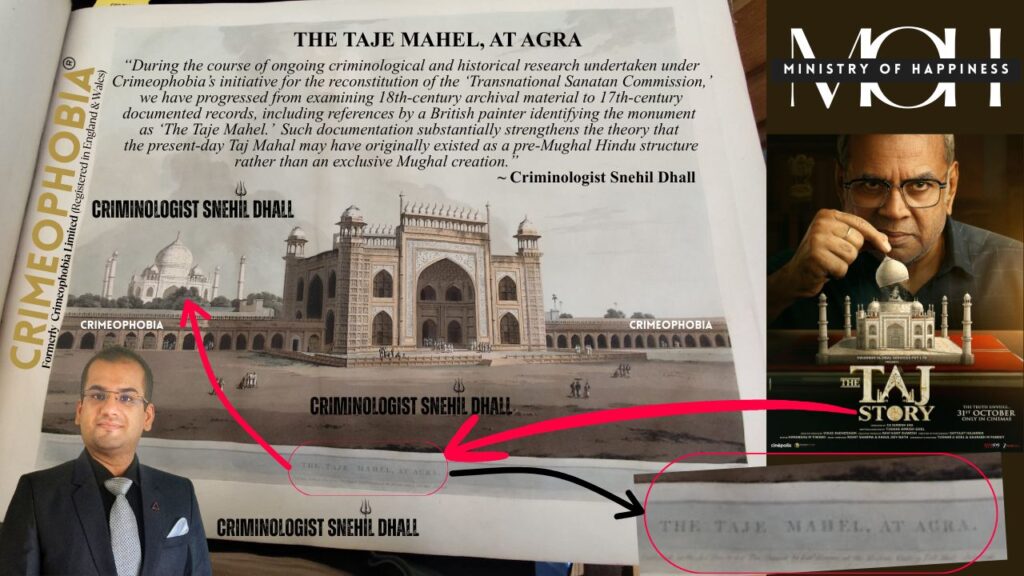
“Document referring Taj Mahal as ‘Taje Mahel’ found” — The Continuing Historical Debate, Cinema, and the Emerging 17th Century Documentation: Crimeophobia
Published on 20/05/2026 | Author: International Desk
“My continuing global research tracing documentary evidence across four centuries increasingly indicates that the monument presently identified as the Taj Mahal may indeed have historically existed under references closer to ‘The Taje Mahel’ and/or ‘Tejo Mahal,’ as consistently argued by several Sanatani Hindu researchers and historians. The emergence of 17th Century archival spellings, discovered during my evidence collection linked with the historical Bombay Cave Temple Commission, cannot be casually ignored within any serious framework of historical or criminological investigation. Across multiple regions of the Indian Subcontinent, there remains a recurring allegation that several original Hindu religious and civilizational structures were subjected to altered narratives, renaming exercises, and historical distortion during successive invasions and political regimes, including the Mughal era. Such allegations require institutional examination through documentary scrutiny, forensic historiography, criminological analysis, archaeology, and constitutional processes instead of selective academic dismissal. It is precisely for this reason that I have officially demanded the reconstitution of the ‘Bombay Cave Temple Commission’ into a broader ‘Transnational Sanatan Commission,’ capable of investigating historical, cultural, religious, and transnational evidence connected to Sanatani civilization across present-day geopolitical boundaries of the Indian Subcontinent. The objective is not conflict, but lawful truth-discovery, preservation of civilizational heritage, and protection of historical authenticity for future generations.” — Criminologist Snehil Dhall
Bureau: The debate surrounding whether the monument presently known as the Taj Mahal was originally conceived as a Mughal mausoleum or whether it existed prior to the Mughal era as a Hindu Sanatani structure has once again returned to the center of India’s historical and civilizational discourse. The controversy, which has persisted for decades across academic, political, legal, archaeological, and ideological platforms, has intensified following the emergence of what is being described as a significant 17th Century archival spelling reference identifying the monument as “The Taje Mahel” by the then British Artist.
The renewed discussion gained additional public attention following the release and discourse surrounding the Hindi film The Taj Story, associated with veteran Bollywood actor and Former Member of Parliament Paresh Rawal, which revisited the long-debated theory that the monument may originally have been known as “Tajo Mahal,” “Tejo Mahalaya,” or “The Taje Mahel” before eventually becoming standardized under the globally accepted title “Taj Mahal.” The film reignited public conversations concerning whether the monument represented a Hindu temple-palace complex later repurposed under Mughal rule or whether it remained, as maintained by mainstream historians, an imperial Mughal mausoleum commissioned by emperor Shah Jahan in memory of Mumtaz Mahal.
The present debate is not merely limited to architecture or nomenclature. It has evolved into a larger confrontation involving civilizational identity, historical ownership, archaeological transparency, colonial historiography, constitutional interpretation, and the manner in which historical narratives were preserved, altered, or institutionalized over centuries. Historians, archaeologists, legal activists, cultural commentators, researchers, criminologists, and independent investigative scholars continue to remain divided over the origins, symbolism, and documentary history associated with one of the world’s most recognized monuments.
According to the widely accepted Islamic and mainstream historical narrative, the Taj Mahal was commissioned by Mughal emperor Shah Jahan following the death of his wife Mumtaz Mahal, whose original name was Arjumand Banu Begum, in 1631. Historians state that construction commenced around 1632 and continued over two decades with the involvement of thousands of artisans, labourers, architects, craftsmen, calligraphers, and engineers. The monument is described as one of the greatest examples of imperial Mughal architecture combining Persian, Timurid, Central Asian, and Indian artistic traditions into a singular architectural masterpiece.
Supporters of the mainstream Mughal account point toward Persian inscriptions, Quranic calligraphy, Islamic funerary symbolism, charbagh garden layouts, Mughal administrative records, royal expenditure accounts, and foreign traveller narratives as evidence supporting the conclusion that the structure was conceived and constructed during Shah Jahan’s reign. Court chronicles such as the Badshahnama are frequently cited as documenting imperial instructions and construction activity connected to the monument. Historians further argue that the cenotombs, burial chambers, geometric planning, marble inlay work, domes, and symmetrical landscape architecture align with broader Mughal funerary traditions visible across several Indo-Islamic monuments.
Mainstream Islamic scholars and historians additionally maintain that many architectural motifs now cited by alternative theorists as “Hindu” — including lotus patterns, geometric carvings, floral symbolism, domes, arches, and decorative designs — were widely used across multiple civilizations during medieval India and therefore cannot independently establish religious ownership or civilizational origin. Archaeologists supporting the conventional view also argue that no officially authenticated excavation or conclusive archaeological evidence has yet emerged proving the existence of a pre-Mughal Hindu temple beneath the structure sufficient to legally overturn the accepted Mughal-origin theory.
However, the Hindu or Sanatani narrative presents an entirely different interpretation of the monument’s history. Several Hindu researchers, independent historians, legal activists, and civilizational scholars argue that the structure predates Shah Jahan and may originally have functioned as a Hindu temple-palace complex, possibly associated with Lord Shiva. The theory, often linked with the expression “Tejo Mahal,” claims that the monument may have been occupied, modified, renamed, or repurposed during the Mughal period. Whereas, the recent document found by Criminologist Snehil Dhall states the spelling as Taje Mahel which is closest to Tejo Mahal. He says “It has been a pronunciation crisis of the British due to which various local names were spelt differently. The same document also referred Hindustan as Hindoostan.”
Supporters of this theory frequently point toward architectural elements such as lotus domes, trident-like symbols, kalash-style finials, octagonal layouts, Vedic geometric alignments, and alleged temple-oriented structural patterns that they claim are more consistent with Hindu temple architecture than with Islamic funerary design. Additional arguments include references to sealed underground chambers that remain inaccessible to the public, with researchers demanding scientific examination, archaeological surveys, and transparent forensic investigation into the contents and structural history of those sections.
Several proponents of the “Tejo Mahal” or “Taje Mahel” theory further argue that the very name “Taj Mahal” may have evolved linguistically over centuries from Sanskritic expressions such as “Tejo Mahalaya,” “Tajo Mahal,” or “Taje Mahel.” Some claim that “Tejo” may refer to “Tej,” signifying divine radiance associated with Lord Shiva, while “Mahalaya” could denote a grand abode, temple complex, or sacred palace structure. According to supporters of this interpretation, colonial transliteration practices, regional pronunciations, and Persianized recording systems may have gradually transformed earlier Indic terminology into the presently accepted “Taj Mahal.”
Advocates of the Hindu-origin theory additionally raise questions regarding the absence of universally accepted original construction blueprints, exhaustive stage-by-stage construction documentation, or complete ledgers conclusively proving every phase of construction exclusively under Shah Jahan’s reign. They further argue that throughout history several structures across the Indian subcontinent were allegedly renamed, repurposed, converted, occupied, or culturally reinterpreted following invasions and political transitions, and therefore similar scrutiny should be applied in relation to the Taj Mahal debate.
The controversy has acquired renewed intensity after Criminologist Snehil Dhall, a Crime & Law Historian, Criminology and Neurocriminology expert, and Legal & Transnational Security expert, reportedly identified a 17th Century British archival documentation wherein a British artist referred to the monument as “The Taje Mahel.” According to Dhall, the significance of this reference extends beyond a simple spelling variation and enters the domain of forensic historiography, documentary chronology, transliteration evolution, and the possible transformation of historical narratives across centuries.
According to Dhall, the discovery emerged during his continuing evidence-collection initiative connected to the historical “Bombay Cave Temple Commission” research project. What reportedly began as criminological and historical investigation into alleged irregularities connected with Aarey Colony and 20th Century documentation gradually expanded into broader archival tracing exercises involving 19th Century land records, 18th Century commission-related archives, and now emerging 17th Century references associated with the Taj Mahal debate.
Dhall states that the chronological regression of documentary evidence from one century to another has revealed what he describes as “a continuing pattern of suppressed or forgotten Sanatani historical references” across the Indian subcontinent. He argues that the emergence of 17th Century references such as “The Taje Mahel” cannot be casually dismissed within any serious framework of criminological, archaeological, constitutional, or historiographical investigation.
The debate has also generated broader questions concerning Mughal architecture itself. One recurring argument raised by supporters of the Hindu-origin theory concerns the geographical concentration of monumental Mughal architecture almost entirely within the Indian subcontinent. Dhall states that unlike the British Empire — which constructed signature administrative structures, railway stations, churches, courts, universities, and colonial institutions across multiple continents reflecting a recognizable imperial style — monumental Mughal structures appear concentrated primarily in India rather than within the Central Asian or Persian ancestral regions associated with Mughal lineage. On the contrary, various researchers have established that the Mughal has primarily constructed Islamic structure from the debris remains of various Sanatani Hindu religious structures and left a few structures but renamed and repurposed them.
Based on this argument, some researchers also question whether the Mughals primarily constructed entirely new monuments or whether they occupied, expanded, modified, renovated, or culturally reinterpreted pre-existing Indian structures following conquest. They argue that if Mughal architecture represented a fully independent imperial style, comparable monumental architectural footprints would likely have existed in larger numbers across ancestral Mughal territories. Mainstream historians, however, reject this interpretation and counter that the Mughal Empire itself was geographically centered in the Indian subcontinent and therefore naturally invested its architectural resources within the territories it governed. Historians also note that the Mughals were Timurid-Mongol rulers who had already assimilated Persian artistic traditions before establishing their empire in India.
Nevertheless, supporters of the Hindu-origin theory continue to argue that the extensive presence of Indic symbolism, temple-like geometry, and alleged Vedic structural patterns within certain monuments traditionally classified as Islamic structures requires deeper multidisciplinary scrutiny instead of immediate academic dismissal. They further maintain that several medieval Islamic rulers historically occupied or modified pre-existing structures following military conquest, a phenomenon that was not uncommon in global imperial history.
The continuing controversy has led to increasing demands for independent archaeological surveys, forensic historiography, comparative architectural analysis, carbon dating where legally permissible, expanded access to archival records, and scientific examination of sealed chambers within the monument. Researchers and activists from multiple ideological positions have argued that the issue should be addressed through transparent constitutional and institutional mechanisms rather than through political polarization, media sensationalism, or selective academic gatekeeping.
Dhall has consequently demanded the reconstitution of the historical “Bombay Cave Temple Commission” and proposed its expansion into a broader “Transnational Sanatan Commission” for on-land, under-land and under-water Hindu structures to be revived and all vedic literature to be preserved by the Indian Government and the United Nations. According to him, such a commission is historically and geographically necessary because the civilizational landscape historically associated with Sanatani heritage extended across territories that now exist as separate sovereign nations within the Indian subcontinent and parts of South-East Asia. He argues that historical, cultural, religious, archaeological, and documentary evidence associated with Sanatani civilization exists beyond present geopolitical boundaries and therefore requires a transnational institutional framework for lawful investigation, preservation, and heritage protection.
According to statements issued through Crimeophobia and its CSR division, the Ministry of Happiness, the initiative has reportedly been entirely self-funded while simultaneously receiving non-financial institutional support in the form of acknowledgments, recommendations, communications, judicial observations, and directions involving constitutional and international bodies including the office of the President of India, the Supreme Court of India headed by the Chief Justice of India, and agencies associated with the United Nations.
However, Dhall maintains that while several proposals relating to the “Transnational Sanatan Commission” have allegedly received conceptual acknowledgment, their formal implementation and legal execution can proceed only through the Government of India. Crimeophobia and the Ministry of Happiness continue to extend research support and assistance to historians, activists, legal stakeholders, documentary researchers, and individuals associated with matters connected to the alleged historical background of “Tajo Mahal.” The organization maintains that independent historical inquiry, archival transparency, constitutional investigation, and lawful evidence-based examination remain essential within a democratic framework. Dhall has also publicly appealed to Paresh Rawal and the associated research and production teams connected with cinematic portrayals of the “Tajo Mahal” theory to forward all documentary references, archival material, scripts, research notes, and supporting evidence to appropriate legal professionals, historians, archaeologists, criminologists, and investigative researchers so that the matter may be examined through authenticated constitutional and evidentiary processes instead of remaining confined to speculation or cinematic interpretation.
As debates surrounding the origins of the Taj Mahal continue to intensify, the emergence of additional archival references — particularly those dating back to the 17th Century — is likely to further deepen demands for scientific verification, archaeological scrutiny, multidisciplinary investigation, and broader review of historical narratives associated with one of the most globally recognized monuments. At the center of the controversy remain two sharply competing interpretations: one viewing the structure as the pinnacle of Mughal funerary architecture commissioned by Shah Jahan, and the other asserting that the monument may represent a far older Sanatani civilizational complex whose original identity was gradually altered through conquest, political transition, renaming, reinterpretation, and historical standardization over centuries. Whether future investigations ultimately reinforce the conventional Mughal account, validate aspects of the alternative “Taje Mahel” or “Tejo Mahalaya” theory, or produce an entirely new understanding of the monument’s layered history, the debate itself has already evolved into a much larger national and transnational conversation concerning history, evidence, archaeology, identity, civilizational memory, constitutional rights, and the lawful pursuit of historical truth.