
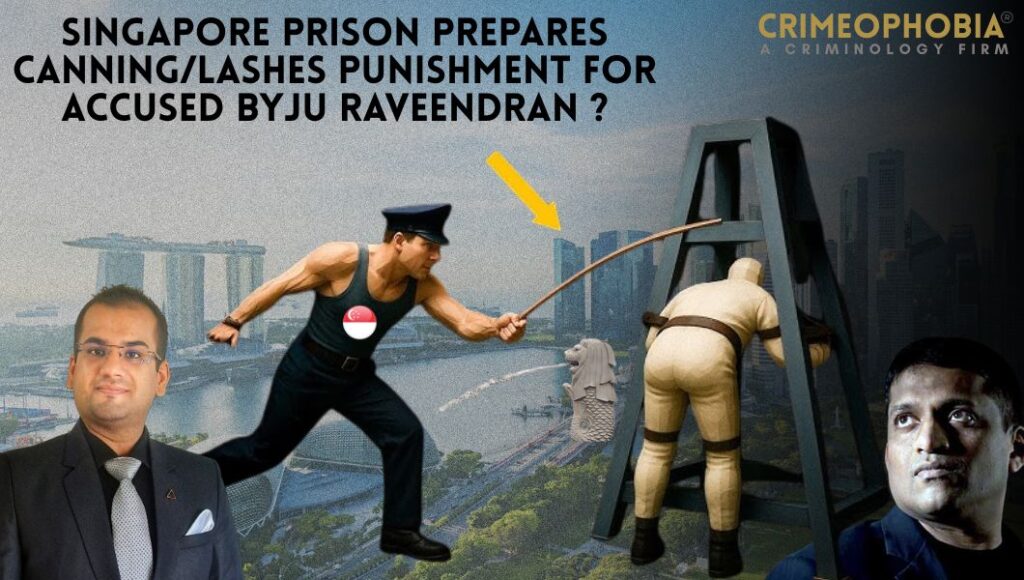
Mumbai Police Lost Opportunity to Arrest Byju Raveendran Under Crimeophobia’s FIR — Now the BYJU’S Founder Faces Singapore Jail and Possible Corporal Punishment Debate?
“Had Mumbai Police acted earlier, Byju Raveendran might have faced only an Indian prison. Now the world is debating whether Singapore prison and its caning laws await him, with lashes punishment possibly coming very soon. I hope the United Nations takes note, at least this time, of the UNTOC implementation initiatives undertaken since 2013. Today, we globally hold what may be one of the only case studies handled by the Crimeophobia team from India, in which we were among the first to report the transnational crimes allegedly committed by BYJU’S, which have now grown into a snowball effect of multiple cases globally.” — Criminologist Snehil Dhall
Singapore: The dramatic downfall of BYJU’S founder Byju Raveendran has now taken an international turn after a Singapore Court sentenced him to six months’ imprisonment for contempt of court, adding another explosive chapter to what is increasingly being described as one of the biggest corporate collapses in global ed-tech history. However, amid the international headlines surrounding the Singapore judgment, Criminologist Snehil Dhall and his organization Crimeophobia for which he is the Founder, have claimed that the downfall could have been prevented — or alternatively contained within India itself — had the Mumbai Police acted decisively on the original FIR (Police Case) initiated through Crimeophobia years earlier.
According to Dhall, the Crimeophobia’s FIR was among the first globally to raise criminal allegations against Byju Raveendran and the functioning of the ed-tech empire. He alleges that the complaint was not merely about commercial misconduct, but about “systematic misinformation, manipulation of educational curriculum, and misleading representation of international legal frameworks such as UNTOC.” Dhall has repeatedly alleged that BYJU’S misrepresented the implementation structure of the United Nations Convention against Transnational Organized Crime within UPSC-oriented educational material by allegedly suggesting that the framework was under implementation through the Central Bureau of Investigation (CBI). According to him, the CBI had already clarified in writing that the issue did not concern their organization due to which a Criminal Writ Petition was filed with the Hon’ble Supreme Court of India for UNTOC implementation in India. Yet BYJU’S allegedly continued to mislead students through UPSC curriculum material published on its platform. The UPSC examination is one of India’s most significant examinations for recruitment into top government and administrative services and Crimeophobia Team has been determined that wrong information cannot be taught to future Indian Government officials which will make it even more complicated for UNTOC implementation in India.
Crimeophobia maintains that such misinformation was not a minor academic error, but a matter affecting national security awareness, legal education, and the understanding of transnational organized crime mechanisms in India. According to Dhall, the accused Byju Raveendran was unwilling to correct the information, following which Criminologist Snehil Dhall succeeded in securing registration of an FIR against him. However, Dhall alleges that the accused manipulated the Mumbai Police system, and the matter continues to remain pending before Indian courts, where the accused has allegedly failed to appear.
“Mumbai Lost Its Opportunity — Singapore Did Not”
Speaking on the recent Singapore judgment, Dhall stated: “Mumbai Police lost its opportunity to arrest Byju Raveendran under the Crimeophobia FIR. Had lawful action been taken at the correct stage, the matter might have remained restricted to a Mumbai prison itself. Instead, the issue snowballed globally.” The Singapore Court reportedly sentenced Byju Raveendran to six months’ imprisonment after finding that he repeatedly failed to comply with court directions linked to disclosure of assets and ownership documents connected to Beeaar Investco Pte. The Court also reportedly directed him to surrender before authorities and imposed legal costs amounting to S$90,000 as per various media reports.
International reports indicate that the Singapore proceedings are linked to investor and creditor disputes involving the Qatar Investment Authority and other overseas stakeholders, while additional legal proceedings continue in the United States regarding alleged misuse of loaned funds amounting to hundreds of millions of dollars. According to Dhall, the offences for which the FIR was registered by Crimeophobia are substantially aligned with the same categories of conduct for which international authorities are now scrutinizing the accused. He further argues that UNTOC was specifically designed to address crimes such as money laundering, human trafficking, and arms and ammunition smuggling, and that many of the allegations now surfacing internationally against Byju Raveendran involve financial irregularities and potential money laundering frameworks, whereas, allegations of leaking data of children and their parents were also under scrutiny with few Indian government departments and judiciary. Crimeophobia Team was among the first globally to formally report and raise concerns regarding these patterns.
Dhall further remarked:
“It is unfortunate that my hometown Mumbai, where I completed my schooling, failed to act appropriately on the merits of the case. However, I am glad that Singapore, where I completed the remainder of my schooling, has taken stronger action. I hope my hometown starts taking organized crime and organized criminals more seriously the next time Crimeophobia reports such matters.” Referring to Singapore’s strict criminal justice system, Dhall added: “During my schooling days in Singapore, police officials conducted crime education sessions in our international hostel at Novena, where even corporal punishment laws and lashes punishment were discussed, and videos were shown to us — memories that remain alive even today. I can now imagine accused Byju Raveendran receiving those lashes from hot iron rods. If a person manipulates educational curriculum, international legal frameworks, and institutional systems for personal benefit, then strict punishment becomes a message to society, which I believe Byju now deserves.”
While the present Singapore contempt proceedings concern asset disclosure violations and not offences attracting corporal punishment, Dhall stated that the case symbolically demonstrates the difference between what he describes as “soft institutional handling” and “strict legal enforcement.” He further stated that the same accused continues to face proceedings before Indian courts, which may have been among the earliest legal proceedings initiated against him.
Crimeophobia Says UNTOC Was Ignored Until Global Collapse Began
According to Crimeophobia, the Byju Raveendran episode has now become a textbook example of why India urgently requires stronger implementation of UNTOC frameworks for which Dhall has been appearing in UN Vienna conferences regularly since several years. Dhall argues that Crimeophobia has, for years, remained one of the oldest independent organizations globally advocating courtroom-level implementation of UNTOC in India, for which the organization claims to have already secured judicial orders long before the present collapse of global ed-tech structures and cross-border financial disputes became publicly visible. According to him, UNTOC is no longer merely a legal implementation issue within Crimeophobia’s proceedings, but has now evolved into a live case study involving an international ed-tech giant whose alleged activities reflect precisely the type of transnational organized criminal structures for which the convention was originally designed. Crimeophobia Team has recently added Middle-East zone for UNTOC implementation with the assistance from its Board of Advisor, Rita Chahwan.
Dhall alleges that Byju Raveendran has conducted transnational organized criminal activities across multiple jurisdictions while continuing to evade effective application of UNTOC frameworks and enforcement structures. Crimeophobia has therefore once again urged United Nations Development Programme and United Nations Office on Drugs and Crime to examine and implement the blueprint model developed by the Crimeophobia team for global implementation of UNTOC mechanisms. The organization has repeatedly argued that modern transnational organized crime no longer operates solely through narcotics, weapons trafficking, or terrorism, but also through educational manipulation, financial routing, offshore structures, institutional influence, digital psychological targeting, international asset movements, human trafficking, smuggling of migrants, and related cross-border mechanisms.
Crimeophobia has already approached the Hon’ble Supreme Court of India regarding implementation of UNTOC in India, where Criminologist Snehil Dhall now appears as Party-in-Person. According to Dhall, the Hon’ble Court admitted the matter and issued “Issue Rule” in 2020, while subsequently also permitting him to personally argue matters connected to proceedings originally filed in 2016. He further alleged that despite India being one of the countries most significantly affected by transnational financial and organized crime structures, international institutional focus often sidelines Indian stakeholders. “The irony is that organizations like Crimeophobia were already warning about failures in UNTOC implementation while influential institutions and corporations ignored the issue. Today, the same corporate ecosystem has collapsed internationally,” Dhall stated.
Allegations Against Police Handling
Crimeophobia Team also raised allegations regarding the handling of the FIR by Aarey Police Station. The team has submitted its reports that procedural irregularities allowed accused Byju Raveendran’s responses and statements to be routed through managerial and legal representatives instead of ensuring direct accountability. According to Dhall: “If the case data had not been manipulated, and if influence-based intervention had not diluted the proceedings, Byju Raveendran may have faced only Indian legal consequences. Now the matter has become an international symbol of corporate collapse, cross-border litigation, and institutional failure.”
The downfall of BYJU’S has already become a global cautionary tale. Once valued at nearly $22 billion and associated with international branding campaigns involving celebrities and sporting sponsorships, the company is now battling insolvency disputes, international creditor actions, governance allegations, investor lawsuits, and criminal scrutiny across multiple jurisdictions. Online public reaction to the Singapore judgment has also reportedly been intense, with several social media discussions describing the case as a “deserved downfall” and referring to allegations of aggressive sales tactics and emotional pressure allegedly imposed upon middle-class families. Crimeophobia maintains that the matter should now be studied as a live international example of how modern transnational organized crime structures may allegedly operate through education, finance, digital influence, and institutional loopholes rather than through conventional criminal networks alone.
Criminologist Snehil Dhall has also urged the United Nations to treat the present matter as an example demonstrating the core necessity for implementation of UNTOC frameworks, arguing that Crimeophobia had already identified and presented the accused as a potential transnational criminal actor years before multiple countries, courts, police agencies, and financial stakeholders began taking action. According to Crimeophobia, the case also represents a major example of predictive policing methodologies pioneered by Criminologist Snehil Dhall.