
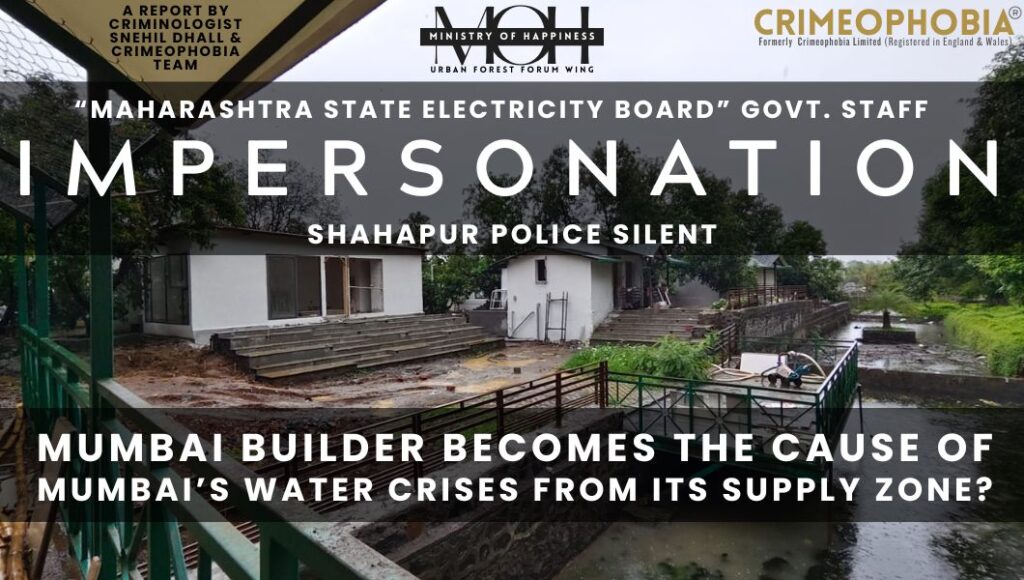
Mumbai’s Water Crisis: Gangsters, Fake MSEB Staff and Builder— The Shahapur Controversy Behind the City’s Lifeline
Published on 13/06/2026; Author: Urban Forest Forum Bureau (MOH)
“As Mumbai faces water cuts, allegations emerge from Shahapur of illegal resorts, diversion of irrigation water, impersonation of government employees, and gangster-backed encroachments within one of the city’s most critical catchment zones that supply water to Mumbai city. Here is a video of MSEB government staff being impersonated and caught.” ~ Criminologist Snehil Dhall
Electricity official MSEB impersonation Video Link: https://youtu.be/DBIZsdqpopk
Land official Tahsildar’s manipulation Video Link: https://youtu.be/2bSlRmh-GZo?feature=shared
Shahapur, Thane: As Mumbai battles shrinking water reserves and recurring concerns over water security, a dispute unfolding in the dam-rich taluka of Shahapur has brought renewed attention to the management of water resources in one of Maharashtra’s most critical water catchment regions, triggering questions about environmental compliance and regulatory oversight. Shahapur, a small town in Thane district, is home to several major reservoirs, including Tansa, Bhatsa and Middle Vaitarna, which together supply a significant portion of Mumbai’s drinking water. Yet even as Mumbai recently grappled with shrinking water reserves and a 10 per cent supply cut imposed by the Brihanmumbai Municipal Corporation (BMC), a controversy brewing in Shahapur has shifted attention from the city’s taps to the source itself. Against this backdrop, concerns have emerged over alleged construction activity on agricultural land in Shahapur’s ecologically sensitive zone.
The dispute arises from a Mumbai-based local builder from Andheri who has allegedly kept the land mafia intact with local goons who are openly terrorizing tribal communities and other farmhouse landowners within Shahapur. The water that is meant for irrigation has allegedly been used for constructing an illegal resort, for which all permissions are reportedly being sought only through the local Sarpanch, who is also the contractor for this resort. The local police have allegedly remained inactive and, in one such meeting, it was unofficially informed by Shahapur Police Station that Bimal Desai takes support from a local gang called the Adhikari Company, which is directly connected with the Gawli gang, as per the sources who informed to the Crimeophobia Team.
The evidence for these activities can be observed in a recent attack on local landowners, in which it has been alleged that the Adhikari Company and/or the Gawli gang appeared not only to terrorize but also to commit trespassing, vandalism, and criminal intimidation. Upon calling the police, who arrived after more than an hour, it was alleged that the police allowed vandalism to continue in their presence. The victim stated that, “A case was filed by Desai, and yet the Civil Court provided status quo regarding our private road, but more than 40–50 gangsters were brought in who broke the walls, manhandled our senior citizen staff, and also got police protection for all of their crimes.”
According to complaints submitted to various authorities, large-scale development work has been undertaken on land designated for agricultural use. The allegations include illegal construction, mass tree felling, rock cutting, ground levelling, deep excavation, and land modification, which complainants claim go far beyond ordinary farming operations. The more troubling question, however, concerns water. Representations made to government departments allege that water meant for agriculture and irrigation is being used to support construction and development activity. If proven, it would present an uncomfortable contradiction: a city being asked to save water while questions emerge about how water is being used in the very region that supplies it. Environmental experts say such concerns cannot be viewed in isolation. Shahapur is not merely another fast-growing town on Mumbai’s outskirts. It sits within a critical catchment zone where changes to land use can have consequences far beyond local boundaries.
Complainants claim they repeatedly approached government departments seeking intervention. They allege that despite objections and representations, activity on the site continued. Multiple government officials have visited the site, but they allegedly stated that no resort is under construction, despite evidence suggesting otherwise. While the resort does not even have access to the mandatory 12-metre road required for obtaining approvals, attempts are allegedly being made to secure the same by claiming a “right of access” for farming while camouflaging the purpose as a resort project. One such case was filed by a Mumbai builder before the Tahsildar, who allegedly did not realize that CCTV footage was capturing all of his statements, in which he stated that no resort work was taking place and that access to the road was required for farming; however, he denied passing an order to that effect. The local Tahsildar had reportedly stated that the property was being used for agricultural purposes and denied the existence of any resort project on the site. However, the existence of multiple complaints, survey proceedings, and correspondence between departments has ensured that the matter remains under scrutiny.
According to complaints submitted to various authorities, large-scale development work has been undertaken on land designated for agricultural use. The allegations include illegal construction, mass tree felling, rock cutting, ground levelling, deep excavation, and land modification, which complainants claim go far beyond ordinary farming operations. The more troubling question, however, concerns water. Representations made to government departments allege that water meant for agriculture and irrigation is being used to support construction and development activity. If proven, it would present an uncomfortable contradiction: a city being asked to save water while questions emerge about how water is being used in the very region that supplies it. Environmental experts say such concerns cannot be viewed in isolation. Shahapur is not merely another fast-growing town on Mumbai’s outskirts. It sits within a critical catchment zone where changes to land use can have consequences far beyond local boundaries.
A video recording has further highlighted allegations that a Mumbai-based builder, in active collusion with elements of the local Shahapur mafia, exercises influence over electricity infrastructure that is critical for pumping and redirecting irrigation and drinking water supplies. Victims allege that electricity intended to facilitate agricultural activity is being misused to support illegal construction under the guise of farming operations. In one incident, local residents reportedly apprehended an individual allegedly impersonating an employee of the Maharashtra State Electricity Board (MSEB). Despite repeated calls for police intervention, officers allegedly never arrived at the site, while MSEB ground staff are stated to have appeared only to shield the impersonator instead of initiating criminal proceedings or lodging an FIR for impersonation of a government servant, perhaps due to fear from local Mafia. Victims contend that Mumbai’s recurring water shortages cannot be attributed solely to deficient rainfall or declining reservoir levels, but must also be examined in the context of the alleged diversion and redirection of drinking and irrigation water for unauthorized construction and resort-related developments within ecologically sensitive catchment regions such as Shahapur.
Victims claim they repeatedly approached government departments seeking intervention. They allege that despite objections and representations, activity on the site continued. Multiple government officials have visited the site, but they allegedly stated that no resort is under construction, despite evidence suggesting otherwise. While the resort does not even have access to the mandatory 12-metre road required for obtaining approvals, attempts are allegedly being made to secure the same by claiming a “right of access” for farming while camouflaging the purpose as a resort project. One such case was filed by a Mumbai builder before the Tahsildar, who allegedly did not realize that CCTV footage was capturing all of his statements, in which he stated that no resort work was taking place and that access to the road was required for farming; however, he denied passing an order to that effect. The local Tahsildar had reportedly stated that the property was being used for agricultural purposes and denied the existence of any resort project on the site. However, the existence of multiple complaints, survey proceedings, video recordings, and correspondence between departments has ensured that the matter remains under scrutiny.
This exposes a broader challenge confronting rapidly developing areas around Mumbai. As tourism, hospitality, and real estate interests push deeper into rural landscapes, regulators are increasingly being asked to answer a difficult question: where should development stop and ecological protection begin? For Shahapur, the answer is particularly significant. This is not merely a town surrounded by dams. It is part of the watershed that quenches Mumbai’s thirst. And as another monsoon arrives, the debate is no longer only about one property, one project, or one dispute. It is about whether the regions that supply water to millions are being protected with the same urgency with which those millions are asked to conserve it.