
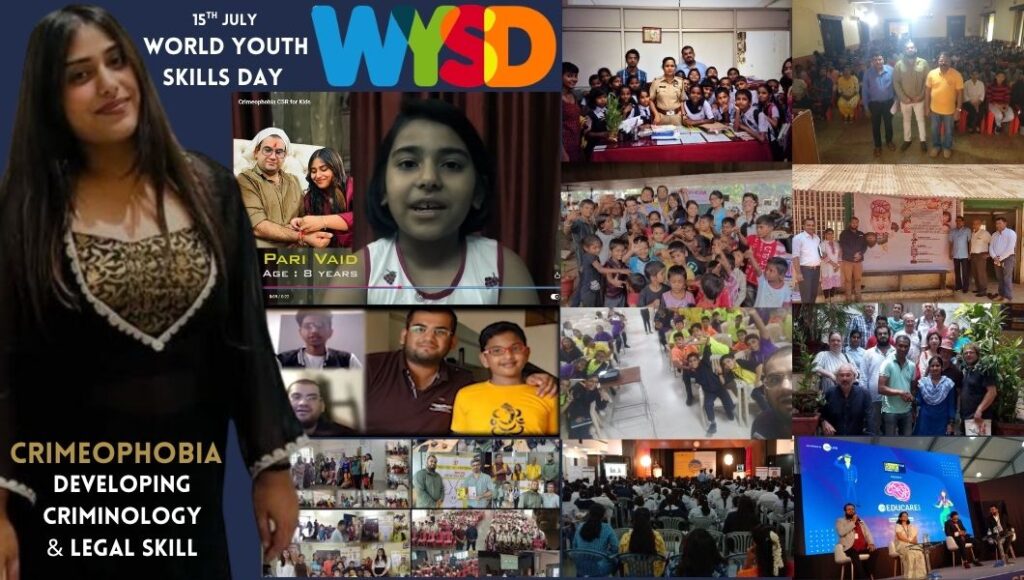
On World Youth Skills Day, Crimeophobia Pays Tribute to Nearly Two Decades of Young Minds been Shaped in Criminology & Law
Published: 12/07/2026; Author: Global Youth Bureau
“On World Youth Skills Day, Crimeophobia pays tribute to nearly two decades of shaping young minds in Criminology, Law, and social awareness, while honouring all youth who have learned and grown alongside the organisation. Among them is Crimeophobia’s youngest legal mind, whose aptitude for law was identified during adolescence and who has now entered adulthood, pursuing legal education with aspirations of joining the judiciary. For nearly two decades, Crimeophobia has believed that youth development cannot follow a one-size-fits-all approach and must be guided by individual aspirations and informed choices. Through entirely pro bono counselling, criminological education, and empowerment initiatives provided as CSR support, numerous young people have been empowered without financial barriers. To further institutionalise this mission, these initiatives have now been reallocated under the Ministry of Happiness, a registered Trust in Maharashtra dedicated to education, mental healthcare, and crime prevention.” — Criminologist Snehil Dhall, Founder, Crimeophobia – A Criminology Firm and Founding Trustee of Ministry of Happiness.
Global Youth Bureau: Every year on July 15, the world observes World Youth Skills Day — a United Nations-designated occasion meant to draw attention to the importance of equipping young people with the skills they need for employment, entrepreneurship, and meaningful work. For most organisations, it is a day for statements. For Crimeophobia, the criminology and crime-psychology platform founded by Snehil Dhall, this year’s occasion is something more deliberate: a tribute to every young person who has, over almost two decades, developed their skills in criminology and law under the organisation’s guidance — students counselled, protected, and empowered long before most of them had a name for the career they were walking toward.
Through an internship programme focused solely on practical training, criminologist Snehil Dhall has long believed that young people need a practical understanding of criminology and law, rather than theoretical knowledge alone, regardless of their educational background. On one occasion, while Dhall was at the Supreme Court of India for proceedings, the Mumbai Police chose to registered an FIR (police case) against Byju Ravindran on Crimeophobia’s complaint on the same day. The complaint was filed under an authority letter given to one of Crimeophobia’s criminology trained youth members — a Tamil-medium student who had failed Class 10, and who handles the organisation’s various policing, court, political, and other liaison work. Whether or not the world chooses to believe it, the first case — police or court — against an ed-tech global giant that claimed to educate the youth was filed by someone many would dismiss as 21 years old “illiterate,” yet who is, in every sense that matters to Crimeophobia, literate.
Similarly, numerous young minds have worked with Crimeophobia regardless of their educational background, age, gender, religion, or nationality — but the youngest among them has been the founder’s own cousin, whom he considers a little sister. That tribute begins where the organisation itself effectively began — with Ms. Pari Vaid, Crimeophobia’s brand ambassador for youth skill-building, and the founder’s cousin, whom he has long regarded as a little sister.
The Six-Year-Old Who Became the Face of a Movement
Pari Raizadi Vaid — the “Raizadi” an honorary title carried down through her family’s forefathers — was around six years old when Snehil first noticed something unusual in her. While he worked on cases and content for Crimeophobia, Pari would sit nearby, absorbing far more than a child her age typically would: asking questions about evidence, motive, and process that most adults never think to ask.
That observation led to a short video — a small girl explaining, in her own words, what a criminologist actually does in her own cuteness, here is the old video https://youtu.be/FTgxOH6EDbc?si=VK-bAsXGjVbHZ-yk. It was intended as a light, family moment about 11 years ago. It became, in hindsight, the founding artefact of Crimeophobia’s youth engagement work, and it is the reason Pari today holds the organisation’s brand ambassadorship for youth skills: she is, quite literally, the organisation’s first documented case of a child’s early instincts being recognised on camera.
Without anyone quite planning it, that early exposure to legal thinking planted a seed. Years later, Pari enrolled in law college, carrying an ambition that had been forming since childhood — not just to practise law, but to one day sit on the bench.
A Career Decision Years in the Making
Pari’s academic record gave that ambition weight. She was a consistent topper through her school years, the kind of student whose choices in college would matter well beyond a report card. But the path from gifted student to settled career is rarely a straight line. For a long stretch, she weighed two demanding, prestigious, and very different futures — the long judicial route toward judgeship, or the equally rigorous route of the UPSC civil services examination toward an IAS career. Both begin, on paper, in similar territory: a strong grasp of law, governance, and public service. But they diverge sharply in what they eventually demand of a person — one built through years on the judicial ladder, the other through one of the country’s most competitive examinations.
What made the choice difficult was not a lack of ability, but an excess of it — Pari was genuinely suited to both paths. That is a dilemma career counselling rarely accounts for: not “what am I good at,” but “which of the things I’m good at do I want to spend a life doing.” Resolving it took years and, by her own account within the family, a fair amount of deliberation. Slowly, the scale tipped toward the judiciary — toward courtrooms, toward the bench, toward the version of justice she had once tried to explain to a camera at six, without yet fully understanding the word.
Pari marked another birthday this July 6th. In keeping with the family’s own instincts around privacy, this piece will not dwell on the number — only on the distance travelled. What began as a six-year-old narrating her cousin-brother’s profession has, over the better part of two decades, become a young woman actively building a legal career of her own. Ahead of World Youth Skills Day, Crimeophobia points to that arc as the clearest illustration of its founding premise: that adolescence is a window in which a child’s raw instincts can be identified and deliberately shaped, rather than left to develop unsupervised.
The Wider Roll of Honour
Pari’s is the organisation’s origin story, but Crimeophobia is careful to note it is not the only one it carries into this World Youth Skills Day. Over nearly two decades, the organisation’s counselling work has extended to children whose starting points were far more difficult, and whose stories carry rather less protection than a family’s own.
Among the more sobering cases the practice has encountered was that of another young child, around seven or eight years old, in Bangalore, drawn into the formal legal process — appearing before police and the courts — as a consequence of a matrimonial dispute between parents that escalated into a child custody matter involving three different States in India. Crimeophobia does not reproduce the specifics of that case here, out of the same instinct for privacy it extends to its own; the point it wishes to mark on this occasion is simply that children can be pulled into the machinery of the legal system through no choice of their own, and that psychological support in those moments is not a luxury but a necessity.
That principle has shaped the reach of the counselling work more broadly. Children from street schools, government schools, and international schools alike have gone through Crimeophobia’s guidance process — a deliberate refusal to let career and psychological counselling remain the preserve of only the most privileged students. That reach has extended further still: to children growing up in orphanages, without the family structure most skilling programmes quietly assume; to young residents of shelter homes run under the women and child welfare ministry; and to unmarried and married women alike, often alongside their own children, for whom skill development has meant not just a career path but a measure of independence and stability. Alongside individual counselling, the practice has also been involved in setting up crime psychology clinics aimed at anti-criminal and anti-terrorism rehabilitation, treating early intervention as a form of prevention rather than mere correction.
Institutional Partnerships Behind the Work
None of this reach, Crimeophobia notes, has been built in isolation. Over the years, the organisation has maintained an ongoing collaboration with the Children’s Aid Society — the juvenile facility functioning under the State Government of Maharashtra — extending its counselling and rehabilitation work to young people within the juvenile criminal justice system, a population that rarely features in mainstream conversations about youth skilling but arguably needs them the most as Anti-Criminal Rehabilitation support.
Crimeophobia has also sustained an association with the Nehru Yuva Kendra Sangathan (NYKS), the youth development body functioning under the Government of India’s Ministry of Youth Affairs and Sports — a partnership that situates the platform’s youth counselling work within the country’s broader, formally recognised infrastructure for youth engagement, rather than treating it as a standalone private initiative including Anti-Terrorism rehabilitations.
Taken together, these collaborations round out the picture that a single family story — however illustrative — cannot tell on its own: that Crimeophobia’s model of catching a child’s instincts early has been tested and applied well beyond one household, across state-run juvenile institutions and national youth bodies alike.
A Day, and a Tribute
World Youth Skills Day exists to make a fairly simple argument on the world’s behalf: that the young deserve to be taken seriously as future professionals, not just as students marking time. Crimeophobia’s own contribution to that argument has, over nearly two decades, been built one young person at a time — in courtrooms children never chose to be part of, in juvenile facilities under the Children’s Aid Society, in classrooms reached through NYKS, in orphanages and shelter homes, among women rebuilding their independence alongside their own children, and in a family living room where a six-year-old once explained a job she didn’t yet know she’d grow into. We have been developing skills that the youth aspire to acquire, based on their own ecosystem and requirements. The intensity and nature of the training provided to the youth are determined with their consent and not at the discretion of Crimeophobia, as it is the youth who encounter criminal elements in their daily lives and may or may not recognize certain activities as constituting crimes.
For Criminologist Snehil Dhall, that work began at home. It has since extended to every student Crimeophobia has counselled, protected, and empowered along the way — and this July 15, the platform’s tribute belongs to all of them. Pari Vaid, its brand ambassador and its first documented case, simply remains the clearest proof of what the rest represent: that a child’s instincts, taken seriously early enough, can become a career.