
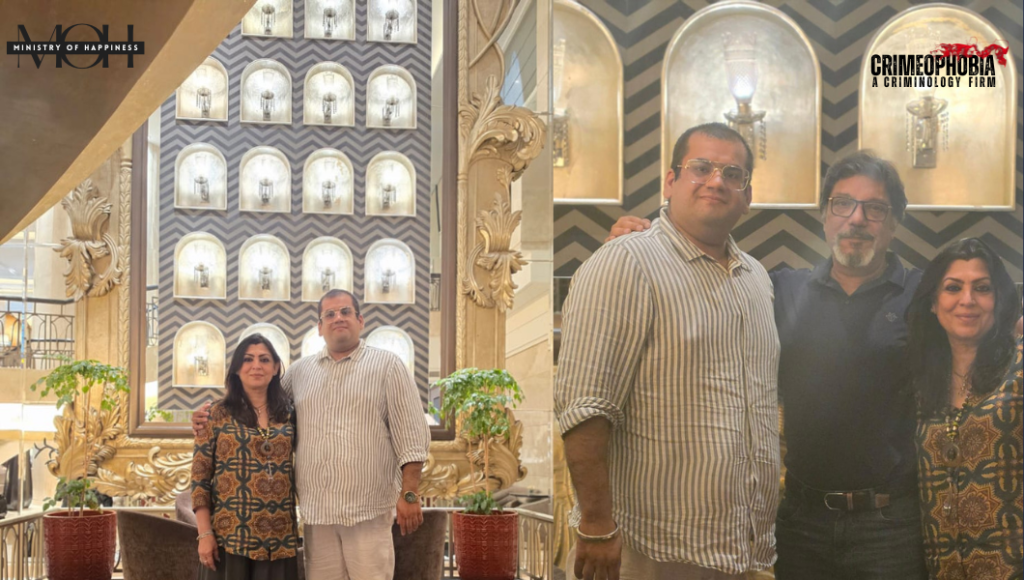
Neetu Mehta Uppal: The Guardian of an Unconventional Dream That Began in Singapore for First-Generation Entrepreneur Snehil Dhall
“When I arrived in Singapore as a young Indian student for schooling—rather than the more conventional route of university education—I was stepping into an unfamiliar world with far more questions than answers. Among the earliest individuals to place their faith in my potential was my official legal guardian, Respected Mrs. Neetu Mehta Uppal Ma’am. What began as an admission interview gradually evolved into a relationship defined by mentorship, guidance, and ultimately family; today, I proudly regard her as my aunt. Long before my journey in criminology, entrepreneurship, and institution-building became visible to the world, she quietly instilled in me the confidence to pursue unconventional aspirations. If my life’s work represents an unconventional journey, then Neetu aunty and her family remain among its earliest believers, enduring well-wishers, and silent architects, whose influence extends far beyond what words can adequately express.” — Criminologist Snehil Dhall
Mumbai/Singapore: In the early 2000s, when studying abroad was largely associated with pursuing undergraduate or postgraduate education, a young Indian student made an unconventional leap by moving from Mumbai to Singapore for his schooling. For Criminologist and Entrepreneur Snehil Dhall, today recognised as the Founder of Crimeophobia, Chairman of the Ministry of Happiness, and a Global Portfolio Entrepreneur, the transition represented not merely geographical relocation but a complete transformation of identity. Being among the first generation in his family of Indian students to relocate overseas for school education rather than university studies, the journey was unprecedented both for his family and for those around him. While the move was made possible through the unwavering support of his parents and elder brother, the academic admission itself remained conditional and uncertain.
However, the defining chapter of this journey began when his interviewer, respected Mrs. Neetu Mehta Uppal —who would eventually become a mentor, guardian, and guiding force in his life— agreed to assume the legal responsibility of an underage Indian student living independently in Singapore. As a legal guardian, Mrs. Neetu Mehta Uppal ma’am responsibilities extended far beyond paperwork. She became responsible for overseeing his food, hostel arrangements, healthcare requirements, emotional well-being, and cultural adaptation, while patiently answering his endless questions about life in a foreign country.
One of the most unusual experiences during those early years involved officials from Singapore’s Anti-Narcotics Department visiting the Novena-based international hostel to educate students about narcotics, their consequences, and Singapore’s strict anti-drug laws, including the showing of videos depicting caning punishments for serious offences. Adapting to such realities was entirely unplanned and became one of the many cultural shocks associated with international schooling.
Another deeply impactful incident occurred when the father of one of his classmates, a senior global executive associated with Apollo Tyres, mysteriously passed away due to drowning. Attempting to understand and decode what had happened became what Criminologist Snehil Dhall retrospectively considers his first unofficial investigation as a teenager student. During this difficult period, she once again stood beside the students and successfully ensured that school examinations were postponed, recognising that they were emotionally unprepared to appear for them.
Incidents that may have appeared unfortunate during school life later reflected in Dhall’s professional career. During those years, she along with members of the school administration, nominated him for the Singapore Government’s Best Courteous Student Award, perhaps because, as she and another professor frequently remarked: “Snehil, you can defuse the most explosive situations.” Over the years, her role evolved from being merely a legal guardian during his schooling years into becoming an emotional pillar for decades.
Despite maintaining this close relationship for years, Criminologist Snehil Dhall recalls a lingering regret that they had never taken a photograph together. That changed only recently when he finally met her again, joined later by her husband, respected Hon. Arvind Uppal Ji, a veteran corporate statesman and one of India’s most respected business leaders. According to Criminologist Snehil Dhall, she played a pioneering role in creating pathways and support systems for Indian school students living abroad and navigating international hostel life. She became an advocate for numerous young Indians studying overseas and remained available whenever guidance was needed, irrespective of geographical boundaries.
Her husband, Hon. Arvind Uppal, meanwhile, quietly contributed in ways that would later influence Dhall’s entrepreneurial thinking. Post 15+ years formation of Crimeophobia, during one of the discussions at their India residence, Hon. Arvind Uppal reportedly advised that Crimeophobia should gradually transition from a retail-client model towards a retainership-based structure. Family discussions also included strategic perspectives from his respected father, a distinguished military veteran, who shared insights that later contributed to the development of Crimeophobia’s defence and security segments.
Mr Uppal himself is one of India’s most distinguished corporate leaders, having served as President Asia-Pacific and Managing Director of Whirlpool Corporation for over a decade, successfully turning around the company’s fortunes and transforming it into one of the leading consumer brands in the region. He also spent nearly eighteen years with Nestlé across India, Switzerland, China, and Southeast Asia, where he played a significant role in the expansion and success of iconic brands such as Maggi. Over the years, he has served on the boards of several multinational corporations, including Whirlpool India, Gulf Oil Lubricants, Akzo Nobel India, and Eureka Forbes, and has received numerous honours, including Business Leader of the Year awards and recognition as one of India’s leading corporate turnaround specialists.
The family also introduced Dhall to unforgettable memories during his schooling years. Among them was their son, Mr. Qaran (Karan), who has today emerged as a prominent singer, songwriter, and music producer. Criminologist Snehil Dhall fondly recalls that during their school farewell, Mr. Qaran had booked an entire club in Singapore and personally served as the DJ for the celebration. Even during periods when Hon. Mrs. Neetu Mehta Uppal was not physically present, she remained accessible through calls and continued offering guidance and encouragement. Significantly, while many around Criminologist Snehil Dhall initially had little understanding of his decision to pursue Criminology and establish Crimeophobia, she remained consistently supportive of his unconventional ambitions.
Beyond professional accomplishments, the couple left a profound cultural impact on Indian students abroad. While she focused on empowering young individuals in their educational and career journeys through mentorship and wisdom, Hon. Mr. Uppal unknowingly encouraged practical self-reliance, particularly by teaching young students to become independent Maggi home-chefs rather than depending entirely upon external support systems, among many other legendary silent contributions he has made towards India. “The husband-wife duo changed the way Indian students study abroad and even influenced how young Indians learn to live independently and cook for themselves,” remarked Criminologist Snehil Dhall.
Reflecting on the journey, Criminologist Snehil Dhall credits his aunt, respected Mrs. Neetu Mehta Uppal, with standing beside him during numerous challenges and even confronting authorities in Singapore on his behalf whenever necessary. Their family’s support, he believes, quietly shaped his worldview and contributed significantly towards transforming him from a young overseas student into an internationally recognised criminologist and entrepreneur. For Criminologist Snehil Dhall, the story is not merely about guardianship. It is a reminder that behind every global success story often lies an unseen family that chooses to believe in someone’s potential long before the world does.
Synopsis: The School admission Interview That Quietly Created an Entrepreneur
For Criminologist and Entrepreneur Snehil Dhall, the journey towards becoming a Global Portfolio Entrepreneur, Founder of Crimeophobia, and Chairman of the Ministry of Happiness did not begin with the incorporation of a company, a university degree, or international recognition. It began with a simple interview in Singapore. At a time when moving abroad for school education was still uncommon among Indian families, particularly for first-generation students, Respected Mrs. Neetu Mehta Uppal Ji became one of the first individuals outside his immediate family to recognise the potential in a young student who was uncertain about his future but deeply curious about the world around him.
Her decision not only to interview him but subsequently to become his legal guardian provided him with his first international ecosystem of trust, responsibility, and empowerment. The encouragement and confidence she instilled became the first push that gradually transformed an inquisitive student into an entrepreneur and institution-builder. Over the years, Criminologist Snehil Dhall would go on to establish what is widely regarded as the world’s first dedicated criminology firm, Crimeophobia, in 2010—commercialising a discipline that had largely remained confined to academia, policing, and governmental institutions.
He would subsequently pioneer crime education initiatives in India years before universities formally introduced criminology programmes, establish one of India’s first Crime Psychology Clinics, and develop original intellectual frameworks including the Theory of Modern Chakravyuh, the Polymath Theory of Organised Crime, Post Crime Trauma (PCT), and Criminal Behaviour Syndrome (CBS). His work expanded across legal practice, behavioural sciences, security advisory, artificial intelligence, predictive policing, financial intelligence, humanitarian initiatives, and public policy, resulting in professional engagements across India, Singapore, the United Kingdom, Europe, the Middle East, and the United States.
The entrepreneurial journey further evolved into international policy advocacy when he became the first independent Indian criminologist to initiate sustained constitutional implementation efforts concerning the United Nations Convention against Transnational Organized Crime (UNTOC), leading to proceedings before the Supreme Court of India and participation in United Nations forums in Vienna. Under his leadership, Crimeophobia diversified into multiple verticals, including legal services, research, education, media, publications, medical criminology, crime psychology, and transnational security studies. This was later complemented by the establishment of the Ministry of Happiness, a charitable institution founded upon the philosophy that “Being Happy Can Reduce Crime,” integrating criminology with social welfare, youth empowerment, and crime prevention.
His portfolio today includes appearances and engagements before the Supreme Court of India, various High Courts, Government Ministries, international forums, and organisations including the United Nations, along with advisory and collaborative roles involving institutions such as NITI Aayog, C-DAC, FICCI, international diplomatic missions, and various governmental bodies. The journey also includes several landmark investigations and initiatives involving organised crime, financial fraud, cyber offences, child protection, human trafficking, environmental governance, heritage conservation, and transnational security. In retrospect, what began as a school admission interview in Singapore ultimately became the starting point of an entrepreneurial and criminological journey that led to the creation of multiple institutions, original academic theories, international advocacy movements, and one of the most unconventional career paths within modern criminology.
For Criminologist Snehil Dhall, the first interview conducted by Respected Mrs. Neetu Mehta Uppal was not merely an admission process—it became the first act of faith that silently transformed a young Indian student into an entrepreneur, institution-builder, and global criminologist.