
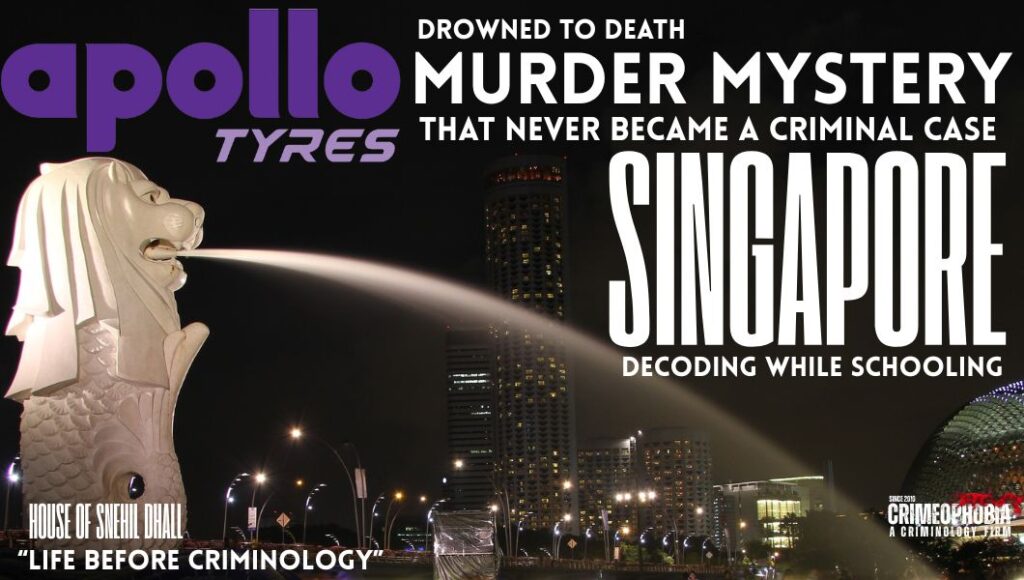
Decoding an Apollo Tyres Top-Management Murder Mystery from Singapore’s School Bench: Life before Criminology
Published: 02/08/2026; Author: House of Snehil Dhall Desk
“People first knew me as ‘Criminologist Snehil Dhall’ and later through Crimeophobia – A Criminology Firm. However, the designation and the institution came much later. Long before either existed, I had already begun decoding crime through criminal psychology, behavioural observation and the reconstruction of human conduct. I never became a criminologist to solve crime; I became a criminologist because I had already begun understanding how crime thinks, behaves and conceals itself. The profession gave me a title. Experience gave me the mindset. Crimeophobia eventually became the institutional expression of a journey that had already begun years earlier.” ~ Criminologist Snehil Dhall
Singapore: During the 11th grade and/or the 1st year of the IB Diploma during his schooling in Singapore, Snehil landed up not just decoding his first murder mystery but also saving a possible attack on another classmate. Although he had no formal training in criminology at that stage and was merely an underage student pursuing his education, the incident became the first practical demonstration of what would later evolve into his understanding of behavioural criminology, crime reconstruction, victimology and offender psychology. The mystery was decoded through behavioural analysis and logical reconstruction but was never institutionally solved because no criminal investigation ever appears to have been initiated despite numerous unanswered questions. Being underage, neither he nor his friend possessed any legal authority to investigate, collect evidence or compel statements. Their role remained limited to observing, reconstructing and understanding the sequence of events that unfolded before them and taking a confession to confirm what had happened.
While the act was boldly supported by another friend, who is now in the financial sector and does not like to be named, they eventually sought the appropriate support of their legal guardian, Neetu Arvind Uppal, who ultimately got their entire IB examination schedule changed. The entire school, along with the Principal, Professors and perhaps even the Chairman, had to place all of their protocols around the activities which Snehil and his friend were carrying out to ensure that no further death arose that night. What had begun as an emergency involving one classmate gradually transformed into an informal behavioural reconstruction of another death that had already been officially concluded. Looking back, Snehil believes the institution understood that the students were witnessing events that had far exceeded the ordinary responsibilities of school-going children.
This was the death of one of the topmost members of Apollo Tyres management who, at one point in time, pioneered the tyre industry, but whose murder was turned into an accidental death due to drowning at a residential building, and whose story was buried in a Singapore swimming pool. To Snehil, this was never merely a drowning incident. It was a murder mystery whose behavioural answers began revealing themselves almost immediately after the sequence of events was carefully reconstructed. Although official records treated the matter as an accidental death, his criminological assessment reached a different conclusion. To him, the mystery had already been decoded, but because no criminal case was ever made and because he was only an underage student without investigative authority, the decoded mystery never translated into a legally investigated crime.
The incident unfolded when suddenly a call was received by Snehil’s friend, who ran to his hostel room, and they immediately left for their classmate’s home, which was about two kilometres away. The story was not just heartbreaking but also majorly confusing. Their classmate’s father had travelled from India to visit him while he was completing his schooling in Singapore and staying with his mother’s sister. At that point, none of them imagined that what appeared to be a family tragedy would eventually become one of the earliest behavioural crime reconstructions of Snehil’s life.
When they reached the residence, the sister’s husband was found squeezing his face and body behind a wall. The mother was in one room while their classmate was in another. Even today, Snehil recalls these behavioural observations as being among the earliest details that immediately caught his attention. Crime scene reconstruction, in his understanding, often begins not from forensic laboratories but from observing the behaviour of individuals present immediately before and after an incident. Although he had no formal criminological education at the time, these behavioural inconsistencies remained permanently embedded in his memory.
Snehil stated “The doctors were not called by anyone, and the classmate was completely unconscious on his bed. The bystanders were dropping a few drops of water on his face to wake him up, but there was no reaction, so they all called me in to check. I took the entire glass of water and threw it on his face, but he did not move even after the water went inside his nose. Another adult stated that rubbing keys on his foot might wake him up, so I started rubbing it strongly, but he still did not wake up.” The complete absence of urgency among several adults present during those crucial moments remained deeply disturbing. Even before any formal reconstruction of the drowning incident began, he found himself questioning why professional medical assistance had not been immediately sought and why improvised methods continued despite the obvious medical emergency.
He added “That was when someone finally thought of calling the ambulance, and he was taken back. The hostel wardens were calling us back due to timing protocols, but we got that changed by calling our legal guardian. We further took permission to visit the hospital, which was again granted to us, and eventually most of our batchmates reached the hospital along with the Principal and teachers.” The fact that examination schedules were altered, permissions were specially granted and institutional protocols were modified reflected the extraordinary nature of the events unfolding around the students that night.
Beginning of Confessions in an Ongoing Crime During School Days
“The night was over, and our classmate recovered the following day. That was when we got to know from our classmate, who was about 120+ kgs. We were the only ones who got his confession after we made him cry when he stated how his father had died.” It was during this emotionally charged conversation that the drowning ceased to appear as an isolated event and instead began forming a behavioural timeline capable of reconstruction. The conversation did not merely provide facts; it provided sequence, timing, opportunity, behavioural choices and unexplained decisions that would later become the foundation upon which Snehil believes the entire mystery was decoded.
Classmate stated at the time that “he was on the 6th floor in his bedroom studying for the exams of the next day while his father, who was an excellent swimmer, was swimming with his little cousin while his uncle, who claimed he did not know how to swim, was sitting at the pool-side. Apparently, a heart-attack-like situation happened to his dad and his uncle ran using the staircase on the 6th floor to tell the classmate that his father was drowning and he should run to save him. The classmate, without a second thought, started running and reached to get his father out of the pool, but he was already dead by then.”This single statement transformed the entire incident from an accidental drowning into what Snehil considers a behavioural murder mystery. Every sentence raised a new question. Every action invited scrutiny. Every omission became as significant as every act that had actually taken place. Long before he formally studied criminology, Snehil instinctively understood that criminal investigations often depend not merely upon what people do, but equally upon what they consciously choose not to do.
Beginning of Circumstantial Evidence Observation During School Days
The swimming pool was exactly in the centre of multiple buildings with at least one hundred flats facing the pool, yet the uncle silently ran to the sixth floor to call the son to save his father. He did not choose to throw a floater, he did not choose to call the residential building, he did not choose to take the elevator or lift and he did not even choose to scream for help. This sequence became the turning point of the entire reconstruction. Individually, each act could perhaps be explained away. Collectively, however, every decision appeared inconsistent with what would ordinarily be expected from a person witnessing a life-threatening emergency involving a drowning victim. Behavioural reconstruction, in Snehil’s understanding, does not merely examine what actions were performed but equally analyses the actions that were consciously omitted despite opportunities to perform them. To him, those omissions became more significant than the actions themselves.
The deceased was described as an excellent swimmer by his son, yet despite the emergency, no immediate public alarm was raised in a residential complex surrounded by approximately one hundred flats overlooking the same swimming pool. No effort was allegedly made to throw a flotation device into the pool. No attempt was allegedly made to alert the building management or seek assistance from residents who could have potentially responded within seconds. Instead, valuable time was consumed by running six floors using the staircase to inform the son, who was preparing for his examinations the following day. Every minute during a drowning emergency carries critical value. Yet the behavioural sequence, as narrated to Snehil, appeared to follow a direction entirely different from what would ordinarily be expected if the primary objective had been to rescue the victim.
Another question that remained unanswered was why the staircase was chosen instead of the elevator or lift. Even assuming that the uncle genuinely believed the son should rescue his father, the behavioural sequence still failed to explain why no simultaneous effort was allegedly made to seek help from dozens of nearby residents while proceeding upstairs. To Snehil, this was not merely a question of movement between floors but a question of behavioural priorities. In his analysis, every decision made during those few minutes appeared inconsistent with the urgency normally associated with an accidental drowning.
The physical layout of the residential complex itself formed part of the behavioural reconstruction. The swimming pool was situated at the centre of multiple residential towers with numerous balconies directly overlooking it. If a genuine emergency had been loudly communicated, numerous independent witnesses could potentially have observed, responded to or assisted in the rescue. No such behavioural pattern emerged from the account narrated to Snehil. Instead, the sequence appeared unusually isolated despite occurring within one of the most visible locations inside the residential complex.
Snehil has consistently maintained that this was the moment when he believed the mystery had already been decoded. Decoding a crime and legally proving a crime are two entirely different processes. The former depends upon behavioural reconstruction, logical sequencing, opportunity analysis and human conduct, whereas the latter requires statutory authority, forensic evidence, admissible proof and institutional investigation. As an underage student pursuing the IB Diploma, he possessed none of those legal powers. Consequently, although he believes the mystery had already revealed its answers, there existed no mechanism through which those deductions could be transformed into a formal criminal investigation.
This incident ultimately became one of the earliest practical experiences that shaped his future approach towards criminology. Long before studying organised crime, behavioural profiling or victimology academically, he unknowingly began applying those very principles while attempting to understand the sequence of events surrounding the death. Looking back, he has often stated that this incident demonstrated to him that crimes frequently reveal themselves through patterns of human behaviour before they reveal themselves through forensic evidence. It was this experience that later strengthened his belief that behavioural inconsistencies often become the first silent witnesses of an offence.
I did visit their India home and within less than a month the mother had moved on and the classmate kept moving from one country to another until he chose to lose touch with everyone. The subsequent developments only added to the emotional complexity surrounding the incident. While Snehil consciously refrains from disclosing numerous private conversations because of privacy, ethics and the continuing dignity of the individuals involved, he maintains that certain observations and experiences from that period can never be forgotten. Some conversations, in his view, are ethically incapable of publication, yet they continue to reinforce the conclusions he had independently reached years earlier.
Various other conversations can never be shared due to privacy and ethics but some acts can never be forgotten or forgiven. He stayed for several months with me and then a few months with another friend in Mumbai after we all graduated, but the story continues to remain that there was a top management member from Apollo Tyres who had an invention that delayed India’s tubeless dream by several years until the invention was eventually completed of Made in India tubeless tyres. To Snehil, this aspect of the case elevated the significance of the incident beyond a private family tragedy. In his analysis, the death involved an individual who had made substantial contributions to one of India’s leading tyre manufacturers and whose work carried industrial significance. Whether that fact bore any relevance to the incident was never officially investigated, but he believes the possibility itself warranted far greater scrutiny than it appears to have received.
To Snehil, that was not an accidental death; it was a murder for which the mystery had an answer but would continue to remain a mystery on official documents because the case was never made. The behavioural reconstruction was complete in his mind, yet the legal investigation that could have either confirmed or disproved those conclusions never appears to have commenced. Consequently, what remained was not merely an unsolved death but, in his view, one of the earliest murder mysteries that profoundly shaped his understanding of criminology years before he would formally study the discipline.
Even today, Snehil continues to ask the same question that first arose in Singapore as an underage student: Why did the Singapore Police never manage to register the crime? Had the behavioural inconsistencies, witness accounts, environmental layout, timeline of events and sequence of human conduct been subjected to the same degree of scrutiny that he later learnt to apply as a criminologist, he believes the mystery may never have remained merely an accidental drowning on paper. Whether history will ever revisit those unanswered questions remains uncertain. To Snehil, however, the mystery itself has never disappeared. It simply remained undocumented as a crime.