
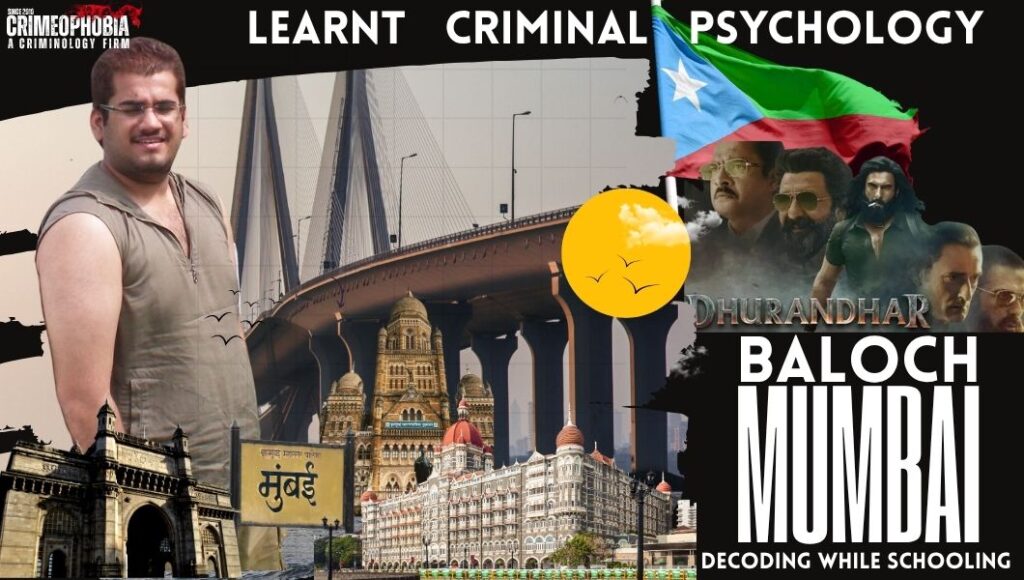
Mumbai-Baloch: Before Criminology, There Was a Community That Taught Me Criminal Psychology on the Ground in Mumbai
Published: 11/08/2026; Author: International Desk
“The Punjabi–Baloch bond portrayed through Ranveer Singh and the Baloch community in Dhurandhar felt strangely personal. Released in two parts on reel life, its third chapter now unfolds in real life, with the Republic of Balochistan declaring Independence on 11 August 2026 from Pakistan, with 44% of the land territory under its control. This time, I chose to share my Baloch connection, having ignored the previous two occasions since it revives memories of a life that began long before my Criminology degree in the United Kingdom, before Singapore-schooling, before Game Theory and the Prisoner’s Dilemma dissertation. It began in Mumbai—where a Baloch, long before I had the vocabulary of criminology, unknowingly introduced and mentored me to criminal psychology, trust, protection, insider threats, human & criminal behaviour and the darker realities that would eventually shape my life before criminology.” ~ Criminologist Snehil Dhall
Mumbai: With 11th August been considered as the Independence Day of Republic of Balochistan, the memories of Mumbai-Baloch are relived by Criminologist Snehil Dhall from several decades ago. Before Snehil Dhall became a criminologist in the United Kingdom, before he studied Economics, Game Theory and the Prisoner’s Dilemma during his schooling in Singapore, and long before Crimeophobia came into existence, there was Mumbai. It was here, during his childhood and teenage years, that Dhall encountered one of the most unusual and least publicly known influences of his formative life: the Baloch community and, in particular, a Baloch Muslim man who gradually became his driver, caretaker, friend, mentor and, at times, what Dhall describes as a form of “shadow protection.”
The Mentor Who Remained Behind the Curtains
The relationship was never a formal mentorship. There was no classroom, curriculum, appointment letter or academic certificate. It developed through ordinary life in Mumbai. The Baloch mentor taught Dhall how to drive a sedan car and remained around him during important years of his schooling before Dhall eventually left Mumbai for Singapore. At different points, he was a driver, caretaker, friend and protector. Most importantly, he preferred to remain behind the curtains and never sought public recognition, which is why his name shall continue to remain undisclosed—the “Mumbai-Baloch.”
“Criminal Psychology Before the Classroom”
The most important distinction in Dhall’s story is that his education in human and criminal behaviour did not begin with a textbook. It began on the ground in Mumbai. Long before he encountered formal theories of Game Theory or the Prisoner’s Dilemma in Singapore, Dhall says the Baloch mentor had already exposed him, through lived experience, to what could later be understood as practical criminal psychology. These lessons emerged through situations involving trust, suspicion, loyalty, fear, protection, access, conflict, people, police, criminals, documents, money and the unpredictable behaviour of those operating around him. The mentor taught him to watch what people did rather than simply listen to what they said; to recognise that an apparently harmless person could possess access or information that made them significant; and to understand that danger could emerge from both outside and inside one’s circle. In retrospect, Dhall considers this his first exposure to criminal psychology—not academic criminal psychology, but its raw, on-ground form.
The Mahabharata and the Psychology of the Insider
One of the most unusual lessons came through the mentor’s explanation of the real-life implications of the Mahabharata, a Hindu Sanatani religious scripture. According to Dhall, the mentor explained that the great conflict of the Mahabharata could not simply be understood as a fight against an external enemy. Arjuna’s dilemma demonstrated that sometimes the battle is against people who are already within one’s circle. The lesson became deeply personal: the most dangerous person is not necessarily an outsider. An insider can possess familiarity, access, information and trust that an outsider may never have. Perhaps he was one of those very few Muslims who regularly visited Hindu Temple, and he especially visited ISKCON Temple which believes in Lord Krishna and in returned he taught Lord Krishna’s philosophy to Criminologist Snehil Dhall which is one of the most researched warfare techniques till today. The mentor therefore unknowingly trained Dhall to understand that protection could not be limited to guarding against strangers. He had to remain alert to insiders—people who knew the family, understood movements, possessed knowledge of documents or funds, understood vulnerabilities and could potentially plan or plot from within a trusted circle. This was during Dhall’s Mumbai high-schooling years.
For Dhall, this became an early practical lesson in criminal psychology. According to his recollection, the Mumbai-Baloch mentor did not simply protect him physically from people outside. There were also occasions when he protected him from people within familiar circles whose intentions were hostile in every possible manner a criminal conspiracy can be implemented. This required understanding behaviour before an incident occurred, assessing who had access to what, identifying inconsistencies, protecting sensitive information and anticipating what someone might do with knowledge already in their possession. Documents, funds and other sensitive matters also required protection. The practical problem was not always identifying an outsider who might steal, attack or interfere. It could involve determining which insiders had legitimate access, who could be trusted with particular information, who knew where documents were kept, who understood financial arrangements and who might exploit familiarity. Dhall recalls learning that protecting something valuable often requires understanding the psychology of everyone surrounding it—not merely the psychology of a conventional “criminal.”
In retrospect, these were questions remarkably similar to modern threat assessment: Who has access? What motivates them? What do they know? What opportunity exists? What would they gain? Who benefits from the outcome? Who is protecting whom? And what happens if trust is misplaced? The Mumbai-Baloch mentor consequently became, unknowingly, an instructor in a form of criminal psychology that existed in Dhall’s life before he even knew the terminology and got the degree of Criminology. He learned that protection is not merely physical; information can become power, documents can become targets, money can create incentives, familiarity can create vulnerability and loyalty sometimes has to be tested rather than assumed.
The German Shepherd and a Lesson Beyond Stereotypes
Another childhood memory became an unexpected lesson in the difference between religious identity and individual behaviour. Dhall had a German Shepherd whose name had been chosen rather randomly by his maternal grandfather maybe on the basis of rhythmic sound. Looking back from what he considers an increasingly intolerant contemporary environment of today, the name would have landed up the dog getting beheaded. Yet the Mumbai-Baloch Muslims around him did not respond with hostility even once. They embraced the dog, cared for him and treated him as part of the ordinary human environment in which everyone lived.
For Dhall, this demonstrated that people cannot be understood through stereotypes alone. His Mumbai-Baloch acquaintances did not attempt to impose their faith upon him, did not seek to convert him and did not treat his Hindu identity as an obstacle to friendship or protection which is what observed between Republic of Balochistan and India. They lived alongside his family, helped him, protected him and accepted relationships on the basis of personal trust. Dhall remembers these Mumbai-Baloch Muslims as people whose conduct, in his experience, emphasised personal ethics, loyalty, coexistence and freedom of belief rather than coercion. He regards that lived experience as sharply different from extremist or jihadist interpretations of Islam that he believes have contributed to negative perceptions of Muslims in contemporary discourse.
His conclusion, however, is based on the people he personally encountered rather than a claim about every member of any religious or ethnic community. His Baloch mentors demonstrated to him that religious identity and extremist ideology are not synonymous. Their behaviour gave him an experience of Islam grounded in friendship, protection and coexistence. The German Shepherd therefore became another symbol of a lesson Dhall would later carry into criminology: behaviour has to be examined individually. A person’s community, religion, ethnicity or background cannot automatically determine his or her intentions. The same principle applies when assessing a potential criminal and when understanding a potential ally. The question is not simply who a person is by identity, but what that person actually does.
A Punjabi–Baloch Bond Beyond Labels
That lesson reinforced the unusual bond between a Punjabi Hindu and a Baloch Muslim. Dhall also recalls similar bonds with members of Afghan and Irani Muslim communities during his formative years. In his experience, these relationships operated beyond the rigid boundaries through which communities are later described in political or religious discourse. They were relationships of neighbourhood, friendship, work, mutual assistance and personal loyalty. Such experiences cannot be generalised to every individual belonging to any particular community. They nevertheless demonstrate an important feature of Mumbai’s social history: communities with different geographical origins, languages and religious identities repeatedly built relationships through ordinary urban life.
Baloch Protection of a Sindhi Family and their Pak – Histories
In the more recent past, according to Dhall, the same Mumbai-Baloch individual and his team were involved in protecting the interests and business environment of a Sindhi family business. For Dhall, this became another example of relationships transcending political and communal divisions associated with the histories of Baloch, Sindhi, Punjabi and other communities. The role involved more than physical security; it involved understanding people, access, information, documents, funds and potential internal as well as external risks. The connection between Baloch and Sindhi communities also has a broader historical dimension. Both have deep histories connected to territories that are today part of Pakistan, and both have experienced displacement, political upheaval and competing national narratives. Baloch nationalist movements have for decades raised allegations concerning political repression, enforced disappearances, security operations and human-rights violations in Balochistan.
Sindhi nationalist and human-rights voices have likewise raised concerns regarding political marginalisation, cultural rights, disappearances and other grievances in Sindh. These matters have received varying degrees of attention from international organisations, governments and human-rights groups, while the political circumstances remain complex and contested. For Dhall, however, the human connection is more immediate than the geopolitical debate. A Baloch protector helping a Sindhi family represented practical solidarity across community boundaries. Such a relationship does not require agreement on every political question; it can emerge from trust, shared experience and recognition that vulnerability exists across communities.
The Baloch Presence in Bombay
The Mumbai-Baloch mentor’s role therefore became larger than that of a conventional bodyguard. He was simultaneously driver, caretaker, friend, mentor and protector, but his most significant contribution was the behavioural education accompanying those roles. He demonstrated that security cannot always be understood as a wall between an individual and an external threat. Sometimes security requires understanding the people inside the wall as well. The Baloch presence in Mumbai itself has a history predating contemporary discussions about Balochistan by generations. Historical accounts document Baloch workers migrating to Bombay during the colonial period. One account records that approximately 5,000 people were brought from Balochistan to Bombay in 1901 to work in stone quarries. They became associated with the term sangtarash, meaning stone workers, and their labour formed part of the physical construction of an expanding Bombay. Over generations, members of the community entered occupations including driving, manual labour, mechanics and the film industry’s stunt profession.
“An Invisible Mumbai Community”
Despite this long history, the Baloch remain one of Mumbai’s comparatively less visible communities. Their story is frequently overshadowed by larger narratives concerning the city’s Muslim communities, migration, Partition and South Asian politics. Dhall’s experience illustrates another dimension: ordinary relationships between Baloch families and other communities living alongside them. Mumbai’s Baloch history becomes still more complex when the Bhagnari community is considered. The Bhagnaris are a Hindu community with ancestral roots in Balochistan and have maintained a presence in Mumbai for generations. Their history is another reminder that Baloch identity cannot simply be reduced to contemporary assumptions about religion or nationality.
Balochistan has historically encompassed populations of different religious and cultural identities, while Baloch communities extend across territories that today fall within Pakistan, Iran and Afghanistan. For Dhall, therefore, the Baloch were never an abstract geopolitical category. They were people he knew in Mumbai. One taught him to drive. One looked after him. One protected him. One cared for his dog. One protected documents and funds. One remained available when circumstances became complicated. And one, without knowing that the young boy he was helping would eventually become a criminologist, contributed to the development of an instinct Dhall would later use professionally: observing human behaviour without immediately judging it.
Mumbai Before Singapore and United Kingdom
Only after this Mumbai chapter did Dhall leave for Singapore for his schooling. Singapore provided another dimension to the way he understood decision-making. He had already spent years observing human behaviour without possessing a formal theoretical framework for explaining what he was seeing. Singapore provided that framework. Among the many economic theories available to him, Dhall became particularly interested in Game Theory and specifically the Prisoner’s Dilemma. The theory offered a structured way of examining situations in which individuals make decisions while considering another person’s choices, with cooperation, betrayal, trust and self-interest producing different consequences. Dhall eventually chose the Prisoner’s Dilemma as the subject of his dissertation during his Singapore schooling and recreated the framework using Microsoft as the subject through which he could scrutinise Game Theory, strategic behaviour, competing interests, incentives and consequences.
The sequence is therefore critical: Mumbai, India was the field; Singapore was the classroom and United Kingdom was the career. Mumbai gave him behavioural experience; Singapore gave him theoretical language and the United Kingdom was where he got the official degree and establishment of Crimeophobia. Mumbai introduced him to practical criminal psychology; Singapore introduced him to Economics, Game Theory and the Prisoner’s Dilemma and United Kingdom allowed him to establish a company in Criminology. Mumbai taught him to observe people; Singapore taught him to analyse decisions and United Kingdom taught him to implement the decisions.
His formal transition from observing human behaviour to becoming a criminologist came later in the United Kingdom. He studied Criminology in the UK, where observations and questions accumulated during his earlier years could be placed within an academic discipline. Mumbai provided lived experience, Singapore supplied an economic and strategic framework, and the United Kingdom provided formal criminological education. London subsequently became the birthplace of Crimeophobia. The firm transformed an intellectual journey that had begun through childhood observation in Mumbai, developed through Economics and Game Theory in Singapore and acquired formal criminological grounding in the United Kingdom into a professional criminology enterprise. The geography of the journey therefore mirrors the development of the idea itself: Mumbai was the field, Singapore the theoretical classroom, the United Kingdom the formal criminology education, and London the birthplace of Crimeophobia. The chronology matters because Dhall’s interest in criminology did not suddenly appear when he received a degree. The terminology came later. The qualifications came later. The institution came later. The instinct to observe came first.
Dhurandhar and a Bond That Predates Cinema
The 2025 film Dhurandhar brought Balochistan and Baloch identity into mainstream popular culture, with its Karachi/Lyari setting and Baloch characters drawing renewed public attention to the region and its people. The movie highlights the Actor Ranvir Singh as a Punjabi who bonds with Baloch to fight terrorist of Pakistan from inside to save India’s sovereignty. For Criminologist Snehil Dhall, however, the Baloch–Punjabi connection portrayed or evoked in contemporary popular culture is not new: as a Punjabi, his relationship with Mumbai’s Baloch communities began several decades ago, long before cinema brought renewed attention to that bond. However, the movie which was released in two parts on reel life has its third part in real life with Republic of Balochistan declaring its Independence on 11th August 2026 from Pakistan with 44% of land territory under them.
11/08: Historical Memory of Balochistan which Indian Prime Minister Nehru ignored
The renewed discussion surrounding Balochistan and the significance of 11 August brought back memories of a deeply personal chapter in Dhall’s life. Historically, 11 August 1947 is associated with the declaration of independence of the Khanate of Kalat, shortly before Partition, and remains an important date in Baloch nationalist memory. The Khan of Kalat, Mir Ahmed Yar Khan, sought to preserve Kalat’s independent status rather than automatically join India or Pakistan. There were political contacts and discussions involving Indian leaders, and later Baloch narratives have interpreted them as evidence that an association with India was possible. Jawaharlal Nehru’s position is therefore central to the historical debate. India under Nehru did not pursue the incorporation of Kalat, despite the alternative possibilities being discussed in 1947.
It would, however, be historically simplistic to say that Nehru merely “rejected Balochistan”; Kalat’s principal position was independence, and the constitutional negotiations were considerably more complicated. Yet the fact remains that Kalat did not become part of India, leaving open a consequential historical question: what might the map and politics of South Asia have looked like had India under Nehru pursued a different course? For Dhall, this history gives renewed meaning to a personal connection that existed long before he had any professional reason to study Balochistan. A Baloch man quietly protected him during his childhood in Mumbai, and later a Baloch team helped protect a Sindhi family business. These relationships had nothing to do with the political disputes of 1947.
The irony is striking: while governments and leaders were deciding the political fate of Kalat, ordinary Baloch relationships were already becoming part of Mumbai’s social fabric. For Dhall, the Baloch connection was therefore not born from politics. It was lived first, remembered later, and understood historically only much afterwards. The significance of 11 August consequently extends beyond contemporary political claims. It recalls a moment when Balochistan’s political future was still uncertain—and, for Dhall, a community whose human connection with his own life had existed decades before the modern debate began.
Understanding the Past Through a Criminologist’s Eyes
Today, Dhall looks back at those years differently. The child who experienced those interactions could not have known that they were quietly teaching him lessons about human and criminal behaviour. The Mumbai-Baloch mentor could not have known that the person he was helping would one day become a criminologist. Neither could have predicted that decades later those experiences would be interpreted through criminal psychology, criminological investigation and security analysis. Professional biographies often begin with universities, qualifications, professors and formal achievements. Dhall’s story begins earlier. Some of his most important lessons came from people who never appeared on a university faculty list and never intended to become mentors.
The Baloch man who remained behind the curtains was one of them. His identity may remain undisclosed, but his lesson remains deeply embedded in Dhall’s intellectual journey: human beings cannot be understood through labels alone. Not Hindu, not Muslim, not Punjabi, not Baloch, not Sindhi, not victim, not accused, not criminal and not protector. People are considerably more complicated than the categories assigned to them. For a future criminologist, perhaps that was the most important lesson of all—and it was learned in Mumbai, on the ground, through lived experience, long before Singapore gave him the theories of Game Theory and the Prisoner’s Dilemma, before the United Kingdom gave him formal criminological education, and before London became the birthplace of Crimeophobia.