
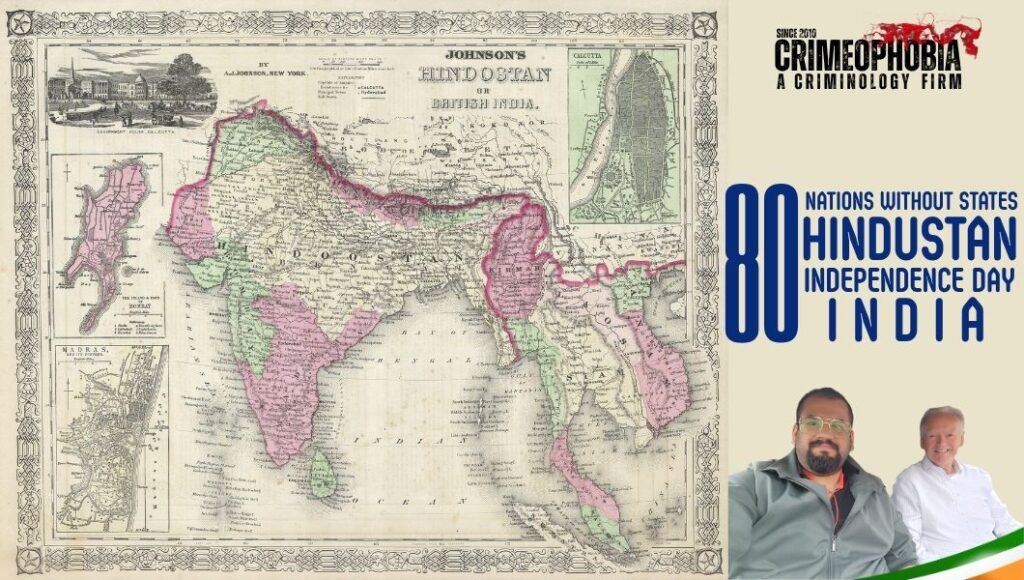
Independence Day 2026: The Criminology of an Unfinished Independence — From Hindustan to a Nation Without a State
Published: 15/08/2026; Author: Crimeophobia Bureau
YouTube Video: https://youtu.be/tzXDADCx9lc
“Crimeophobia’s detailed historical research, supported by documentary evidence concerning the Bombay Cave Temple Commission, has provided the foundation for proposing a Transnational Sanatan Commission. Today, as India celebrates its 80th Independence Day, I propose that the Western world must also understand the historical presence of Hindustan through the conceptual framework of International Relations. The independence settlement of 1947 created Pakistan and India, but the question of Hindustan remains historically unresolved. Through Crimeophobia’s British Board of Advisor, we seek to introduce the West to a nation’s ideology, civilisation and collective identity that exists without a corresponding state or country—and to examine what the British ultimately left behind in which Hindustan for Hindus was never created.” ~ Criminologist Snehil Dhall
Hindustan: Independence Day is traditionally remembered as the day on which India became free from British colonial rule. Yet, from a criminological perspective, 15 August 1947 demands a more fundamental question: what exactly became independent in 1947, and what happened to Hindustan in the political settlement that accompanied Partition? As India celebrates its 80th Independence Day in 2026, Crimeophobia believes independence cannot be understood merely through flags, parades and constitutional ceremonies. It must also be examined through political criminology, genocide studies, forced migration, collective trauma, identity, territoriality, state formation and the criminology of mass violence.
The historical record presents a complicated story. The Indian Independence legislation created two Dominions—India and Pakistan, while British parliamentary debates repeatedly used the terminology of “Hindustan and Pakistan.” British parliamentarians referred to “the Indian States, Pakistan and Hindustan”, while other interventions expressed regret that the original conception of “Hindustan and Pakistan” had not been retained. This does not mean that contemporary international law recognises a sovereign State of Hindustan; it does not. Rather, it demonstrates that Hindustan existed within the political discourse surrounding British decolonisation itself. The question is therefore not invented retrospectively, but arises from the historical record of Britain’s withdrawal.
There is also a distinction between Britain voluntarily giving independence and Britain recognising that its ability to continue governing India was collapsing. On 5 March 1947, Sir Stafford Cripps stated before the House of Commons that it was “quite obviously” impossible for Britain to continue its responsibility indefinitely when it no longer possessed the power to carry it out. British parliamentary debates also contained objections to the idea that Britain had simply “given” India freedom, with one parliamentarian stating that India had “won” its freedom. From a criminological perspective, this reveals the crisis of colonial authority and the circumstances in which power was transferred rather than presenting independence simply as a benevolent British gift.
The most painful reality is that independence came alongside Partition and mass violence. Approximately 15 million people crossed the newly created borders, while widespread violence, particularly in Punjab, accompanied the migration. Families were separated, homes destroyed and communities displaced, with enormous numbers subjected to killings, abductions and sexual violence. Independence was celebrated on 14 and 15 August, while the final Radcliffe boundary decisions were announced only on 17 August. Millions therefore experienced independence without knowing precisely where the new border would run. From a criminological perspective, Partition must be studied as mass victimisation, forced displacement, collective violence and social trauma, rather than merely as constitutional restructuring.
Crimeophobia’s conceptual framework of Post Crime Trauma (PCT) provides another lens through which Partition can be understood. A crime or mass atrocity does not necessarily end when physical violence stops. Fear, displacement, inherited memories, family narratives, demographic transformation, mistrust and intergenerational trauma can continue for generations. Partition produced precisely these conditions. Families carried stories of murdered relatives and lost homes; refugees rebuilt their lives while preserving memories of places to which they could never return; and religious identities became intertwined with memories of victimisation. Understanding historical Hindu victimisation, however, must not become hostility towards Muslims or any other community. Crimeophobia does not advocate collective guilt. A mature criminological approach must distinguish understanding victimisation from legitimising retaliation, while ensuring that historical victimisation is not erased merely because it is politically uncomfortable.
The symbolism of Vande Mataram adds another dimension to this year’s Independence Day. 2026 marks its 150th anniversary, and the song was included for the first time in the Independence Day ceremony at the Red Fort before the national anthem. Its historical association with India’s freedom movement makes its present prominence significant. The question Crimeophobia raises is therefore not simply why a particular song was included, but how nations decide which symbols represent historical memory, which become institutionalised, which remain contested and which are kept outside official narratives. The delayed prominence of Vande Mataram invites a broader examination of how the cultural memory of the independence movement has been constructed over eight decades.
This brings the discussion directly to Hindustan. Crimeophobia’s position is not that international law presently recognises Hindustan as a sovereign state. Rather, Hindustan is proposed for examination as a historical, civilisational and national conception. The British parliamentary record itself used the terminology of Hindustan, and one British parliamentarian expressed regret that a “part of India” had effectively taken the name of the whole. The distinction between a nation and a state is crucial. A state possesses sovereign governmental authority, defined territory and international legal personality, whereas a nation may exist through shared history, culture, civilisation, collective memory and national consciousness without possessing an independent sovereign state. Political science already recognises this through concepts such as “stateless nations” and “nations without states.”
It is within this conceptual space that Crimeophobia Founder and Criminologist Snehil Dhall, through Crimeophobia’s British Board of Advisor, Mr. Graham Williamson who has been two time Councillor in the UK, London, is taking the discussion beyond India’s domestic discourse and into a Western conceptual framework. Crimeophobia has prepared a video featuring Mr. Graham Williamson in which Dhall had introduced to the concept of Hindustan and engages with the relevance of what a “Nation Without a State” actually means. His participation is particularly significant because he brings a British perspective to a question connected directly with Britain’s colonial administration, parliamentary debates over independence and the constitutional process that resulted in Partition. The video therefore represents an intellectual intervention: a British voice is being invited to examine what happened to the concept of Hindustan when Britain departed.
The proposition is deliberately analytical: if the British did not create an independent sovereign State called Hindustan when they withdrew in 1947, does that automatically mean that Hindustan ceased to exist as a national or civilisational conception? Political theory does not require that conclusion. A nation may survive without a state, just as a state may contain multiple national identities. Crimeophobia therefore seeks to introduce Hindustan to the Western conceptualisation of a Nation Without a State, using the language of International Relations to distinguish nationhood from statehood and to invite the Western world to understand Hindustan through an established conceptual framework rather than simply through the contemporary political map.
This research is also connected to Crimeophobia’s documented proposal for a Transnational Sanatan Commission which has been headed by its CSR division named “Ministry of Happiness” a registered Trust under Government of India (Maharashtra). Crimeophobia has conducted detailed historical research, including documentary evidence concerning the Bombay Cave Temple Commission, as part of the historical foundation for proposing this institutional framework. The proposed Commission is not intended as an instrument of persecution, exclusion or territorial violence. Its proposed purpose is to examine civilisational continuity, historical victimisation, cultural preservation, displacement, heritage, transnational identity and the relationship between Sanatan civilisation and the modern nation-state system. The historical geography of Sanatan civilisation does not correspond neatly with contemporary international borders, because civilisations frequently precede states and cultures survive the creation or disappearance of political boundaries.
The criminological relevance is substantial because modern criminology extends beyond conventional individual crime to state crime, political violence, genocide, crimes against humanity, forced displacement, victimology, structural violence, collective violence and the social consequences of mass atrocities. Partition therefore belongs within criminological inquiry, as does the study of what happens when political restructuring creates populations who perceive themselves as historically displaced, culturally threatened or nationally unrecognised. The purpose of criminology is not to manufacture new enemies or justify retaliation; it is to understand the conditions that produce victimisation and prevent the repetition of cycles of violence.
Accordingly, Crimeophobia believes Independence Day should also be a day of historical accountability and intellectual courage. India achieved independence and Pakistan emerged as another independent Dominion, but the historical conception of Hindustan deserves to be examined separately rather than assumed to have disappeared because the political map changed. Millions suffered, communities were displaced, families destroyed and generations inherited the consequences. Eighty years later, independence must therefore be studied alongside Partition, freedom alongside displacement, nationhood alongside statehood and historical victimisation without creating contemporary collective guilt.
The Crimeophobia video featuring Graham Williamson is therefore more than a commemorative Independence Day message. It introduces a British voice to the concept of Hindustan, explains the relevance of the “Nation Without a State” framework and invites Western audiences to consider whether South Asian history can be adequately understood solely through the contemporary map of Indian Sub-Continent also referred as South-East Asia or the original akhand Bharat which was divided but Hindustan was never created. Through the voice of its British Board of Advisor, Crimeophobia seeks to communicate a concept familiar within International Relations but not conventionally applied to Hindustan: what happens to a nation when it possesses civilisation, people, historical consciousness and collective identity, but does not possess a corresponding state or country?
On India’s 80th Independence Day, Crimeophobia therefore proposes that the world examine not only what India became in 1947, but also what was left unresolved. The “Transnational Sanatan Commission” has gained it proposal-level support from the United Nations, President of India and Supreme Court of India, while it is intended to open that conversation through documentation, research, institutional recognition and serious historical inquiry. It is not a call for violence, revenge or persecution. It is a call to examine history. If International Relations recognises the conceptual existence of nations without states elsewhere, then the historical conception of Hindustan should also be capable of scholarly examination. The question is ultimately simple but profound: India became independent, Pakistan became independent—but what happened to Hindustan? Perhaps the answer does not require another border. Perhaps it requires recognising that a nation can exist through civilisation, history, collective memory and national consciousness even when it has never been constituted as a sovereign state.