
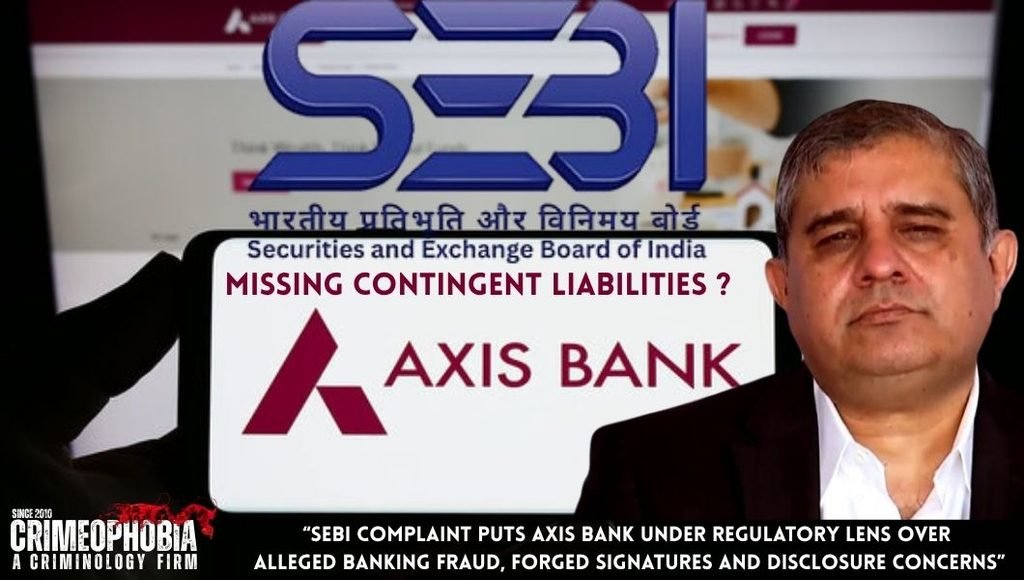
Axis Bank to Face Regulatory Scrutiny Over Crimeophobia’s SEBI Complaint Alleging Banking Fraud, Forged Signatures, Concealed Contingent Liabilities
Published 30/08/2026; Author: Finance & Law Crimeophobia Desk
“A decade ago, Axis Bank refused to support the financial fraud allegedly committed by its top-management & branch employees, due to which the Crimeophobia Team acknowledged and respected their rights; however, the Bank now uses its empanelled law firm to protect those accused in the alleged financial fraud, which brings Crimeophobia back to the case upon being re-engaged by its clients, comprising three generations of alleged victims. Crimeophobia highlights the contingent liabilities before SEBI, which Axis Bank Limited should have disclosed, particularly for protecting its top-management employees accused in the FIR, and seeks an independent investigation into the alleged misconduct of top Axis Bank officials; the complaint alleges 50+ disputed & forged signatures, manipulation of multiple sanction and link agreement documents, post-NPA transactions, and Bank-funded legal defence of accused employees, despite the Bank having previously refused to support their alleged crimes.” ~ Criminologist Snehil Dhall
Mumbai: A formal complaint has been placed before the Securities and Exchange Board of India (SEBI) against Axis Bank Limited, seeking an independent regulatory and forensic examination into allegations of banking fraud allegedly committed through the Bank’s own officials and systems. The complaint, submitted by Crimeophobia – A Criminology Firm, raises questions extending beyond the underlying criminal proceedings to corporate governance, internal controls, legal expenditure, contingent liabilities, securities-market disclosures and protection of shareholders. The matter has now been taken up by Crimeophobia’s Finance & Law Division in view of the exceptional technicalities, extensive documentary inconsistencies and the specialised financial, forensic and legal scrutiny required to properly examine the transaction.
Crimeophobia’s clients span three generations, who, according to the allegations and documentary material under examination, are presently at the verge of becoming homeless as a consequence of an alleged banking fraud by bankers, wherein almost every material document connected with the loan transaction is alleged to have been manipulated, forged, incorrectly processed or otherwise compromised. The alleged manipulation has now culminated in a situation where the family faces the prospect of auction of the secured property, notwithstanding that the Hon’ble Bombay High Court has granted a “Stay” in the proceedings. While such judicial protection is crucial, a stay is, by its very nature, a temporary protective measure and not a final adjudication of the underlying dispute. The Finance & Law Division has therefore undertaken an expert examination of the entire transaction, including the loan-sanctioning process, signatures and documentation, collateral and mortgage records, NPA classification, subsequent banking actions, criminal proceedings and the regulatory implications arising therefrom, so that the underlying documentary and financial trail may be independently scrutinised rather than allowing the immediate threat of auction to obscure the larger questions concerning the alleged banking fraud.
The complaint was addressed to SEBI with copies to the Reserve Bank of India, Axis Bank’s headquarters, its empanelled law firm and the State of Maharashtra through Juhu Police Station. It describes the matter as an alleged case of “banking fraud by bankers”, rather than an ordinary borrower-bank dispute. Axis Bank is a listed entity on both the National Stock Exchange and BSE, with the NSE symbol AXISBANK and BSE scrip code 532215, making the alleged litigation and financial exposure potentially relevant to investors and the securities market. According to the complaint, the underlying dispute concerns a property-linked financial transaction in which more than 50 signatures are alleged to have been forged or disputed across link agreements, sanction letters and other banking documents.
The complaint alleges that the documentation was generated, processed or maintained within the banking system and raises the fundamental question of how multiple documents carrying disputed signatures could enter official Bank records without being detected by internal verification mechanisms. The complaint further states that the allegations extend across eleven sanction letters and four link agreements, making the matter substantially broader than a dispute concerning one isolated signature. Crimeophobia has asked SEBI to examine the original documents, signature-verification records, document-management audit trails, sanction records, collateral records, valuation documents and internal approvals to establish who prepared, received, verified, approved and subsequently relied upon the documents.
A significant distinction between the alleged 50+ signatures and the criminal case
A central issue raised by the complainant is the apparent gap between the scale of the alleged documentary irregularities and the scope of the criminal proceedings presently on record. According to the allegations placed before SEBI, while the wider banking record is said to contain 50+ disputed or allegedly forged signatures, the FIR and subsequent criminal proceedings presently concern only a substantially smaller number of alleged forged signatures, described by the complainant as 7+ documents having multiple forged signatures involving senior management-linked banking officials.
The complaint argues that the criminal proceedings before Juhu Police Station and the Andheri CMM Court have not technically or finally reconciled all the documentary contradictions. It specifically identifies the successive sanction documents, four link agreements, disputed signatures, collateral records, NPA dates, NOCs and the precise responsibility of each banking official as matters requiring independent examination. The complaint stresses that pendency of criminal proceedings does not prevent SEBI from examining separate questions concerning governance, internal controls, disclosure and investor protection. The distinction is significant because a criminal investigation may proceed on particular offences and accused persons, whereas a securities regulator can examine whether a listed institution properly identified and disclosed material litigation, financial exposure, governance risks and other information relevant to shareholders.
Axis Bank’s earlier written position under scrutiny
One of the most significant pieces of evidence highlighted by Crimeophobia is an earlier written communication from Axis Bank. According to the complaint, the Bank expressly stated that it could not be deemed to have knowledge of any mala fide intention or fraud committed by its officials and that the Bank could not be made liable for such conduct. The complaint says this was a written communication, subsequently reproduced in a Written Reply-cum-Affidavit filed before the Bombay High Court. The complaint now asks SEBI to reconcile that position with subsequent events.
It alleges that persons accused in the criminal proceedings have been represented through a law firm empanelled with Axis Bank and that the Bank may have borne or facilitated legal expenses for accused employees or former employees. The complaint specifically requests examination of who authorised such expenditure, how much was spent, whether the persons remained employees when the expenses were incurred and whether the Bank continued supporting their defence after their employment ended. The complaint does not ask SEBI to treat the allegation of “blackmail” appearing in the underlying material as established fact. Instead, it asks the regulator to independently determine whether any accused persons actually received Bank-funded legal representation and, if so, the legal and corporate basis for that expenditure.
The 2016–17 paper trail
Another major issue is the chronology. According to the complaint, concerns regarding the transaction were raised with Axis Bank as early as 2016, while the FIR was subsequently registered in 2020 following investigation. Crimeophobia argues that this chronology requires examination of what the Bank knew before the FIR, which officers were informed, whether an internal investigation was conducted, whether employees were disciplined or removed and whether the same individuals continued handling banking transactions. The complaint also refers to correspondence exchanged with Axis Bank on 27 December 2016 and 27 March 2017. It specifically relies upon the Bank’s counter-reply dated 27 March 2017, including its stated position that it was not responsible for actions carried out by its staff. Crimeophobia argues that this contemporaneous communication should be examined alongside the subsequent criminal proceedings and alleged Bank-funded representation.
Collateral, valuation and mortgage questions
The complaint goes beyond signatures and alleges several deficiencies in the creation and verification of collateral. Among the issues placed before SEBI are disputed collateral descriptions, questions concerning physical verification, valuation deficiencies, disputed mortgage and guarantee documentation and an alleged absence of contemporaneous lien records. The complaint points to a chronology involving an Axis Bank sanction dated 16 October 2015, an IDBI NOC dated 21 October 2015 and subsequent collateral documentation. It asks how security could have been treated as sufficiently verified for sanctioning if relevant NOC and transfer documentation were obtained only subsequently. It also alleges that the Bank’s documentation concerning collateral was inconsistent with the physical configuration and ownership of properties and asks SEBI to examine original valuation reports, title documents, site-inspection records, photographs, society records, mortgage documents and internal verification records.
A second regulatory flashpoint: NPA classification
The complaint also challenges the Bank’s treatment of the loan account as a Non-Performing Asset. According to the material submitted, Axis Bank’s contemporaneous records evidence an NPA classification on 28 October 2016, while 21 December 2017 was subsequently relied upon as a fresh NPA date. Crimeophobia alleges that credit enhancements or restructuring were undertaken after the original NPA classification and raises the possibility of prohibited “evergreening”. It argues that the later NPA date requires reconciliation with the Bank’s own earlier records and the applicable RBI prudential framework. The complaint separately alleges that the subsequent Section 13(2) SARFAESI demand notice is procedurally defective because of the disputed NPA chronology and further raises issues concerning unilateral post-NPA enhancement of exposure and the alleged discharge of third-party mortgagor/surety liability under Section 133 of the Indian Contract Act.
Why SEBI has been approached
Crimeophobia’s complaint maintains that the matter cannot be resolved solely by waiting for the criminal court to determine individual criminal liability. Its stated concern is whether the underlying documentary record reveals a broader failure of banking controls and whether the resulting litigation, legal expenditure and potential exposure were appropriately reflected in Axis Bank’s financial and securities-market disclosures. The complaint specifically asks SEBI to examine annual reports, notes to accounts, contingent-liability disclosures, material-event disclosures, Board and Audit Committee records, legal invoices and internal litigation databases. It asks whether shareholders were given a complete picture of legal expenditure and potential exposure arising from criminal proceedings involving current or former employees.
Axis Bank has now responded
The latest development is that Axis Bank has responded to the notice/complaint, following the matter being brought to the attention of its senior leadership, including its Managing Director and Chief Executive Officer. The response now forms an important part of the developing record because the regulator’s central question is not simply whether the Bank denies responsibility, but whether its present explanation can be reconciled with its earlier written position, the disputed banking documents, the criminal proceedings and the allegations concerning representation of accused personnel. However, the specific Axis Bank response document is not contained in the materials supplied for preparation of this article.
Accordingly, its substantive contents, denials or explanations have not been attributed here beyond the fact of the response stated in the instructions for this article. Any publication of the Bank’s precise defence should reproduce its actual position from the response rather than speculate about it. The complaint itself makes clear that it does not ask SEBI to presume guilt. Instead, it seeks preservation and forensic examination of the primary records. It asks for the complete original record relating to the eleven sanction letters and four link agreements, disputed signatures, NOCs, lien records, NPA documentation, internal communications and legal expenditure, followed by reconciliation against Axis Bank’s regulatory and financial disclosures.
The matter therefore now presents a broader regulatory question: whether the alleged conduct represents isolated employee misconduct or exposes deficiencies in the internal controls, governance, documentation, litigation management and disclosure framework of a listed banking institution. Crimeophobia has requested an independent investigation and has expressly stated that, if Axis Bank’s position is correct, its own records should establish that the banking processes, collateral creation, NPA classification, employee representation and securities-market disclosures were lawful and properly authorised.
Conversely, if the primary records reveal material discrepancies that were known, ignored, retrospectively regularised or inadequately disclosed, the complaint seeks appropriate regulatory and investigative action. At stake, therefore, is not merely an individual banking dispute. The allegations raise questions about banking integrity, corporate accountability, investor protection, shareholder-funded legal expenditure and the transparency expected from a listed financial institution. The final determination of the allegations remains with the competent investigative, judicial and regulatory authorities.