
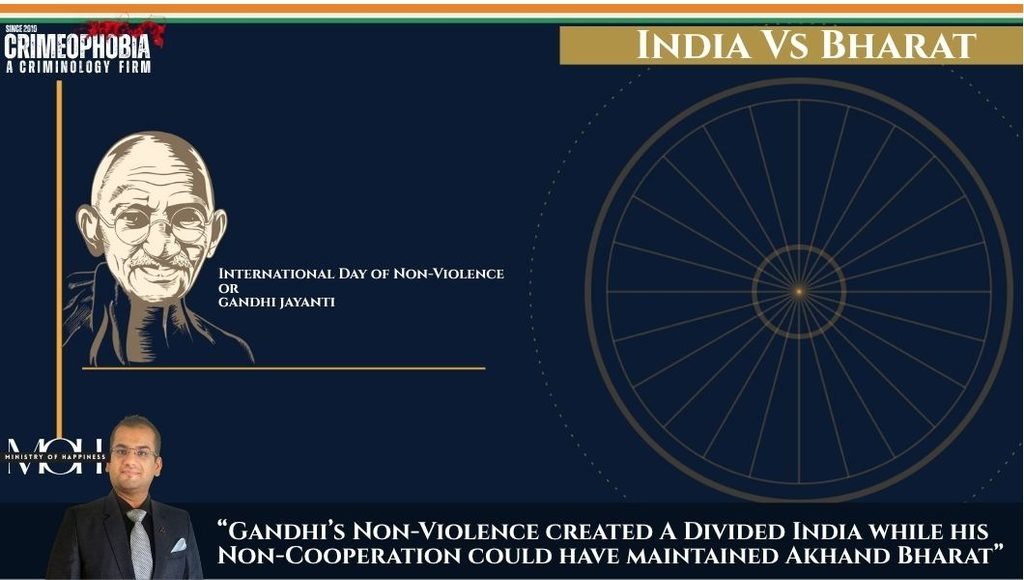
India vs Bharat: Non-Violence created Divided India while Non-Cooperation could have maintained Akhand Bharat
Published: 02/10/2026; Author: International Desk
“India vs Bharat: Non-Violence created Divided India while Non-Cooperation could have maintained Akhand Bharat, and on Gandhi Jayanti we must ask whether organised refusal, not mere restraint, might have changed Partition’s course. Non-violence can carry a firm ‘No’ without hatred, and our response to heritage loss need not be a weapon; it can be an archive, a commission, a court. Let records speak and law decide, so that Bharat is protected through the Transnational Sanatan Commission (Formerly Bombay Cave Temple Commission) without abandoning India.” ~ Criminologist Snehil Dhall
Bharat: The most intriguing contradiction in Gandhi’s political philosophy emerges when his two greatest instruments—non-violence and non-cooperation—are placed beside the question of Partition, Pakistan and the civilisational identity of Bharat. The world today remembers Gandhi primarily as the apostle of non-violence, and the United Nations formally observes 2 October as the International Day of Non-Violence. Yet the United Nations itself identifies non-cooperation as one of the principal categories of non-violent action, alongside protest and persuasion and non-violent intervention. In other words, the international system that celebrates Gandhi’s non-violence also recognises the very instrument that Gandhi used to make non-violence politically consequential: the withdrawal of cooperation.
This creates an extraordinary historical word-play. Gandhi’s non-violence asked India not to answer violence with violence; Gandhi’s non-cooperation asked India not to answer injustice with cooperation. The first controlled the method of resistance; the second controlled the relationship with the system being resisted. Gandhi’s political genius was that he understood that a ruler could survive an angry population, but could struggle to survive a population that systematically withdrew its cooperation. The British Empire was therefore confronted not merely by protest but by boycott, civil disobedience, Swadeshi, institutional withdrawal and mass refusal.
The unresolved question is what might have happened if the same principle of non-cooperation had been applied more consistently to the political demands that ultimately produced Partition. This is not an assertion that Gandhi alone created Pakistan, because the historical record does not support such a conclusion. Partition emerged from a complex interaction between the British Government, the Congress, the Muslim League and other political forces. Gandhi himself opposed Partition. The question is instead a counterfactual one: could the politics of non-cooperation have produced a different political negotiation if the demand for a separate religiously defined state had been met not merely through non-violence, but through a structured refusal to cooperate with the political consequences of communal separation?
That question becomes even more provocative because Gandhi’s own final political interventions demonstrate that he did not regard non-cooperation as an instrument to be used selectively only against the British. He believed that cooperation itself carried moral consequences. His philosophy therefore contained the possibility of saying: we shall not hate you, we shall not attack you, but neither shall we cooperate with what we consider unjust. That distinction is at the heart of the present civilisational debate.
The tragedy is that the vocabulary of Gandhi’s non-violence became universal while the harder vocabulary of his non-cooperation was progressively softened. Non-violence became associated with peace; non-cooperation became associated with protest. But Gandhi’s original formulation was more strategically powerful. Non-cooperation was not simply protest. It was organised refusal.
That is why the question of Pakistan cannot be examined merely through the lens of military conflict. The deeper question is whether the post-Partition Indian state developed sufficient institutional mechanisms for non-cooperation without hatred, deterrence without annihilation and refusal without violence. Modern India has gradually developed precisely such instruments: diplomatic restrictions, trade restrictions, visa measures, suspension of bilateral mechanisms, international diplomatic mobilisation and, when required, calibrated military responses. These are not automatically Gandhian instruments, but conceptually they demonstrate what Gandhi understood decades earlier—that cooperation is itself a source of power.
The contemporary relationship between India and Pakistan makes this contradiction particularly visible. India has, at different moments, combined military deterrence with diplomatic pressure and non-cooperation. The important point is not to characterise every government decision as “Gandhian”, but to recognise the conceptual evolution: India can refuse cooperation without declaring war upon an entire population; it can exercise force without making unrestricted violence the objective; and it can maintain international engagement while selectively withdrawing cooperation from a particular state or institution.
The same analytical discipline becomes necessary when discussing Islam, Muslims and conversion. It would be historically and sociologically inaccurate to describe more than a billion Muslims as a single political entity or to suggest that Muslims collectively pursue conversion of non-Muslims. Muslims across the world live under different constitutional systems, practise different traditions and hold widely differing political views. There are also Muslim-majority countries with serious internal political, sectarian and geopolitical conflicts, just as there are Muslim communities living peacefully alongside people of other faiths in non-Muslim-majority societies.
The more precise contradiction concerns religious propagation versus political conversionism. A person peacefully explaining, practising or propagating a religion is not committing a crime merely because the religion is Islam, Christianity, Hinduism or another faith. Similarly, a person voluntarily changing religion is exercising a different phenomenon from coercive conversion, trafficking, fraud, intimidation or conversion obtained through unlawful inducement. The criminal law must concern itself with the latter where evidence establishes an offence, rather than treating peaceful religious activity itself as criminal.
Indeed, Gandhi’s own writings make this distinction particularly interesting. His approach to religion was not based upon the proposition that one faith should conquer another. Scholarship examining Gandhi’s writings on religion and conversion records his belief that a person wishing to convert others should first attempt to become a better follower of his or her own faith rather than make conversion the principal objective. He also emphasised respect for other religions while retaining reverence for his own.
This creates another Gandhian paradox. The man who opposed violent conversion also opposed religious hatred; the man who defended religious coexistence also believed deeply in his own Hindu civilisational inheritance. Gandhi did not understand pluralism as requiring a person to become indifferent to his own tradition. His Constructive Programme placed communal unity alongside village development, education, removal of untouchability, economic equality and other forms of social reconstruction.
The civilisational question raised by Criminologist Snehil Dhall therefore enters the discussion at a different level. Dhall’s initiative for a proposed Transnational Sanatan Commission is presented not as a violent response to another religion, but as an institutional and documentary response to what he describes as an unfinished question of Sanatan heritage protection. The initiative seeks to revive, in a modern transnational form, the historical question surrounding the Bombay Cave Temple Commission, using archival evidence and institutional mechanisms rather than physical confrontation.
This distinction is fundamental. If the problem is believed to be historical dispossession, loss of heritage, destruction of religious infrastructure, transnational trafficking of antiquities or inadequate protection of civilisational sites, the response need not be violence. It can be documentation, litigation, archaeology, diplomacy, institutional reconstruction, international cooperation and non-cooperation with systems that fail to protect heritage. In that sense, Dhall’s proposed Transnational Sanatan Commission can itself be understood as a distinctly non-violent form of civilisational resistance.
The word-play becomes almost Gandhian in its construction: Gandhi used non-cooperation to fight an empire; Dhall proposes institutional cooperation to protect a civilisation, while retaining non-cooperation as the peaceful response to institutions that refuse to protect it. Gandhi fought through refusal. Dhall’s proposed mechanism seeks to fight through records. Gandhi mobilised people. Dhall seeks to mobilise archives, institutions and international heritage mechanisms. Gandhi’s battlefield was the colonial political system. The proposed Transnational Sanatan Commission’s battlefield is documentation, heritage law, institutional accountability and international cooperation.
Dhall’s published account states that his initiative is anchored in British-era archival material concerning the historic Bombay Cave Temple Commission and that he has pursued the matter through constitutional and institutional channels. His account of the Supreme Court proceedings states that the proposed Transnational Sanatan Commission remains an initiative to be pursued before competent executive, administrative and international authorities after the Court found the issues not judiciable at that stage while preserving liberty to pursue the matter, while the Hon’ble President of India and the United Nations have accepted the proposal wants the Government of India and/or Home Ministry to endorse and implement the same. This should properly be described as Dhall’s account of the initiative and proceedings rather than as a declaration that such a commission has already been established.
The significance of Dhall’s recent archival work in the United Kingdom therefore lies in its methodology. If the historical Bombay Cave Temple Commission existed, what was its mandate? What records describe its creation? What happened to its institutional functions? What happened to the heritage that it was created to examine? And can historical records provide a lawful foundation for a contemporary transnational heritage institution? These are questions that documents can answer more reliably than political rhetoric.
This is where the distinction between India and Bharat becomes more than a question of nomenclature. Constitutionally, there are not two countries. India is the modern Republic’s international name; Bharat carries the deeper civilisational vocabulary of the subcontinent. The constitutional genius was not to force a choice between them but to place them together.
The real question, therefore, is whether modern India can preserve the civilisational inheritance represented by Bharat without abandoning constitutional equality. The answer cannot be the collective targeting of another religion. Nor can the answer be the denial of historical identity. The answer must lie in institutions capable of distinguishing between faith and extremism, conversion and coercion, citizenship and political ideology, religious propagation and criminal conduct, heritage protection and religious hostility.
This is precisely why the Transnational Sanatan Commission proposal can be framed as a non-violent continuation of the question Gandhi left unresolved. Gandhi demonstrated that a civilisation could resist an empire without physically destroying its people. Dhall’s initiative proposes that a civilisation can seek restoration and protection of its heritage without physically confronting the people of another faith. The difference is that Gandhi’s non-cooperation was principally political, whereas Dhall’s proposed commission is principally institutional, historical and heritage-oriented.
There is another contradiction worth preserving. Gandhi’s non-violence was universal enough to inspire the United Nations, but his non-cooperation was sufficiently particular to identify the institution from which cooperation should be withdrawn. The modern world frequently wants the first without the second. It wants peace without asking what cooperation sustains conflict. It wants dialogue without asking what behaviour makes dialogue meaningful. It wants non-violence without always recognising that non-violence can include a very firm “No.”
That “No” is the missing vocabulary in much of the modern debate.
A non-violent civilisation can say no to terrorism.
It can say no to coercion.
It can say no to the destruction of heritage.
It can say no to illegal trafficking of antiquities.
It can say no to institutional indifference.
It can say no to political violence.
And it can say no to the proposition that protecting one civilisation requires hating another.
That is where Gandhi’s two ideologies meet.
Non-violence says: I will not destroy you.
Non-cooperation says: I will not help you destroy what I believe must be protected.
Bharat says: I will remember what I am.
India says: I will protect it through the constitutional Republic.
And the proposed Transnational Sanatan Commission says, in Dhall’s formulation: if history has left a civilisational institution unfinished, the answer need not be a weapon—it can be an archive, a commission, a court, a diplomatic table and an international framework.
The irony is therefore almost complete. Gandhi’s greatest international legacy became non-violence. His less celebrated strategic legacy was non-cooperation. The United Nations celebrates the first while formally recognising the second. Modern India increasingly demonstrates both through a combination of restraint, deterrence and selective disengagement. And Criminologist Snehil Dhall’s proposed Transnational Sanatan Commission attempts to apply the same broad principle to civilisational heritage: fight the problem without fighting the people.
Perhaps that is the most important distinction between violence and resistance.
Violence attacks the person.
Non-violence confronts the problem.
Non-cooperation withdraws support from the problem.
And civilisational preservation documents the problem so that history itself becomes evidence.
That is the Gandhian contradiction that makes the India-versus-Bharat debate far more interesting than a mere argument over two names. The Constitution has already declared them one: India, that is Bharat. The unresolved question is whether the Republic can preserve the memory, heritage and civilisational continuity of Bharat through the very non-violent institutional methods that Gandhi taught the world to recognise as instruments of political power.
On Gandhi Jayanti, the question is therefore not whether India should abandon non-violence.
It is whether India should finally rediscover the other half of Gandhi’s formula:
Non-violence without surrender. Non-cooperation without hatred. Resistance without revenge. Heritage without hostility. And Bharat without abandoning India.