
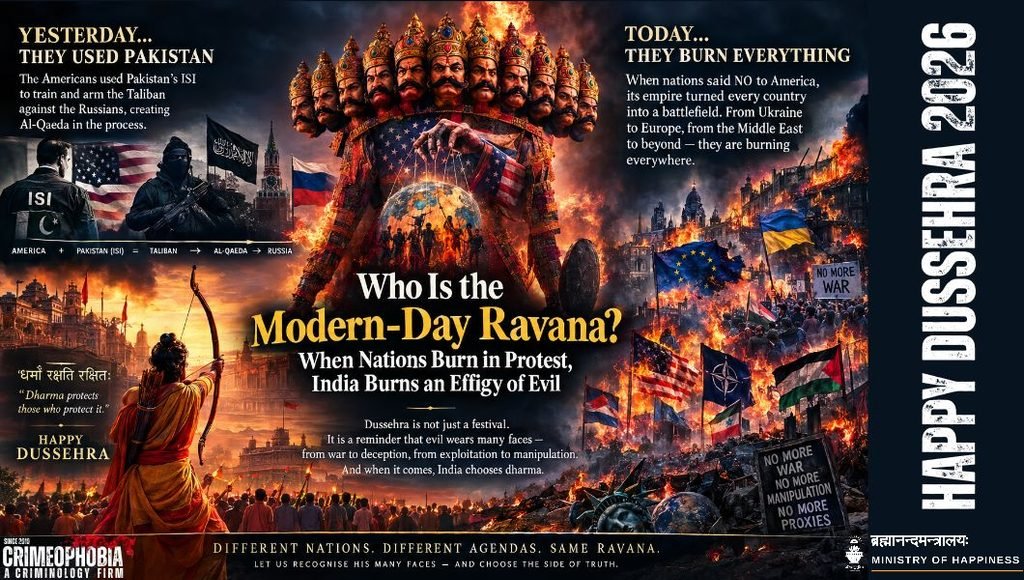
How will India burn today? Who Is the Modern-Day Ravana? When Globally Nations Burn in Protest, India Burns an Effigy of Evil: Happy Dussehra
Published: 20/10/2026; Author: Crimeophobia’s International Desk
“Ravana’s ten heads remind us that power can wear many faces. From Cold War proxy conflicts to contemporary geopolitical rivalries, the world must examine strategic interests beyond public declarations. As nations confront unrest and uncertainty, Dussehra offers India a distinct civilisational message: burning Ravana’s effigy symbolises the rejection of evil, not the destruction of nations. The challenge is to recognise deception, demand accountability, and uphold dharma through discernment, courage and evidence. An Opinion Article on Sanatani Civilisation, Strategic Deception, Global Unrest and the Meaning of Dussehra” — Criminologist Snehil Dhall
Bureau: India and the Sanatani Hindu civilisation possess a distinctive way of interpreting power, character and the consequences of human ambition. In our civilisational imagination, Ravana is not merely a villain with a single identity; he is Dashanan, the ten-headed king of Lanka, whose multiple heads offer a powerful metaphor for the many dimensions of an individual, an institution or a geopolitical power. The Indian tradition does not necessarily judge a person, an ideology or a nation by its most visible face alone; it asks us to examine the different faces that may emerge when circumstances, interests and ambitions change. Ravana’s ten heads, interpreted in different traditions as representations of knowledge, capability, desire, anger, greed, pride and other human attributes, remind us that intelligence without restraint, power without righteousness and ambition without moral discipline can ultimately become instruments of destruction.
This understanding of multiple dimensions is also reflected in the martial traditions of the Indian subcontinent, particularly the celebrated Sikh maxim associated with Guru Gobind Singh Ji: “Sava lakh se ek ladaun, tabhi Gobind Singh naam kahaun”—“When I make one fight a lakh and a quarter, only then shall I be called Gobind Singh.” The verse expresses extraordinary courage, spiritual conviction and the ability of disciplined determination to confront overwhelming numerical superiority. Sikhism has its distinct religious identity, while sharing deep historical and cultural connections with the wider civilisational landscape of India; the maxim, therefore, stands as a powerful expression of courage and resistance that can be appreciated across communities without diminishing that distinct identity. Its contemporary significance lies not in celebrating violence for its own sake, but in demonstrating that strength cannot be measured by numbers alone, and that strategy, conviction, discipline and the willingness to withstand adversity can alter the balance between apparently unequal opponents.
The same principle of examining multiple faces becomes indispensable when interpreting international politics. The history of the Cold War demonstrates how geopolitical powers have supported particular forces, governments and armed movements when their immediate interests demanded it, only to confront different strategic consequences when those relationships changed. During the Soviet-Afghan War, the United States covertly financed and armed Afghan mujahideen factions through Pakistan, while Pakistan’s Inter-Services Intelligence Directorate helped train rebel groups and distribute weapons. The historical record, however, requires an important distinction: the support provided to Afghan resistance factions does not establish that the United States directly created, controlled or trained Osama bin Laden or the organisation that later became al-Qaeda. The relationship between the Afghan jihad, foreign sponsorship, Pakistan’s intelligence apparatus and the subsequent emergence of transnational terrorism is more complicated than a single chain of command. Nevertheless, the episode illustrates a serious strategic lesson: the short-term use of armed proxies can generate long-term security consequences that extend far beyond the original battlefield.
The subsequent wars in Afghanistan and Iraq, conducted under the wider framework of the American-led War on Terror, intensified the debate about whether military intervention can eradicate extremism or merely transform its geography, leadership and methods. The attacks of 11 September 2001 were attributed to al-Qaeda, and the investigation documented in the 9/11 Commission Report identified the organisation’s responsibility while examining the failures of intelligence, security and international cooperation that preceded the attacks. There is no established evidentiary basis for the claim that the United States orchestrated 9/11 because of a betrayal of bin Laden after the anti-Soviet campaign but it is claimed to be true in principle and hidden files. The more defensible criticism is that the geopolitical environment of the 1980s, including external support for armed resistance and the subsequent failure to contain emerging extremist networks, helped create conditions whose consequences were not adequately anticipated. The distinction matters because a serious examination of state responsibility must rest on documentary evidence rather than replacing one unverified narrative with another.
The contemporary strategic landscape raises a related question: have the methods of international competition changed as the limitations of direct military intervention have become more apparent? Russia’s war against Ukraine, Western military and financial support for Kyiv, continuing international sanctions against Moscow, and the complex competition surrounding energy supplies illustrate how military confrontation and economic interdependence can coexist. The United States and Russia have at times maintained diplomatic contacts and explored areas of mutual interest despite their profound disagreements; this does not, by itself, establish that Russia has become an American business partner in a coordinated strategic arrangement. Similarly, Iran’s resistance to American pressure, Russia’s continued military capacity and the economic importance of energy markets demonstrate that military superiority does not automatically translate into unrestricted political control. The central question is whether the international system is moving towards a more complicated contest in which sanctions, energy diplomacy, information operations, financial pressure, alliances and domestic political instability can matter as much as conventional military force.
This is where the metaphor of the modern-day Ravana becomes relevant. If a state publicly declares its commitment to democracy, peace and the international rule of law while simultaneously pursuing policies that critics consider destabilising, should its actions be judged only by its stated intentions, or should the international community examine all the consequences of its conduct? The question applies to every major power, not exclusively to the United States. Russia, China, European governments, regional powers and emerging coalitions must all be examined through the same evidentiary standard. A nation may present one face to its allies, another to its adversaries, a third to international institutions and yet another to its domestic population. The existence of these competing interests is not proof of a secret conspiracy; it is precisely why independent verification, transparent institutions and rigorous scrutiny are necessary.
The question becomes even more consequential when public protest turns into violent disorder. Demonstrations may begin with legitimate grievances involving inflation, unemployment, housing, immigration, public services, political representation or government accountability. Yet peaceful mobilisation and organised violence are not interchangeable phenomena. Where protests escalate into arson, looting, assaults or the destruction of public infrastructure, investigators must determine whether the escalation arose from spontaneous anger, organised criminal activity, political mobilisation, online incitement, foreign influence or some combination of these factors. The answer cannot responsibly be assumed in advance. Foreign interference is a genuine subject for security investigations, but claims that a particular government engineered unrest require corroborating evidence, including financial records, communications, operational links and independently verified investigative findings.
Reports of violent demonstrations and unrest across parts of Europe in October 2026 have renewed concerns about public order, economic insecurity and the vulnerability of political institutions to polarisation. International media coverage has described disturbances involving clashes with police, arrests, looting and damage to property, while also reporting the economic and public-service grievances underlying some demonstrations. These events warrant serious investigation; however, the existence of unrest in multiple countries does not establish that the United States, NATO, Russia or any other single power directed it. Nor does disagreement within an alliance automatically mean that its members have abandoned one another. Such conclusions require country-specific evidence rather than the construction of a single geopolitical narrative from unrelated incidents. The essential question for any democracy is whether its institutions can distinguish legitimate dissent from criminal violence without suppressing lawful expression or allowing disorder to become a substitute for political accountability.
The evolution of violent extremism also requires careful scrutiny. Terrorist organisations, criminal networks and exploitative individuals can adapt their methods when earlier tactics lose effectiveness or attract greater resistance. Sexual exploitation, coercive relationships, grooming, trafficking and organised sexual abuse must be investigated wherever evidence supports such allegations, regardless of the identity, religion or nationality of the perpetrators. The expressions love jihad and grooming gangs are used in different political and social contexts, but they are not interchangeable legal findings, and the existence of a criminal offence must be established through evidence in the individual case. It would be irresponsible to presume that every interfaith relationship represents organised coercion or that all sexual-abuse networks are directed by a foreign government. At the same time, it would be equally irresponsible for authorities to disregard credible evidence of systematic exploitation merely because the subject is politically sensitive. The appropriate response is evidence-led criminology, victim protection, professional investigation and equal application of the law.
A similar distinction must be maintained when discussing the international visibility of the Palestinian cause. Palestinian flags, pro-Palestinian demonstrations and related political campaigns have appeared in numerous countries, reflecting a range of views concerning Palestinian statehood, civilian suffering, the conduct of the war in Gaza, Israeli policy and the wider Middle East. These activities cannot, simply by virtue of their international reach, be characterised as a unified operation directed by the United States or any other government. American policy itself has included support for Israel alongside diplomatic efforts, humanitarian initiatives and disagreements with Israeli governments over particular decisions. The international political environment is therefore more complex than a straightforward transfer from one proxy conflict to another. The more important question is whether governments, political movements and media organisations apply consistent standards to civilian protection, political violence, religious freedom and the sovereignty of nations.
India’s own experience deserves consideration within this wider discussion. Indian society contains profound religious, linguistic, regional and political diversity, and public demonstrations are an established feature of democratic life. Where a protest fails to attract sustained public support, or where an attempt to mobilise people around a particular cause does not produce its intended political outcome, the result should be understood through evidence concerning public participation, organisation and public opinion rather than automatically attributed to foreign interference. Equally, the actions of Indians living overseas can become significant when they respond to international portrayals of their homeland. Diaspora communities have the right to participate in peaceful demonstrations, challenge representations they consider inaccurate and express their attachment to Indian history and civilisation.
In this context, accounts of Indians and people of South Asian heritage assembling overseas, expressing support for India and concluding an event with the Indian National Anthem provide a reminder that national identity can become a point of unity even among people whose political or religious backgrounds differ. The idea of Akhand Bharat, as invoked by some cultural and civilisational movements, represents a particular historical and ideological vision of the interconnectedness of the Indian subcontinent before its modern political divisions. Its meaning is contested, and it should not be confused with the present-day sovereign borders or political positions of India, Pakistan, Bangladesh and neighbouring states. Nevertheless, the historical memory of a shared subcontinental past remains an influential element of cultural discourse. Where people from different backgrounds choose to stand together peacefully, their participation can demonstrate the possibilities of dialogue and cultural affinity without requiring uniformity of belief or agreement on territorial questions.
For Sanatani Hindus, the annual observance of Dussehra provides a particularly powerful framework for reflecting upon these contradictions. Known also as Vijayadashami, the festival falls on the tenth day of the bright fortnight of Ashvin, generally in September or October, following the nine days of Navratri. In the widely celebrated Ramayana tradition, it commemorates Lord Rama’s victory over Ravana and the rescue of Sita, affirming the triumph of dharma over adharma. In other regional traditions, the day is associated with the victory of Goddess Durga over Mahishasura, and its observance takes different forms across India. The festival is therefore not confined to one story or one ritual; it embodies a broader civilisational understanding that injustice, arrogance and destructive power must ultimately be confronted by righteousness, courage and moral discipline.
Ravana’s ten heads are especially significant in a world where power rarely operates through a single instrument. In popular interpretations, they may represent ten human weaknesses; in other readings, they evoke extraordinary learning, capability and intellectual range. The deeper lesson is that the possession of knowledge, wealth, military strength or political influence does not necessarily confer moral legitimacy. Ravana is remembered not simply because he possessed formidable capabilities, but because those capabilities could not protect him from the consequences of arrogance and wrongdoing. His story warns against the assumption that intelligence makes a person infallible, that military strength guarantees victory, or that an institution can escape accountability merely because it possesses the power to shape the narrative surrounding its conduct.
The burning of Ravana’s effigy on Dussehra is, accordingly, a religious and cultural act of symbolic rejection. Communities gather, participate in Ramlila performances, recall the events of the Ramayana and witness the destruction of an effigy representing the defeat of evil. In Maharashtra, the observance can also include the worship of weapons and tools, the traditional crossing of boundaries known as Simollanghan, and the exchange of Apta leaves as symbolic gold. These practices connect the festival to courage, prosperity, renewal and the responsible exercise of power. The burning is not intended to signify the destruction of a real population, a religious community or a sovereign nation; it expresses a moral choice to reject the conduct represented by Ravana. The distinction between symbolic destruction and actual destruction is fundamental to understanding the festival.
This distinction becomes particularly striking when contrasted with societies experiencing violent unrest. India’s Dussehra celebrations may include the deliberate burning of a constructed effigy in a designated public ritual, while elsewhere buildings, vehicles, shops and public facilities may be set alight during disorder. The two forms of fire are not equivalent. One is a ritual governed by cultural meaning and public arrangements; the other may be the consequence of criminal violence, social breakdown or confrontations requiring investigation. To suggest that India is literally burning its own society because an effigy is set alight would be to confuse symbolism with events on the ground. Likewise, describing every demonstration abroad as the product of foreign manipulation would erase the genuine grievances and domestic political circumstances that may have produced it.
The same care is required when discussing reports that Christmas celebrations have been cancelled or restricted in particular places because of security concerns, protests or public-order difficulties. Such claims must be verified individually, including the location, responsible authority and stated reason for any cancellation. A local restriction or event cancellation cannot establish that Christmas has been cancelled across an entire country, just as a disturbance in one Indian city cannot represent the experience of the whole Indian nation. The integrity of public debate depends upon distinguishing verified events from dramatic generalisations, particularly when religion and national identity are involved.
For international media organisations, Dussehra therefore offers an opportunity to report on India without reducing its religious practices to sensational imagery. The burning of Ravana’s effigy is not evidence of a nation in revolt against itself; it is a long-established expression of a religious narrative about the defeat of wrongdoing. It should be covered with the same cultural context that responsible reporting would provide when explaining the symbolism of a national memorial, a religious procession or a public ceremony elsewhere in the world. A photograph of flames, without an explanation of the ritual, can mislead audiences unfamiliar with its meaning. A photograph accompanied by an accurate account of the Ramayana, Vijayadashami and the moral symbolism of Ravana Dahan can instead provide a meaningful introduction to India’s living traditions.
The modern-day Ravana, then, may not be one individual, one government or one religious community. The metaphor is more useful when applied to the patterns of conduct that recur across institutions and generations: strategic deception, the exploitation of vulnerable populations, the manipulation of public grievances, the pursuit of power without accountability, the commercialisation of conflict and the use of selective moral standards to justify actions that would be condemned if undertaken by an adversary. Such conduct must be established through evidence in each case, rather than attributed collectively to a nationality, a faith or an entire civilisation. If the ten heads of Ravana represent the many dimensions of human ambition, the modern challenge is to recognise those dimensions without allowing suspicion to become a substitute for proof.
India’s civilisational strength lies not merely in remembering the victory of Lord Rama, but in repeatedly asking what that victory demands from society in the present. It demands discernment rather than credulity, courage rather than intimidation, justice rather than vengeance and vigilance rather than complacency. It demands that crimes be investigated regardless of the perpetrator’s influence, that peaceful protest be protected without excusing violence, and that governments be judged by evidence rather than by the strength of their public relations. It also demands that cultural traditions be understood on their own terms instead of being distorted to fit an external political narrative.
When Sanatani Hindus gather on Dussehra to burn Ravana, the central message is not that another country, another religion or another people must be destroyed. It is that the forces represented by Ravana must not be permitted to dominate human conduct. The fire is symbolic; the responsibility it invokes is real. While nations confront unrest, geopolitical rivalry and the consequences of decisions made in pursuit of strategic advantage, India’s annual observance offers an enduring reminder that victory without righteousness is incomplete, power without restraint is dangerous, and knowledge without wisdom can become its own downfall.
The question for our time is therefore not simply who the modern-day Ravana is, but whether the world possesses the discernment to recognise his many faces. On Dussehra, India burns an effigy to reaffirm a civilisational ideal: that evil must be confronted, injustice must be challenged, and the triumph of dharma must begin with the courage to recognise wrongdoing—even when it wears the face of power.