
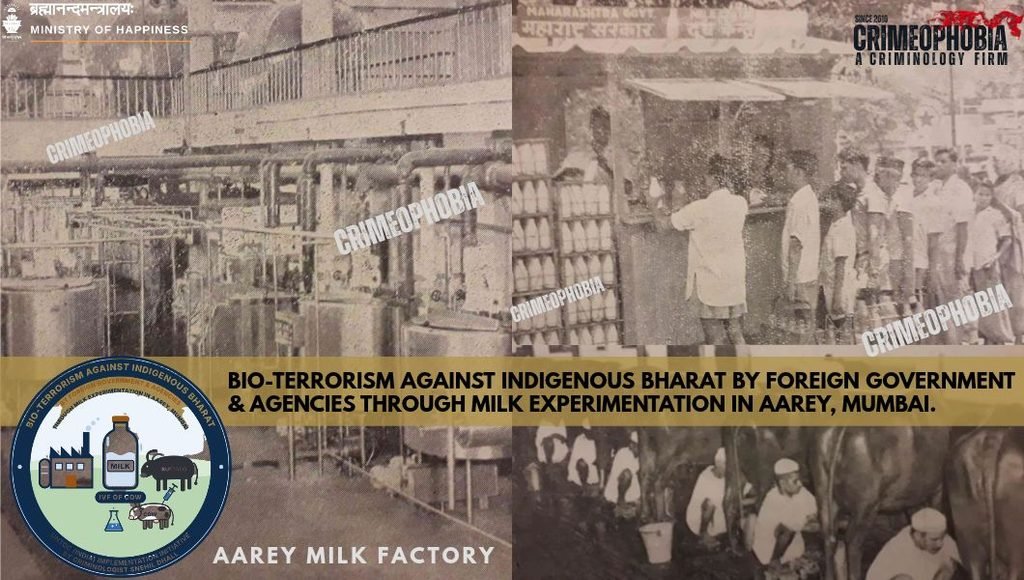
Crimeophobia Initiates Survey on Bioterrorism Against Indigenous Bharat Through Milk Experimentation in Aarey, Mumbai, by Foreign Governments and Agencies
Participate in the Survey: https://forms.gle/Xz65Ljac46zGXQ8UA
“On World Antimicrobial Resistance (AMR) Awareness Week runs from 18 to 24 November 2026, Crimeophobia invites citizens, researchers, scientists, historians, former dairy employees, government and international research stakeholders to participate in a historical and contemporary investigation into Aarey’s dairy experimentation, biological-security vulnerabilities and potential transnational threats. Through the Medical Intelligence Team of Crimeophobia Care Clinic – Crime Psychology & Medico-Legal, we seek to document historical records, archival photographs, scientific findings and first-hand accounts to facilitate evidence-based criminological research and institutional scrutiny. I urge everyone to contribute to this initiative by completing and circulating our public research survey.” — Criminologist Snehil Dhall
MUMBAI: Can a country’s dairy infrastructure become a vulnerability to its biological security? Could historical milk experimentation, livestock research and foreign institutional involvement have consequences extending beyond public health into national security? These questions form the basis of an important criminological investigation undertaken by Criminologist Snehil Dhall, placing Aarey Milk Colony, Mumbai, at the centre of a research initiative concerning biological security, potential bioterrorism, foreign interference and the protection of Indigenous Bharat.
Established by the Government led by the Indian National Congress, Aarey Milk Colony represented a significant public dairy infrastructure project. Buffaloes were relocated from Bombay’s congested city stables, establishing an organised dairy ecosystem supported by livestock, workers and milk-processing facilities. Historical photographs document this transformation, including traditional milking operations, dairy workers and the colony’s infrastructure while the documents speak a hidden bio-terrorism immediately after independence. Its historical landscape, including references to former temples and traditional associations, also warrants systematic preservation and investigation that made Criminologist Snehil Dhall to initiate detailed Case-Study research based on United Nations Transnational Organised Crime (UNTOC) protocols.
His team initiated Crimeophobia’s research that seeks to examine Aarey beyond conventional historical and environmental narratives. The central investigation concerns whether historical milk experimentation, biological research and external institutional collaborations exposed India’s indigenous livestock, biological resources, food systems or population to risks requiring national-security scrutiny. In particular, potential involvement of foreign governments and agencies in activities affecting India’s biological security deserves examination through authenticated records, scientific evidence and independent investigation. The possibility of bioterrorism against Indigenous Bharat is a serious investigative concern requiring evidence-based examination, rather than a conclusion presumed without forensic substantiation.
Although the company is now shutdown but the Milk, livestock, biological materials and food-production systems are strategic public-health resources which changed the way India consumed Milk. Their misuse, unlawful experimentation or compromised research safeguards created vulnerabilities extending across generations. Crimeophobia’s newly formed Medical Intelligence Team is undertaking an interdisciplinary exercise combining historical documentation, scientific scrutiny, criminological analysis and contemporary citizen evidence. The objective is to establish facts, identify institutional gaps and determine whether credible evidence warrants further investigation into biological threats, foreign interference or organised transnational activities.
The investigation also connects with Crimeophobia’s longstanding initiative concerning the effective implementation of the United Nations Convention against Transnational Organized Crime (UNTOC) in India. The Convention provides an international framework for cooperation against organised criminal networks, cross-border activities and associated serious offences. Its relevance to this research lies in examining potential transnational dimensions of unlawful activities, trafficking, illicit financial networks and institutional vulnerabilities, wherever supported by evidence. India’s commitments under UNTOC and the Biological Weapons Convention provide important international contexts for examining organised criminal threats and biological-security concerns through appropriate legal and institutional mechanisms. On 26 October 2026, Crimeophobia presented its research concerning Aarey Milk Factory before the Government of India’s High-Level Committee on Demographic Change, bringing ground-level research and institutional documentation into national deliberations. For Criminologist Snehil Dhall, Aarey is not merely a Mumbai-based research subject. It represents an opportunity to examine the intersection of biological security, indigenous resources, public infrastructure, institutional accountability and transnational organised crime.
Crimeophobia encourages citizens across India and international research stakeholders to contribute historical records, archival photographs, scientific information, first-hand accounts and relevant institutional documentation. Former dairy employees, residents, scientists, historians, medical professionals, researchers, legal experts and public officials are particularly encouraged to participate. Every genuine response can help identify historical connections, missing records and questions requiring further scientific or institutional examination. Participants are requested to distinguish documented facts from personal observations and matters requiring verification. India’s biological security cannot remain outside criminological investigation, and historical institutional activities must be open to evidence-based scrutiny. International cooperation, scientific independence and institutional accountability are essential to understanding and addressing potential transnational threats.