
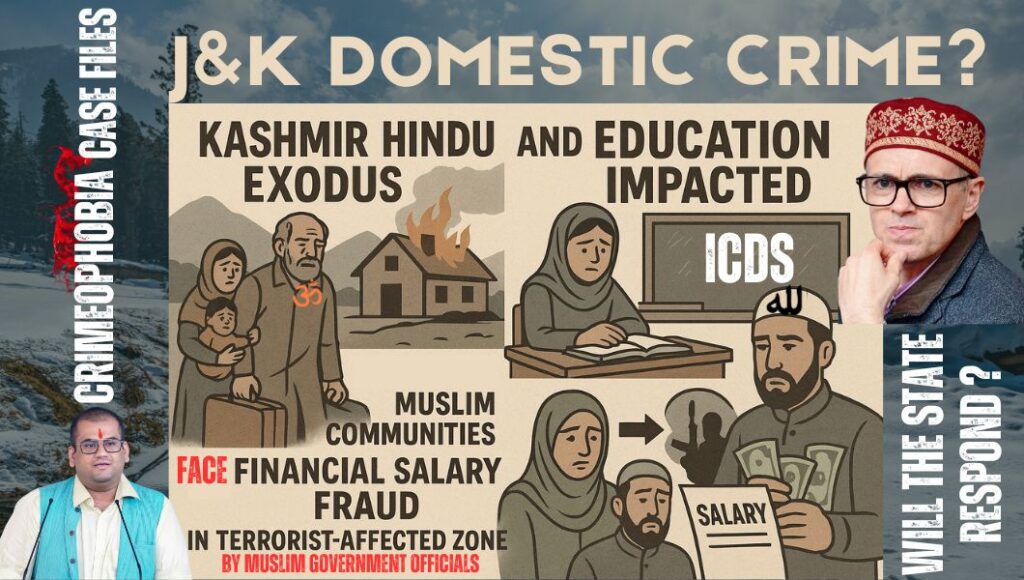
Crimeophobia’s J&K Case: Rishi Kashap’s Kashmir Hindu Exodus has impacted Education even for the Muslim Communities with Financial Salary Fraud by Muslim J&K Officials
By Special Correspondent, Bureau
Srinagar: The geopolitics of northern India inevitably turns to Jammu and Kashmir. The Financial Salary Fraud Case, handled by Crimeophobia, convinced the entire team that it is not merely the absence of education that breeds terrorism, but the absence of a complete educational ecosystem and the mentality to sustain it that drastically fuels it.
When Rishi Kashyap founded Kashmir, it was proudly called “Heaven on Earth.” But even heaven, it seems, can be turned into hell, courtesy of invaders who conveniently morph into politicians and later employ terrorists to rebrand Kashmir as “Hell on Earth.” The international audience, of course, watched this tragedy like a popcorn-fueled spectacle—not just a WrestleMania, but a full-scale hub of terrorist attacks—until the Indian Army had to step in.
For decades, local politicians spoke the language of terrorists, otherwise known as Pakistan, and systematically destroyed the homeland of the Kashmiri Pandits—one of the most intellectually gifted communities, not only in India but globally. Education was dismantled in the name of religion. In more recent times, Crimeophobia encountered a case where not only Hindu education but also Muslim education was under siege, thanks to internal politics, petty rivalries, and official confessions in what can only be described as a criminal conspiracy. This scandal is now known as the Financial Fraud & Salary Scam by the Crimeophobia Team, which is deep within the Integrated Child Development Scheme (ICDS), launched by the Central Government and whose operations are handled solely by respective state governments.
The case reached Crimeophobia through its founder, Criminologist Snehil Dhall, from an unusual source: his own driver for local transportation in the region. The driver noticed that most of Dhall’s meetings were happening on Gupkar Road in Srinagar during his trip. Concerned about his own family’s situation, he revealed that ICDS officials were not only harassing them but actively dismantling the education system in Jammu and Kashmir. The case came with almost no documented proof, and the challenge of conducting interrogations from Mumbai without physical access to the department, officials, or records for verification of evidence and witnesses had to be carried out with zero documented access. The notion of “Muslim torturing Muslim” wasn’t new, but here it bluntly demonstrated that terrorism’s growth was directly linked to education’s collapse, and the individual case had to be dealt with care to avoid a geopolitical hijack that would only worsen the case for the victims.
Through tactical intelligence, Dhall secured and recorded all documents proving ICDS’s financial fraud. Every piece of evidence was formally placed on record, forming a chain of confessions from within the department. Kashmiri language barriers, when they arose, were bridged by the victims themselves. The outcome was nothing short of shocking: the victim, officially listed as an ICDS Supervisor, was receiving the salary of an Anganwadi worker. The difference in pay had mysteriously vanished—untraceable—though all confessions were documented, despite the J&K Government department refusing any recovery.
Since ICDS is run 50% by the State Government and 50% by the Central Government, the focus shifted to New Delhi. The Jammu and Kashmir administration, unsurprisingly, showed no inclination to assist victims, and local advocates, for reasons best left to the imagination, refused to serve any notice against the Government. All correspondence, therefore, moved to the Central Government’s Ministry of Women and Child Development, which acknowledged the evidence duly recorded by the Crimeophobia Team and even issued an order directing the J&K State Government to investigate the fraud. The state-run ICDS, however, appeared to treat the Central Government’s orders as optional reading material and continues to disobey the orders.
With no advocate willing to understand or approve the petition against the Financial Salary Fraud, Crimeophobia shifted jurisdiction to New Delhi. A formal petition was filed before the Delhi High Court, which once again issued orders against the Central Government and the J&K State Government ICDS—both to respond and to provide relevant data.
“The Central Government has already filed their reply; however, the J&K Government isn’t responding despite the court giving them multiple opportunities. Recently, dates have been listed regularly, but due to a heavy board, hearings have been postponed ever since the order was passed. We have filed an application for an early hearing so that the matter is listed at the very start of the daily board,” says Adv. Mareesh Sahay, Advocate-on-Record for the Supreme Court of India and Board Advisor to the Crimeophobia Team.
“We have taken a strong stand for our pro bono client because the future of Jammu and Kashmir—its youth and its education—has always been a core geopolitical issue. A ‘leave none to tell the story’ model has been deployed, but we continue to work on rebuilding educational support, not just for Muslim communities, but also for the Hindu communities that suffered an exodus after genocide. Whether these funds were used for terrorist activities—we cannot say for certain,” says Criminologist Snehil Dhall.
These developments unfold in the shadow of Article 370’s abrogation—a constitutional change that sharply stopped stone-pelting incidents and ended a long cycle of confrontations in which the Indian Army was relentlessly placed under international human rights scrutiny. Ironically, the same Western nations that once accused India over Kashmir are now grappling with similar unrest within their own borders, where native land-origin communities are raising voices hauntingly similar to those of displaced Kashmiri Pandits. In many such places, the original inhabitants now find themselves suppressed under Islamic violence and political takeover—a geopolitical déjà vu hard to miss.
For Dhall, the parallels are glaring. “This is not just about one community. First, it was the Kashmiri Pandits whose education was erased through violence. Now, it is the Muslim youth whose future is being stolen through bureaucratic corruption by creating major conflict for its own faculty. Terrorism thrives when education dies, and the same geopolitical forces that once drove the Hindu exodus are now corroding Muslim intellectual growth.”
The case lays bare a grim truth: whether wielded by the sword of past invaders or the pen of corrupt officials, the educational lifeblood of Jammu and Kashmir has been drained in cycles, leaving Hindu and Muslim children alike with fewer tools to build a peaceful future. In his new role, Chief Minister Omar Abdullah should address the ongoing financial fraud and salary scams within the Integrated Child Development Services (ICDS), which the Crimeophobia Team has already documented. Based on this evidence, the Central Government along with the High Court has already ordered the J&K State Government to respond. “We do understand this silence from J&K is because they are under guilt, but the geopolitics have changed, and the Chief Minister is capable of reviewing the matter,” says Criminologist Snehil Dhall.