
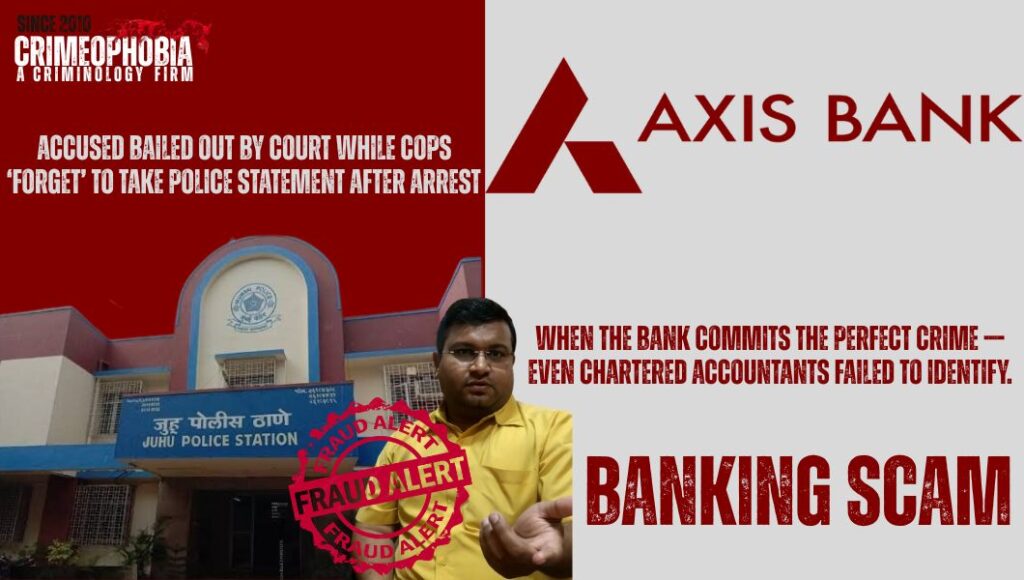
Juhu Police Fly to Bhopal for NBW Arrests in Axis Bank Scam — But “Forget” to Record Key Statement in FIR of Forgery and Financial Fraud case: Crimeophobia
“In complex financial crimes, the sophistication is often so refined that even statutory gatekeepers fail to detect irregularities until the damage is already embedded within the system. What is deeply concerning, however, is not merely the alleged banking misconduct, but the surrounding procedural anomalies. When Non-Bailable Warrants are reportedly neutralised with remarkable efficiency, and when officers travel across states to arrest an accused yet allegedly ‘forget’ to record a police statement integral to the FIR, the issue transcends individual lapse and enters the domain of structural scrutiny. As a criminologist, I view such patterns not as isolated events but as behavioural indicators within institutional ecosystems. The question is not about presuming guilt; it is about examining how financial institutions, accused individuals, and enforcement mechanisms appear to operate in parallel without proportional accountability. Repeated media reports and investigative actions concerning banking officials in unrelated matters only reinforce the necessity for forensic transparency and independent audit trails. Ultimately, the only consistently disadvantaged stakeholder in such scenarios is the victim, who endures financial loss alongside procedural delay. Justice in financial crime must be demonstrable, not theoretical. Accountability must be systemic, not selective.” — Criminologist Snehil Dhall
Mumbai: Axis Bank has been repeatedly implicated in a range of reported scams, frauds, regulatory lapses, and high-profile allegations as covered in multiple credible news sources. Investigations by the Central Bureau of Investigation led to the arrest of an Axis Bank manager in Mumbai for allegedly facilitating cyber-fraud syndicates by opening and managing mule accounts used in large-scale digital frauds, while separate coverage from Moneycontrol and NDTV detailed the arrest of a bank manager and sales executives in Bengaluru in connection with an alleged ₹97-crore stock market fraud scheme involving Axis Bank staff. In addition, a writ petition filed by Member of Parliament Subramanian Swamy before the Delhi High Court alleged a scam of nearly ₹5,100 crore involving Axis Bank making undue gains through share transactions in Max Life Insurance.
Although the bank and financial fraud conspirators have already been reviewed multiple times, the present case highlights the alleged silence or reluctance of enforcement agencies, particularly the police, in resolving the matter. This time, however, their actions were officially recorded in Court but the Senior Inspector of Juhu Police Station assured Criminologist Snehil Dhall that immediate action would be taken without further delay after Mr. Dhall conducted the Legal & Security Audit of the criminal proceedings. What appears to be a brazen mix of forged documents, inflated property valuations, banking irregularities, and questionable police procedure has reignited outrage in the ₹4-crore loan saga of M/s Carpe Heat Transfer Pvt. Ltd., once again dragging senior officials of Axis Bank into the spotlight.
At the heart of the storm are guarantors turned victims turned FIR complainant Mr & Mrs. Goyal, who mortgaged two residential flats in 2015 — one at Malad – building 30 years old then (then approx. ₹85 lakh; now approx. ₹90 lakh) and another at Roadpali (then approx. ₹35 lakh; now approx. ₹60 lakh). Shockingly, Axis Bank allegedly valued these at ₹1.26 crore and ₹50 lakh respectively — figures dramatically higher than both prior bank valuations and then prevailing market realities. The ₹4-crore facility (₹1.5 crore CC, ₹1 crore LC, ₹1.5 crore BG) sanctioned on 16 October 2015 was backed by securities declared at ₹4.7 crore. Yet IDBI Bank’s valuation just months earlier in August 2015 reportedly pegged one key property at ₹95 lakh. Axis Bank’s own valuation report — crucial to the sanction terms — is now stated to be “missing.”
Forged Signatures & ROC Uploads
Between December 2015 and December 2016, four link agreements were uploaded to ROC records — allegedly bearing forged signatures of both guarantors. Matters exploded when the principal borrower reportedly executed a notarised Video and Affidavit-cum-Indemnity Bond dated 30 March 2017 admitting the signatures were forged. In a span from Dec’15 to Dec’17 in the same loan account Bank sanctions, revises time & again minimum 8 more sanctions without any intimation to Guarantors & accept the sanction letters including 4 Link agreements as mentioned above with Forged Signatures. A High Court-empanelled handwriting expert reportedly confirmed the forgery. Letters dated 9 June 2017 were acknowledged by the bank, demanding withdrawal of facilities and flagging possible collusion. Instead of corrective action, a fresh sanction letter dated 14 August 2017 allegedly restructured the facilities to ₹814.70 lakh — astonishingly continuing to show the Goyals as guarantors despite written objections and admissions of forgery. The revised terms even allocated 15% of discount proceeds to the guarantors’ account — raising serious questions on intent and internal oversight.
SARFAESI Action Without Safeguards?
On 11 October 2018, Axis Bank issued a Section 13(2) notice under the SARFAESI Act, declaring dues of ₹3.02 crore. Yet no lien marking reportedly appeared in society records of the Goyals’ properties. Despite repeated objections, possession proceedings were executed in July 2019. Guarantors allege the bank:
- Artificially inflated valuations contrary to sanction norms
- Failed to inspect properties and books
- Ignored admitted forgery
- Altered credit structures without guarantor intimation
- Uploaded forged ROC documents without verification
- Failed to exhaust remedies against the principal borrower
NBW Arrest in Bhopal — But No Statement Recorded?
The most explosive development has now emerged from Juhu Police Station. Acting on Non-Bailable Warrants of the Andheri Court, Juhu Police reportedly travelled to Bhopal and arrested certain accused. However, in a move that has stunned legal observers, it is alleged that the Investigating Officer failed to record the statement of a key accused in the FIR — despite having full custody opportunity. The accused was brought to Mumbai but neither re-arrested in connection with the FIR nor formally examined. The FIR, registered on 8 January 2020 at Juhu Police Station, names four Axis Bank officials: Mr. Rajesh Dewangan, Mr. Sumit Sultania, Ms. Jhanvi Patel, and Ms. Leena Agarwal. Now, citing alleged investigative dilution, the complainant has sought addition of the entire Board of Directors of Axis Bank under criminal conspiracy provisions, alleging the pattern suggests a deeper systemic modus operandi potentially linked to structured financial manipulation.
Criminologist Snehil Dhall of Crimeophobia reportedly met the Senior Inspector of Juhu Police Station after the accused were released and yet no Police Statement was taken on FIR. The Senior Inspector assured renewed action after reviewing the brief, however, he also said to have expressed inability to clarify procedural lapses by previous Investigating Officers — including why a critical statement was not recorded and why custodial opportunities were not utilised.
Bigger Questions Loom
The unfolding controversy raises disturbing questions:
- Were guarantors trapped through forged corporate filings?
- Were valuations manipulated to inflate lending exposure?
- Why was admitted forgery not acted upon immediately?
- Why was a key accused not examined despite NBW execution?
- Was the investigation deliberately weakened?
- Where protocols are followed by the Bank Management against the criminal conspiracies in which only civilians and customers are suppose to suffer?
As the complainant now pushes for expanded conspiracy charges and custodial interrogation, the case is fast transforming from a loan dispute into a test of banking governance, forensic accountability, and police integrity. If proven, this would not merely be a financial irregularity — it would represent a systemic collapse of fiduciary duty, regulatory oversight, and criminal investigation. The silence, for now, is deafening.
The FIR Complainant stated that “Within 10 days of the last sanction granted by the Bank on 11/12/2017 vide Sanction Letter dated 11/12/2017, the account was declared NPA on 21/12/2017, raising serious procedural and regulatory concerns as to how an account could slip into NPA status within such a short span after fresh sanction. Furthermore, there appear to be three different and conflicting NPA dates recorded by the Bank: first, as per the Bank’s own Certificate filed before the DRT on 28/10/2016; second, as stated by the SME Centre Head, Ms. Leena Nanak Chand Agarwal, in her email dated 25/07/2017 at 16:00, wherein she mentioned that the account had become NPA as the irregularities had crossed 90 days; and third, by letter dated 21/12/2017, i.e., within 10 days of the last sanction. The existence of three separate NPA dates for the same account reflects material inconsistencies requiring strict scrutiny.
Speaking to Adv. M.P Sahay (Advocate-on-Record) Supreme Court of India, he said “If these allegations withstand judicial scrutiny, the matter transcends a ₹4-crore loan dispute and raises prima facie concerns of criminal conspiracy, document fabrication, regulatory breach, and investigative dilution. The alleged forged signatures, conflicting NPA dates, missing valuation records, and failure to record a key statement despite NBW execution collectively suggest systemic lapses rather than isolated errors. In a regulated banking framework handling public funds, accountability must be uniform and investigation must be substantive, not symbolic. Should the courts find merit, a time-bound, independent, and forensically audited probe would be the only legally sustainable course to restore institutional credibility and uphold the rule of law.”