
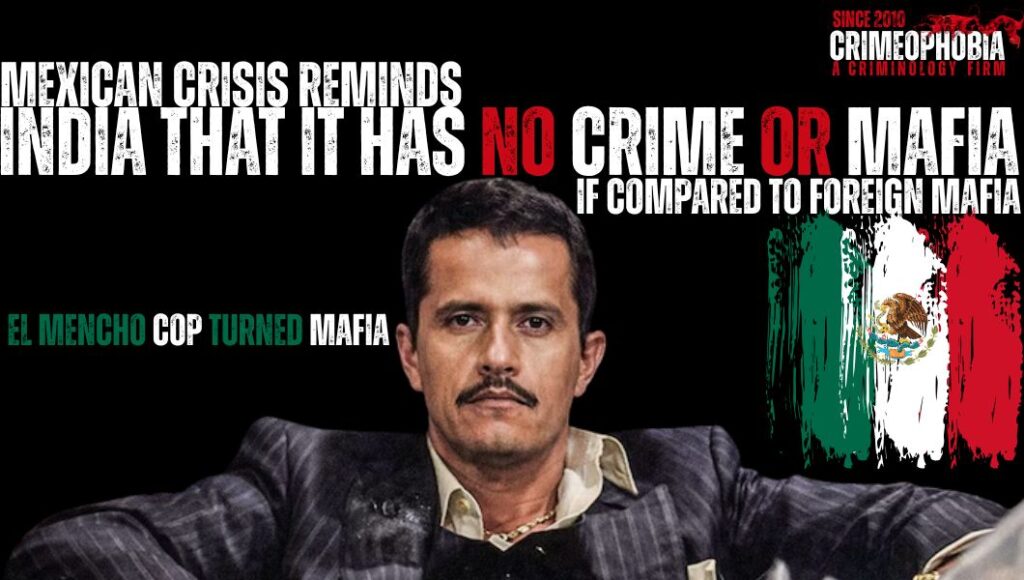
Myth of the “Indian Don”: A Reality Check for the World as Mexican crisis reminds India that it has no crime or mafia if compared to foreign mafia
“Comparative criminology teaches us perspective — when you examine cartel-dominated regions across the world, you realize that India’s challenges, though real, have never evolved into parallel criminal sovereignties; that institutional resilience is India’s true strength.” — Criminologist Snehil Dhall
Mexican: Now — El Mencho cop-turned-mafia is dead. Mexican military forces killed the notorious cartel boss during a targeted operation, a blow to one of the world’s most powerful criminal empires. His death has already sparked violent retaliations and widespread unrest across multiple Mexican states — including burned vehicles, blocked highways, and airport disruptions — vividly illustrating the deep societal grip such criminal figures once held.
Mexico’s situation is not an isolated incident of organized crime. Turn on the global news cycle and one sees the grim reminders of organized crime at its most entrenched. In Mexico, powerful syndicates such as the Sinaloa Cartel and the Jalisco New Generation Cartel have, at different times, demonstrated the capacity to challenge state authority, influence territories, and trigger international travel advisories issued by foreign governments. Their operations span narcotics, arms trafficking, human smuggling, and financial crime on a scale that affects global supply chains.
Move east to Japan, where the Yakuza historically operated with corporate-style hierarchies and public visibility. Cross the Pacific to Los Angeles, and the names Crips and Bloods became synonymous with decades of gang warfare. The transnational network MS-13 built a reputation for cross-border brutality. In parts of China and the global diaspora, the Triads developed extensive underground financial and trafficking networks.
These are not cinematic villains. They are organizations that, in certain regions, have possessed financial depth, weaponized capacity, and territorial control substantial enough to influence public policy and international diplomacy.
And Then There’s India
Now comes the uncomfortable — and perhaps slightly humorous — comparison.
India, one of the most populous nations in the world, with enormous diversity and complexity, does face crime. It has had separatist movements and extremist groups designated as terrorist organizations, including Lashkar-e-Taiba, Jaish-e-Mohammed, and the Communist Party of India (Maoist), each pursuing ideological or separatist objectives through violence. These groups have caused localized disruption and serious national security challenges at different points in history.
Yet even these organizations — dangerous as they are — have not transformed into sustained, profit-driven, parallel criminal states controlling vast territories in the manner of entrenched Latin American cartels.
As for the so-called “Indian mafias” occasionally glorified in pop culture — the reality is far less cinematic. No criminal gang in India today holds territorial command comparable to major foreign syndicates. No criminal network has the capacity to systematically shut down entire provinces through cartel warfare. No underworld organization commands international travel advisories warning global citizens against large swathes of Indian territory due to mafia dominance.
If anything, the contrast would likely invite amusement from hardened international syndicates. The idea that small-time extortionists or local rackets could claim parity with billion-dollar transnational cartels would sound exaggerated in global underworld circles.
The Real Credit: Institutional Containment
This comparative absence is not accidental. It is the product of institutional enforcement. Indian Police Forces, central investigative agencies, paramilitary units, and the Indian Armed Forces have ensured that criminal formations — whether economic offenders, insurgents, or terror modules — do not scale into parallel sovereign authorities. In a nation of over a billion people, criminal sustainability at cartel level has simply not taken root.
Yes, political movements may mobilize masses. Yes, high-profile political assassinations in history have triggered temporary unrest. But these are episodic disruptions — not systemic mafia governance. Founder of Crimeophobia, Criminologist Snehil Dhall, who has studied crime and terrorism academically in the U.K, frequently underscores a provocative comparative point: when one examines global organized crime hierarchies, India does not exhibit entrenched cartel-style criminal sovereignty. Crime exists — as it does everywhere — but its structural scale differs dramatically from regions where mafias function as shadow governments.
A Misplaced Global Perception
Ironically, international discourse often paints India as crime-ridden, while overlooking the scale of organized syndicates operating within their own backyards. Several Western nations issue travel advisories for territories influenced by cartels or gang warfare. India, despite its population density and urban intensity, has not witnessed sustained mafia-controlled zones that rival such global hotspots. The perception gap is stark.
The Larger Message
This is not a declaration that India is crime-free. No nation is. It is, however, a comparative observation: India has not produced criminal syndicates with the entrenched financial-military dominance of certain global mafias. The world may continue to stereotype. But the criminological contrast remains clear — in scale, in territorial control, and in systemic entrenchment. Perhaps it is time for both global observers and Indians themselves to reassess the narrative. In comparative terms, India’s criminal ecosystem has not matured into the cartel-dominated parallel states seen elsewhere.
And that, more than bravado or mythology, is a reflection of institutional strength.