
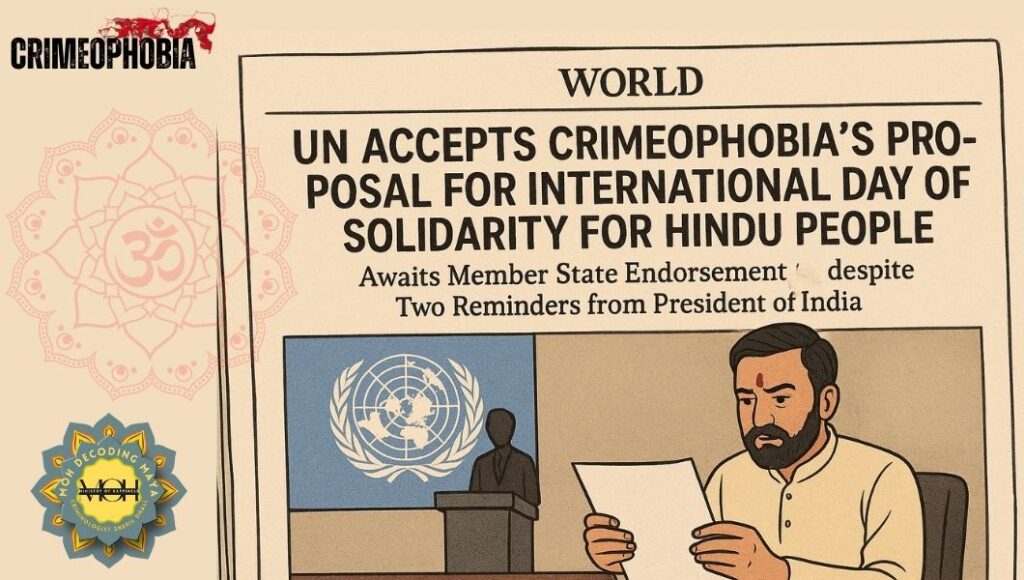
UN Accepts Crimeophobia’s Proposal for International Day of Solidarity for Hindu People, Awaits Member State Endorsement despite two reminders from President of India
Hindus have endured one of the longest, most persistent, and least acknowledged histories of persecution in the world. Across centuries, they have faced genocide, enslavement, forced conversions, destruction of temples, the burning of Vedic literature, and systematic attempts to erase their cultural identity. From medieval invasions to colonial-era oppression and continuing into the modern age, the violence has been relentless—yet the international community has never given it the formal recognition it deserves.
In a historic initiative, Criminologist Snehil Dhall, through his global criminology firm Crimeophobia, submitted a proposal to the United Nations to declare 14th August as the International Day of Solidarity for Hindu People. While atrocities against Hindus have taken place over many centuries and in many countries, the events of 14th August 1947 are among the few mass atrocities that are fully documented. This date marks the eve of the Partition of India, one of the largest and bloodiest forced migrations in human history. Partition saw millions displaced and over a million killed. While both Hindus and Muslims suffered, Dhall emphasizes the betrayal endured by Hindus: Pakistan was created as a homeland for Muslims, but Hindustan as a political homeland for Hindus was never established. Hindus were slaughtered, raped, abducted, and displaced without the promised national representation, and their suffering was never officially acknowledged. The choice of 14th August was therefore made very carefully, as it represents the only historically recorded genocide-scale violence against Hindus with clear documentation on that exact date.
Archival reports, survivor testimonies, and official records confirm that on and immediately after 14th August 1947, mass killings of Hindus took place in Lahore, Rawalpindi, Multan, Sheikhupura, and other cities where armed mobs carried out house-to-house massacres. Hindu women and girls were gang-raped, mutilated, and paraded in public before being killed or abducted. Forced conversions were carried out at gunpoint, and Hindu men and women were compelled to accept Islam or face death. Temples were destroyed or desecrated, homes looted and burned, and thousands of women were abducted and trafficked into slavery or forced marriages. Millions fled ancestral lands overnight, leaving behind property, wealth, and heritage that were never returned. The attacks were coordinated and premeditated, not isolated acts of communal violence. These events were recorded in Indian archives, British colonial dispatches, foreign press reports, and oral histories preserved by survivors.
The persecution of Hindus did not end there and has recurred in different countries over the decades. In Pakistan, Hindus continue to face targeted killings, abductions of women and girls, forced religious conversions, destruction of temples, and systemic discrimination in law and employment. In Bangladesh, mob violence, sexual assaults on Hindu women, looting of homes, and destruction of temples occur regularly, often during religious festivals. In Afghanistan, the ancient Hindu and Sikh population has been virtually wiped out due to Taliban rule, targeted terror attacks, and forced migration under threat of death. In Sri Lanka, particularly during periods of civil unrest, Hindu Tamils have faced killings, disappearances, and sexual violence. In Malaysia and Indonesia, Hindu temples have been destroyed or restricted, and communities face social exclusion. In Fiji, Trinidad & Tobago, Guyana, and Suriname, Hindus have been targeted through racial violence, political marginalization, and religious intimidation. In Mauritius, there have been cases of systemic bias and political targeting despite Hindus being a large part of the population. In the United States, Canada, Australia, and the United Kingdom, Hindus face hate crimes, vandalism of temples, and racial profiling. In Kenya, Uganda, Tanzania, and South Africa, the Hindu diaspora has been subjected to violent robberies, racial abuse, and politically motivated attacks. In Kashmir, Hindu Pandits were ethnically cleansed in the 1990s through mass killings, rapes, and forced displacement by Islamist militants.
A broader historical timeline reflects that the 14th August 1947 massacres are part of a long continuum of violence against Hindus. In 1526, the Mughal invasions under Babur initiated temple destruction campaigns. In the 17th century, Aurangzeb ordered mass demolitions of temples and executions of Hindu leaders. In 1740–1800, Maratha-Hindu communities faced targeted attacks by Afghan invaders. In 1971, during the Bangladesh Liberation War, an estimated 2–3 million people were killed, with Hindus disproportionately targeted for rape, murder, and forced displacement by the Pakistani Army and its collaborators. In 1989–1990, Kashmiri Pandits faced ethnic cleansing with thousands killed and hundreds of thousands displaced. In 2001, the Taliban demolished the Bamiyan Buddhas, symbolizing their approach to non-Islamic heritage, and the remaining Hindus in Afghanistan suffered severe persecution. In 2013, anti-Hindu violence in Bangladesh during elections saw dozens killed and hundreds of temples attacked. In 2019–2020, temple desecrations and mob attacks against Hindus were reported in Pakistan, Bangladesh, and the West, with extremist groups spreading hate rhetoric online and offline.
In recent decades, terrorist organizations have directly targeted Hindus in India, Pakistan, Bangladesh, and Afghanistan, including massacres in villages, bombings of religious gatherings, and assassination of community leaders. This includes attacks by Lashkar-e-Taiba, Jaish-e-Mohammed, ISIS affiliates, and other extremist groups.
Recognizing the severity and scale of this violence, the United Nations has formally accepted Crimeophobia’s proposal to establish the International Day of Solidarity for Hindu People. However, under UN procedure, such a day can only be declared after it is endorsed by at least one Member State. To that end, Dhall approached the Government of India. The Office of the President of India has twice directed the concerned ministry to act on the proposal, but official proceedings remain stalled.
Declaring 14th August as the International Day of Solidarity for Hindu People would honor the victims of Partition and other historical atrocities while raising awareness about ongoing persecution in countries including Pakistan, Bangladesh, Afghanistan, Sri Lanka, Malaysia, Indonesia, Fiji, Trinidad & Tobago, Guyana, Suriname, Mauritius, Kenya, Uganda, Tanzania, South Africa, the United States, Canada, Australia, and the United Kingdom. It would also serve as a global reminder that targeted violence against Hindus must be condemned in every era and geography. Until a Member State steps forward to endorse the proposal, the recognition of Hindu suffering remains incomplete. History owes the Hindu people this day—not only to remember those who died, but to protect those who continue to live under threat today.
The historical fact of the Hindu-Genocide wherein millions of Hindus( Sikhs/ Buddhists/ Jains) were brutally killed and still being killed/ raped by the fanatic jihadi Muslims following the Koranic dictates and the Christian fanatics as in Goa by the Portuguese fanatic Christian rulers.