
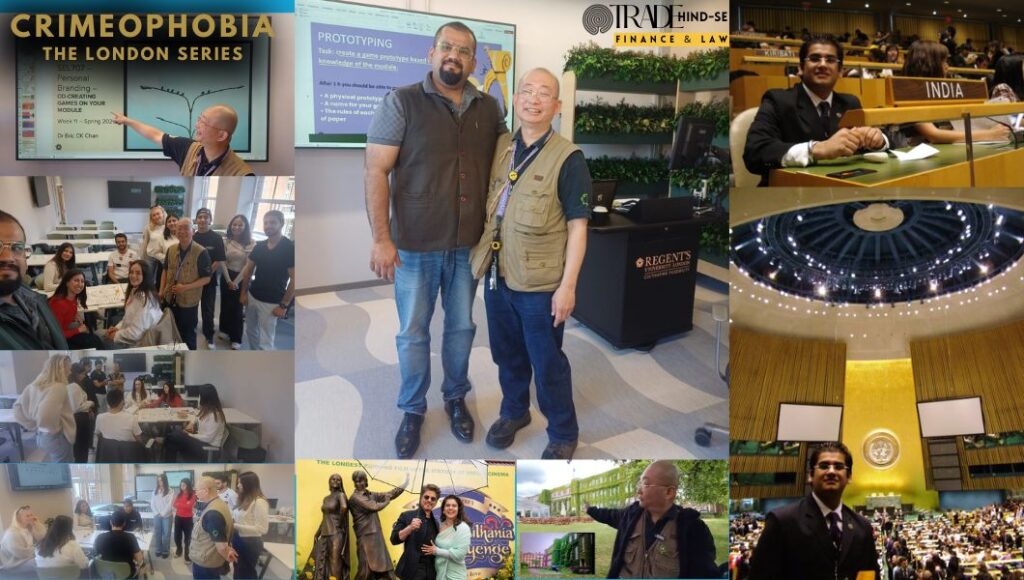
From Bollywood Legacy to Global Trade Strategy at Regent’s: The Mentor-Student Saga Behind Crimeophobia’s International Vision After the UN-GA Visit
Published on 23/05/2026; Author: International Desk
“Dealing with International Relations, Trade, and Diplomacy is not overnight work for me. I have been working on it for over two decades, and recently I got the opportunity for a reunion with the man who not only clicked my photographs inside the United Nations General Assembly but also mentored me through International Business & Trade, that eventually helping me understand that Crime & War indeed affect Global Trade. Today, I wholeheartedly welcome Dr. Eric C.K. Chan as he joins Crimeophobia’s Trade Hind-Se. While he is a Chartered Fellow in Management from London, our strategic ecosystem also includes a Chartered Accountant, two additional Chartered Wealth Managers, along with a formal Indian Corporate Law Services & Judicial Officer who has also served with the Central Bureau of Investigation (CBI) and the Serious Fraud Investigation Office (SFIO) of the Government of India. Trade today is no longer limited to imports and exports alone. Businesses now require advisory systems capable of understanding crime, war, sanctions, geopolitical instability, and cross-border strategic risks before they affect industries, investments, and elite business families globally which is what we plan to initiate with Crimeophobia’s venture of Trade Hind-Se that would deal with Finance & Law.”
— Criminologist Snehil Dhall
Mumbai / London / New York: Long before global corporations began openly discussing the impact of war, organised crime, sanctions, geopolitical instability, and ideological conflicts on international business, a young student of International Relations from London had already begun decoding the intersection between diplomacy, trade, and crime from inside the corridors of the United Nations. That student was the Founder of Crimeophobia, Criminologist Snehil Dhall. And standing beside him during those formative years was Dr. Eric C.K. Chan, a globally recognised strategic management expert whose mentoring would eventually contribute toward the creation of one of the most unusual transnational criminology frameworks to emerge from the U.K. and India.
What began as a student-mentor association inside Regent’s University London, which was Regent’s College at the time, has now evolved into an international trade advisory initiative under Trade Hind-Se by Crimeophobia, integrating International Relations, International Trade, Criminology, Strategic Management, and Geopolitical Risk Analysis into a single advisory structure for elite businesses operating across borders.
The Unofficial MBA That Changed the Course of Global Criminology
During his academic years in London, Snehil Dhall was officially enrolled in Honours in International Relations with minors in Psychology. Unofficially, however, he describes himself as simultaneously undergoing an “MBA under Eric Chan.”
While studying diplomacy and global affairs academically, he was deeply immersed in practical business ecosystems through Dr. Chan’s mentorship. The exposure extended far beyond classroom education.
From the very first semester, Dhall managed to secure multiple university sponsorships and investments for extracurricular activities, including field visits to the United Nations General Assembly and memberships at elite diplomatic & military institutions hosting closed-door interactions with Prime Ministers, Defence Ministers, External Affairs Ministers, senior military officers, diplomats, and global policy leaders.
Alongside business competitions intended primarily for MBA students, Dhall continued simultaneously pursuing diplomatic exposure and geopolitical studies. According to him, the combination created an unusual academic ecosystem where International Relations theory and International Business practice continuously merged in real-time.
The result was not merely academic development — it became the foundation for a future criminology enterprise.
The Silent Message Inside the United Nations
According to Dhall, one of the defining turning points of his life occurred during observations made at the United Nations General Assembly. While many viewed the institution as the global centre of peace diplomacy, Dhall claims he observed something different — a structure where “peace of trade” often dictated “peace of land.”
That realization fundamentally altered his professional direction.
Rather than pursuing a diplomatic career, he shifted toward Honours in Criminology, focusing on organised crime, conflict systems, criminal psychology, and geopolitical behavioural structures. The transition eventually led to the conceptualization of Crimeophobia which was registered in London as Crimeophobia Limited and eventually shifted to Mumbai, now recognised for its transnational criminology research and strategic advisory frameworks.
The integration of business discipline acquired through Dr. Chan’s mentorship reportedly became one of the key reasons Crimeophobia evolved beyond a conventional criminology setup into a hybrid strategic advisory structure handling crime analytics, international risk mapping, diplomacy-linked assessments, predictive policing concepts, and cross-border conflict analysis.
Business, Crime, Diplomacy — The Triangle the World Finally Understood
Nearly two decades later, the student and mentor reunited again — not inside a classroom, but within a new strategic ecosystem. While the student had now turned into Criminologist & Entrepreneurship and his mentor had elevated into Chartered Fellow (Chartered Management Institute) while continuing to remain an Educationalist too. But this time, Criminologist Snehil Dhall joined Dr. Eric Chan’s business programme not as a student, but as a mentor to his current students, guiding them on branding strategy, perception management, and behavioural positioning while they developed prototype business gaming modules for Personal Branding.
The interaction revived memories stretching back to Singapore, where Dhall had earlier studied Economics and Business Management during his International Baccalaureate diploma and conceptualized his own “Game Theory” model inspired by the Prisoner’s Dilemma. Ironically, one of the earliest global diplomacy events jointly organised by Dhall and Eric Chan at Regent’s had also revolved around identity, sovereignty, and nationhood — analysing distinctions such as Sri Lanka versus Ceylon that is similar to India versus Bharat — years before such civilisational debates became globally mainstream for understanding International Trade & Relations.
According to Dhall, very little has changed about Eric Chan’s leadership style over two decades except age itself. The enthusiasm of students around him, he says, remains exactly the same. For the first time in nearly twenty years, the two finally appeared together in a photograph — a moment Dhall considers personally significant given that he possesses no photographs with many of his other mentors and guides from the same era.
Regents, Global Elite Networks, Trade Diplomacy & the Saga of Dilwale Dulhania Le Jayenge
Although unintentionally, the first shot of India’s legendary film Dilwale Dulhania Le Jayenge was filmed at Regent’s University London (at the time it was Regent’s College), where Shah Rukh Khan was portrayed arriving at college in his luxury sports car as a student. Interestingly, the same institution also became the conceptual birthplace of Crimeophobia. While the film later received its own statue at Leicester Square in recent years, Crimeophobia continues to remain one of the only dedicated Criminology Firms of its kind even today, as universities globally do not encourage entrepreneurship or business creation after completing a degree in Criminology. The profession traditionally continues to remain confined to the job industry rather than evolving into an independent business or corporate ecosystem.
Over the decades, Regent’s University London has remained one of the preferred educational ecosystems for families connected to billionaire circles, international business dynasties, diplomatic networks, and globally influential elite communities. The institution’s international environment has consistently attracted individuals associated with high-value trade ecosystems, governance structures, global finance, and cross-border business operations. According to the strategic direction now being developed under Trade Hind-Se by Crimeophobia, both Dr. Eric C.K. Chan and Criminologist Snehil Dhall intend to collectively utilise their combined expertise in International Trade, Diplomacy, Strategic Management, Criminology, Geopolitical Risk, and International Relations to provide specialised advisory support to elite business families, ultra-high-net-worth networks, institutional stakeholders, and global leadership ecosystems operating across multiple jurisdictions.
Their long-standing exposure to elite educational, diplomatic, and international business circles is now expected to become a core operational advantage for businesses requiring sophisticated geopolitical and trade-sensitive advisory structures in an increasingly unstable global environment.
Trade Hind-Se: The New Advisory Architecture for Elite Businesses
Although Eric Chan’s twelve-week spring programme has concluded, the collaboration itself has now formally entered a new phase. Dr. Eric C.K. Chan has officially joined the strategic initiative Trade Hind-Se by Crimeophobia, where he will lead the Council Board overseeing international trade advisory structures and institutional business expansion models. The initiative is positioned around a core reality now openly acknowledged worldwide: crime, war, sanctions, geopolitical instability, ideological conflict, and organised networks directly affect trade ecosystems.
Trade Hind-Se intends to provide strategic advisory support for elite businesses, high-value networks, institutional stakeholders, and international enterprises seeking expansion across jurisdictions while simultaneously understanding geopolitical vulnerabilities capable of disrupting supply chains, client ecosystems, investments, regulatory exposure, or operational continuity. The advisory model operates on the understanding that even businesses without direct import-export operations remain vulnerable to international trade disruptions through indirect client relationships, sourcing chains, logistics structures, financial systems, conflict zones, or politically exposed dependencies.
Dr. Eric C.K. Chan: Strategic Management Expert With Global Influence
Dr. Eric C.K. Chan is globally recognised for over three decades of work across strategic management, institutional governance, organisational restructuring, audit systems, and international advisory frameworks. A Chartered Fellow and senior academic associated with Regent’s University London, he has advised institutions and businesses across multiple jurisdictions on leadership strategy, transformation mechanisms, governance models, and international operational structures. Within the professional journey of Criminologist Snehil Dhall, Dr. Chan is acknowledged as the earliest mentor responsible for integrating MBA-oriented strategic thinking into Dhall’s evolving transnational criminology framework while he was still pursuing International Relations before transitioning into Criminology.
Their collaboration across International Business and International Relations has continued for nearly two decades, including joint exposure at the United Nations General Assembly, contributing toward a rare interdisciplinary understanding of how diplomacy, crime, economics, behavioural systems, governance, and trade architecture interact globally. Today, that same understanding forms the operational backbone of Trade Hind-Se by Crimeophobia — a platform seeking to redefine international trade advisory through the combined lens of strategic management, criminology, geopolitical intelligence, and diplomatic risk assessment.