
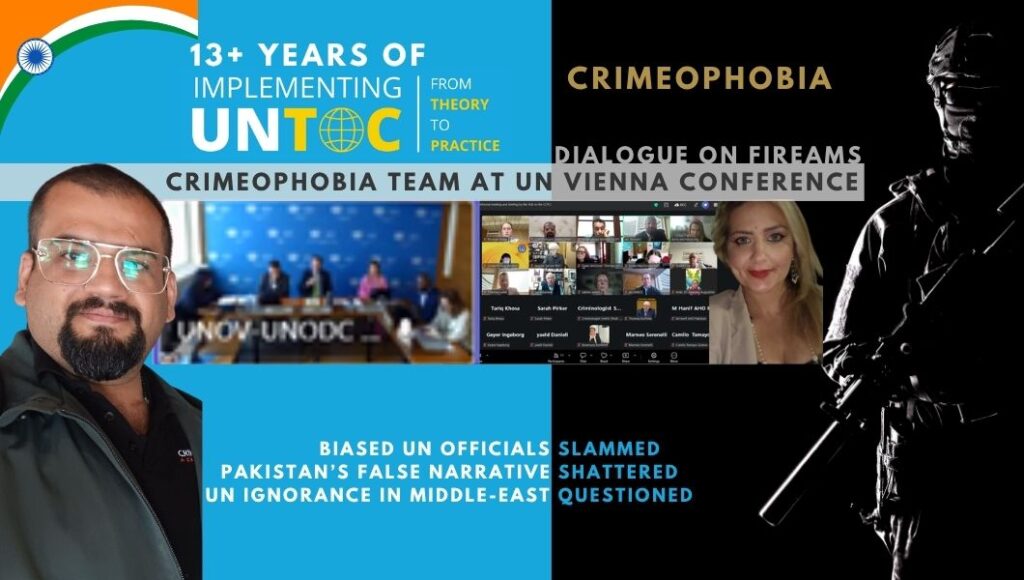
Crimeophobia Team Slams United Nations Yet Again for Their Absence and Ignorance in the Middle-East & India Against Transnational Organised Crime at UN Vienna Conference on Firearms
Author: Crimeophobia-UN Desk; Published on 17/05/2026; Bureau
“Crimeophobia Team has yet again slammed certain UN officials during Vienna Conference for their diplomatic failures in India and the Middle-East, while a few biased representatives now appear busy promoting Pakistan to redeem years of false propaganda by projecting sudden concern over transnational organised crime. Ironically, even UN officials indirectly acknowledged during the session that Pakistan’s representatives continue struggling to convince their own government to effectively address and ratify stronger organised crime mechanisms merely 2-3 years prior, while India had already ratified UNTOC more than 13 years ago. Crimeophobia itself has actively contributed to UNTOC-linked implementation initiatives for more than a decade through field-level criminological intervention & research on anti-arms & ammunition smuggling, money laundering, anti-human trafficking, and organised crime analysis. Therefore, any attempt to compare India’s ground-level implementation ecosystem with politically manufactured narratives elsewhere is not only diplomatically misleading but operationally disconnected from reality.” — Criminologist Snehil Dhall
UN, Vienna: A sharp diplomatic confrontation unfolded during the United Nations Vienna Conference on Firearms after representatives associated with Crimeophobia publicly criticised the continued institutional inactivity of various United Nations mechanisms in addressing transnational organised crime affecting India and the Middle-East. The intervention, led by Crimeophobia’s Founder, Criminologist Snehil Dhall and Lebanon-based Crimeophobia Board Advisor Rita Chahwan, raised serious concerns regarding the implementation failures surrounding the United Nations Convention against Transnational Organized Crime (UNTOC), the operational visibility of international agencies in conflict-sensitive regions, and what was described as the “selective political promotion” of Pakistan within international narratives despite escalating organised crime concerns.
Criminologist Snehil Dhall strongly challenged what he described as an “attempted narrative propaganda” advanced by Pakistan’s representative during the conference proceedings. Dhall asserted that Crimeophobia, as a criminology firm operating from India, has already been operating “ten years ahead” in practical implementation, field analysis, and transnational organised crime research compared to the frameworks and representations allegedly being projected by certain biased UN officials for Pakistan through what he termed as “a single biased UN representative who appears institutionally compromised.” While the Crimeophobia Team is working on research linked to arms and ammunition made of metal, dummy, 3D-printed, and non-metal materials, the UN and/or the so-called Pakistan, which funds terror activities, are nowhere close to even initiating any kind of research, while India, through Crimeophobia’s research, has moved much ahead in planning its documentation. The repeated statements of one UN official were slammed by Criminologist Snehil Dhall, which was strongly noted by the Chair, Secretary, and other UNODC officials during the Vienna conference.
The intervention escalated into one of the more diplomatically sensitive exchanges during the session when Dhall openly criticised the conduct of the concerned UN official for repeatedly promoting Pakistan while allegedly ignoring long-standing ground-level concerns emerging from India and the Middle-East regarding firearms-linked organised crime, terror financing, trafficking corridors, and criminal-political ecosystems. According to observers present during the session, Dhall’s response was subsequently acknowledged by several other UN officials and participants who appreciated the need for more balanced institutional engagement concerning organised crime realities emerging from the region. Dhall further questioned the operational inactivity of both UNDP (India) and UNODC (India) with respect to the effective implementation of UNTOC within India, despite more than a decade of field-level criminological documentation, anti-human trafficking initiatives, predictive policing analysis, and organised crime intervention work undertaken by Crimeophobia. During the exchange, officials at the Vienna platform acknowledged the organisation’s ten-plus years of work and reportedly conveyed appreciation for its continued efforts while indicating that appropriate support mechanisms would be explored.
The discussion subsequently expanded beyond India into the broader Middle-East, where Crimeophobia Board Advisor Rita Chahwan addressed the regional dimensions of organised crime, human trafficking, narcotics, firearms-linked criminal ecosystems, and terrorism financing. Chahwan, who has worked under anti-human trafficking and anti-narcotics research initiatives associated with Crimeophobia for nearly a decade, highlighted the operational realities emerging from Lebanon and surrounding regions. Crimeophobia internally regards Chahwan as one of the few former interns elevated to the position of Board Advisor owing to her sustained focus on what the organisation describes as “real Islamic world concerns,” rather than what it termed “superficial political narratives centred around symbolic debates involving hijab, religion, and identity politics.” Her intervention highlighted her understanding of the Arabic language, investigative journalism skills, regional culture, organised crime structures, and terrorism-linked criminal dynamics operating within the Middle-East. She leads Crimeophobia’s ground research, in which she argues that modern Islamic societies across the region continue to possess rich cultural traditions involving music, dance, clothing, and secular social frameworks, while international institutions appear to have distanced themselves from the ground realities affecting ordinary populations.
During her address while representing Crimeophobia, Chahwan stated that large sections of the Middle-East increasingly seek institutional focus on issues such as organised crime, terror financing, narcotics, arms trafficking, economic exploitation, and extremist ecosystems rather than divisive identity-based narratives surrounding loudspeakers, dress codes, or ideological symbolism. She further alleged that organised criminal ecosystems operating across the region frequently exploit political structures, economic systems, ideological movements, and instability corridors to sustain transnational criminal operations involving narcotics trafficking, firearms circulation, human trafficking, and extremist financing networks. According to her observations, the absence of stronger institutional intervention and implementation mechanisms by international agencies has contributed to prolonged instability, violence, and armed conflict across several parts of the Middle-East. She also highlighted issues linked to Hezbollah and other terrorist organisations that are destabilising regional peace.
Chahwan also questioned the limited grassroots visibility and operational outreach of the United Nations Office on Drugs and Crime (UNODC) within affected civilian communities, particularly in relation to public awareness campaigns, anti-human trafficking mechanisms, firearms-linked organised crime prevention, and the disruption of terrorism-financing ecosystems. Her remarks further raised concerns regarding whether international institutions were adequately addressing the intersection between organised crime, political-economic interests, and regional instability.
The diplomatic sensitivity of the discussion intensified when the session moderator interrupted Chahwan during her intervention and reminded her of the procedural limitations governing the conference discussions, specifically restrictions relating to direct references to individual nation-states and politically sensitive regional allegations involving neighbouring countries. The moderator observed that certain portions of her remarks were approaching procedural boundaries established under the session rules since terror funding from a few Middle-East countries had been highlighted. Following the interruption, Chahwan strategically reframed her observations toward the broader Middle-East region and redirected the discussion toward institutional accountability, requesting clarification regarding how international agencies proposed to formulate an effective regional strategy against terrorism financing, organised crime syndicates, illicit arms trafficking networks, and cross-border extremist ecosystems.
In response, the moderator acknowledged the legitimacy and seriousness of the broader regional concerns raised by Chahwan, noting that the observations emerged from practical field experience within an exceptionally complex geopolitical environment. However, despite acknowledging the gravity of the issues raised, the discussion reportedly transitioned to another speaker without any substantive policy clarification, operational roadmap, or direct response concerning the implementation failures highlighted during the intervention. The exchange has since drawn significant attention among observers monitoring international frameworks dealing with transnational organised crime, particularly concerning allegations of selective geopolitical engagement, institutional inactivity, and the widening disconnect between ground-level realities and diplomatic narratives presented within multilateral platforms.
Crimeophobia’s intervention over the years has strongly established that the Islamic culture of original Islamic communities is completely different from that of those who initiate such activities in the rest of the world. The Islamic world does not entertain certain orthodox behaviour within its own countries, due to which only a few ideological individuals move to other countries to force conversions as per their ideology, which itself is not accepted by their own homeland Islamic nations. While there is no presence of a UN ideology for maintaining peace in the Middle-East, a few UN officials are allegedly initiating similar conflicts by promoting terror states like Pakistan, for which Criminologist Snehil Dhall and his team continue to condemn and correct what they describe as false narratives highlighted and presented for political mileage or funding purposes.