
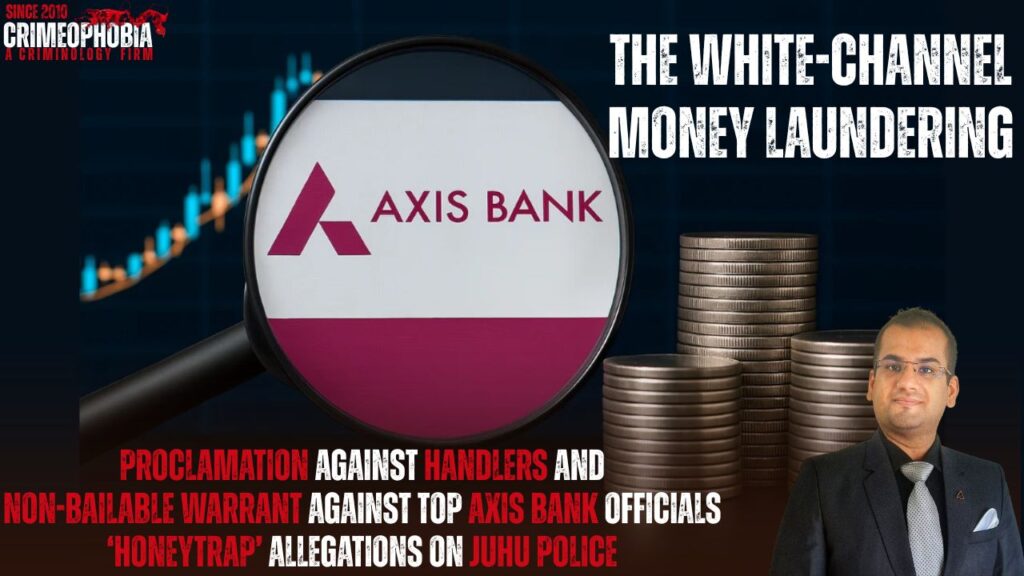
Crimeophobia’s Intervention Triggers Proclamation Order against Handlers, NBW against Top Axis Bank officials while victim alleged ‘Honeytrap’ of Juhu Police
Mumbai: A major development unfolded before the Andheri Court of the Chief Metropolitan Magistrate (CMM), where Criminologist Snehil Dhall, appearing as a subject expert and Intervenor, initiated arguments that led to the issuance of Non-Bailable Warrants (NBWs) and proclamation proceedings against multiple accused in a high-value Axis Bank fraud case involving forgery, financial manipulation, and alleged systemic exploitation of banking channels. The intervention, filed under Crimeophobia’s title, marked one of the first instances where detailed criminological submissions were placed at the threshold stage, prompting the Court to take a stringent view of the matter.
During the proceedings, the Court recorded that several accused persons remained absent despite due process. The order clearly reflects that the Court acknowledged the intervention applications, being satisfied with the case material already on record, proceeded to issue NBWs while also initiating proclamation under Section 82 of the Code of Criminal Procedure. A proclamation under Section 82 CrPC is a coercive legal mechanism whereby the Court publicly declares an accused as absconding and directs them to appear within a specified time, failing which further steps such as attachment of property and declaration as a proclaimed offender may follow. In parallel, four senior officials from Axis Bank’s top management faced rejection of their bail applications, following which fresh NBWs have been issued against them. The Court’s stance indicates that the matter is being treated with heightened seriousness, particularly considering the allegations of forgery, financial fraud, and breach of trust.
Dhall, acting as an Intervenor for affected parties spanning three generations of victims of the same family, emphasized before the Court that the case reflects not merely isolated financial misconduct but a structured pattern of organized financial crime. Crimeophobia Team is now preparing to highlight the Axis Bank’s White-channel for money laundering in which central to the allegations is the role of Manish Carpenter (Carpenter being a surname, not a profession), the mastermind who alongwith his brother & sister in connivance with the Axis Bank Officials are accused of forging Banking documents of Link Agreements & Sanction Letters which are provided by Axis Bank authorities with more than eleven signatures of victims to facilitate the release of top-up loans & release of mortaged collateral – immovable property. These loans were allegedly obtained under the pretext of collateral-based investments pitched to first-time investors. Once the loans were disbursed, it is alleged that repayments were defaulted, the funds were siphoned off, and the burden of liability was transferred onto the victims, whose properties were consequently under threat as the said Loan account was classified as Non-Performing Assets (NPAs) and later the properties subjected to auction.
The Crimeophobia Team now plans to further highlighted that such patterns are not isolated but indicative of a broader “white-channel” mode of money laundering, wherein legitimate banking systems are used as conduits for illicit financial flows. Unlike traditional black-market laundering, this method operates within formal financial institutions, using apparently compliant loan structures, documentation, and disbursement processes. The mechanism typically involves the creation of forged or manipulated documentation, coercion or misrepresentation to obtain borrower consent, strategic default on loans, and eventual asset liquidation, thereby converting illicit gains into seemingly legitimate financial outcomes. The involvement or alleged inaction of institutional stakeholders can enable the layering and integration stages of laundering, making detection significantly more complex.
The Court’s observation on the seriousness of the matter came in the backdrop, reinforcing the presence of subject-expert intervention in complex financial crime litigation. However, the proceedings have simultaneously brought the functioning of the Juhu Police Station under intense scrutiny. Despite opportunities granted through judicial orders, including NBWs, the police have allegedly failed to arrest a female accused even for the second time, and her police statement in the FIR continues to remain pending. This has raised serious concerns regarding investigative intent and procedural compliance.
As highlighted in earlier findings reported by Crimeophobia, the police had undertaken a high-profile operation to Bhopal to execute a Non-Bailable Warrant and successfully secured the custody of one out of eight accused. However, despite this effort, they allegedly failed to record her statement in the FIR, which is a fundamental requirement in criminal investigation. The RTI report further indicates that the accused was transported using a private vehicle, raising procedural questions and concerns regarding adherence to established policing norms.
The contradiction between executing a court-directed arrest and failing to complete basic investigative formalities has been cited as a major lapse. The Crimeophobia report suggests that while the police subjectively acted swiftly to comply with the NBW, the omission of recording the accused’s statement effectively weakened the evidentiary chain, thereby impacting the progress of the FIR. Thereafter Criminologist Snehil Dhall met the Senior Inspector of Juhu Police Station, he orally confirmed that steps would be taken to initiate arrest in the FIR immediately. For a few weeks, officials reportedly showed diligence for revisiting Bhopal but never did. However, during the court hearing held on 16th April 2026, the same accused appeared before the Hon’ble Andheri Court and subsequently returned without any arrest action by the police, raising further questions about enforcement.
Adding to the controversy, one of the victims has now formally submitted a complaint before the Maharashtra State Commission for Women, alleging a possible compromise by Juhu Police Station during the transit custody of the accused which was meant only for obeying Court order and not Police proceedings. The complaint points to the unexplained time gap during the Bhopal-to-Mumbai transit, the failure to undertake mandatory procedures, and a continuing pattern of inaction even after judicial escalation. Based on the circumstantial evidence, one of the victim has raised suspicion of a “honeytrap” angle, alleging that the conduct of the police indicates compromise at multiple levels for which she now waits for response from Maharashtra State Commission for Women. Her primary contention states that why are female criminals been supported by Juhu Police Station and not female victims?
At present, there are no officially established or confirmed cases directly linking honeytrap allegations to officers of Juhu Police Station; however, the present complaint introduces a serious dimension that may warrant independent scrutiny if supported by evidence.
The case now highlights a stark contrast between judicial assertiveness and investigative inertia. While the Court has escalated the matter through NBWs and proclamation proceedings, the allegations surrounding the Axis Bank fraud model and its suspected use as a white-channel mechanism for money laundering have triggered demands for deeper regulatory, criminal, and institutional accountability. With intervention applications and formal complaints now on record and coercive judicial measures in force, the matter is expected to witness intensified legal action in the coming hearings, potentially extending beyond the accused to examine systemic vulnerabilities within the financial and investigative framework itself.