
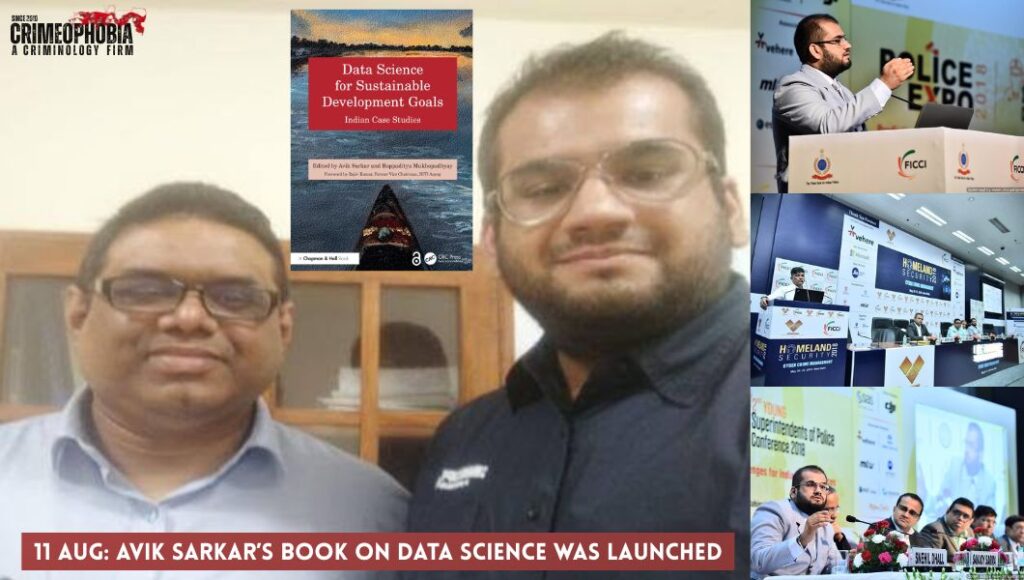
From Sustainable Development to National Security: Avik Sarkar’s New Book Recalls a Shared Data-Science Journey with Snehil Dhall
Published: 14/08/2026; Author: Crimeophobia Bureau
“Avik Sarkar’s journey is a remarkable example of how data science can move beyond algorithms and technology to become an instrument of public policy, national security and societal transformation. Our shared platforms on data science, national security, counter-terrorism and predictive policing gave me an opportunity to witness how thoughtfully data can bridge technology with criminology and security. His new book on Data Science for Sustainable Development Goals reflects the same commitment to applying evidence and analytics to real-world challenges. For Crimeophobia and for me personally, Avik’s intellectual support over the years has strengthened our efforts to bring data science into criminology, predictive intelligence and our continuing work around UNTOC implementation. I warmly congratulate him on this important publication.” ~ Criminologist Snehil Dhall
New Delhi: He joined Crimeophobia as Board of Advisor while being the Head of Data Cell in the institute called ‘NITI Aayog’ for which the Chairman is Prime Minister of India. Currently, he shifted his passion in teaching and works with the Indian School of Business while having immense knowledge of Big Data, Artificial Intelligence, and transforming technologies. He is also heading the development of India Data Portal, a portal for analysis & visualization of govt. data and now he has released his book on Data Science for Sustainable Development Goals: Indian Case Studies. The Book launch co-edited by Avik Sarkar and Bappaditya Mukhopadhyay, took place in New Delhi on 11 August, bringing together an eminent gathering of senior policymakers, government officials, international organisations and experts at the intersection of data, technology and sustainable development. The occasion was graced by Dr. Rajiv Kumar, former Chairman of NITI Aayog, Government of India, as Chief Guest, alongside Dr. Saurabh Garg, Secretary, Ministry of Statistics and Programme Implementation, Government of India; Ms. Anna Roy, Senior Advisor and Head of the Women Entrepreneurship Programme, NITI Aayog; and Ms. Eunsong Kim, Programme Specialist and Chief of Sector for Social and Human Sciences, UNESCO, together with various other distinguished expert speakers. The presence of senior representatives from India’s policy establishment and an international organisation such as UNESCO underscored the growing importance of data science as an instrument of evidence-based policymaking, sustainable development and institutional decision-making. The New Delhi release therefore provided an especially appropriate setting for a book examining how data, analytics, artificial intelligence and technology can be applied to India’s development challenges.
The publication represents more than another academic volume on artificial intelligence, Big Data and analytics. For Crimeophobia – A Criminology Firm, it marks an important moment in the continuing convergence of data science with governance, public policy, national security and criminology. Avik Sarkar, a member of Crimeophobia’s Board of Advisors, has spent years working at the intersection of data, analytics, artificial intelligence and public policy. His new publication examines how data science can contribute to India’s Sustainable Development Goals through practical Indian case studies, while his professional association with Crimeophobia has simultaneously supported another application of data-driven thinking: understanding crime, criminal networks, predictive policing, counter-terrorism and transnational organised crime.
Published by Chapman & Hall/CRC, Taylor & Francis, the book examines the practical application of data science to the United Nations Sustainable Development Goals. It moves beyond technology as an abstract discipline, exploring how data, artificial intelligence, machine learning, deep learning, forecasting, optimisation and other analytical methodologies can assist governments and institutions in addressing real-world developmental challenges. Its Indian case studies span governance, healthcare, education, agriculture, sanitation, infrastructure, participatory planning, surveillance and public administration. The underlying proposition is increasingly relevant to governments worldwide: data acquires public value when it can be converted into evidence, evidence into insight and insight into effective policy.
That proposition has particular relevance to Crimeophobia because its Founder, Criminologist Snehil Dhall, has pursued an interdisciplinary approach in which criminology is not treated merely as an isolated academic discipline, but as an intelligence framework capable of interacting with law, behavioural science, technology, national security and institutional governance. The professional relationship between Sarkar and Dhall extends beyond Sarkar’s formal association with Crimeophobia. Much before Mr. Sarkar formally joined Crimeophobia, the two had already shared platforms discussing Data Science in National Security and Counter-Terrorism, bringing together perspectives that rarely occupy the same disciplinary conversation.
On one such occasion, Avik Sarkar moderated a panel in which Criminologist Snehil Dhall participated alongside distinguished representatives of India’s national-security establishment, including a Joint Secretary associated with the National Security Council Secretariat, Government of India. The panel brought together three distinct perspectives: the national-security establishment, the analytical and technological world of data science, and the criminological perspective represented by Dhall. Sarkar’s role as moderator provided the intellectual bridge through which these perspectives could be brought into a common discussion concerning emerging threats, data, intelligence and preventive security.
A separate occasion brought this convergence into Predictive Policing, in a session organised by the Bureau of Police Research & Development (BPR&D). There, Snehil Dhall participated as the only participant specifically positioned as a subject expert in criminology, with the Intellectual Property of his criminological work, while the other participants brought expertise primarily from IT products, technological solutions and security forces. The distinction was significant because predictive policing is frequently reduced to software, surveillance infrastructure or artificial intelligence. Yet technology alone does not constitute criminological intelligence. A predictive system can identify patterns, but understanding what those patterns mean, distinguishing behavioural indicators from coincidence, assessing causation, recognising criminal typologies and interpreting the human factors behind criminal conduct remain fundamentally criminological questions.
This is precisely where Crimeophobia has sought to establish a distinctive position. Technology can process information at extraordinary speed; criminology provides the intellectual framework through which criminal behaviour and risk can be interpreted. Data can reveal correlations, but criminological expertise is required to determine whether those correlations possess meaningful behavioural significance. Artificial intelligence can detect anomalies, but human expertise remains necessary to determine whether an anomaly represents criminality, vulnerability, social change or simply an unusual but legitimate pattern. Predictive policing, therefore, cannot be reduced to predictive technology. It requires the convergence of data science, criminology, policing, law, ethics and institutional accountability.
It is in this context that Avik Sarkar’s longstanding support for Snehil Dhall’s journey as a data-oriented criminologist becomes particularly relevant. Over the years, Sarkar’s expertise in data science, Big Data, analytics, artificial intelligence and public policy has provided an important intellectual foundation for Crimeophobia’s efforts to examine how data-driven methodologies can be incorporated into criminological analysis. Their association demonstrates how a data scientist and a criminologist can occupy different professional disciplines while contributing towards a common objective: converting complex information into meaningful intelligence capable of improving institutional decision-making.
The significance becomes even greater when the discussion moves from conventional crime to national security and transnational organised crime. Contemporary organised crime can span jurisdictions, financial systems, digital platforms and social structures. Criminal activity generates information through financial transactions, communications, corporate structures, movement patterns, digital footprints, geographical relationships and behavioural indicators. Understanding such networks increasingly requires analytical capabilities capable of processing information across multiple dimensions. The convergence of criminology and data science therefore becomes not merely desirable, but increasingly necessary.
This has a direct conceptual relationship with Snehil Dhall’s longstanding work concerning the United Nations Convention against Transnational Organized Crime (UNTOC). Importantly, Avik Sarkar’s new book is specifically focused on data science and the United Nations Sustainable Development Goals, and does not purport to be a book about UNTOC. The connection lies instead in a shared methodological principle: international objectives require reliable data, measurable indicators, institutional coordination and evidence-based decision-making.
Crimeophobia and Snehil Dhall have pursued India’s implementation of UNTOC for years, examining transnational organised crime not merely as a criminal-law problem but as an institutional, national-security and governance challenge. Data science can provide an important enabling architecture for this work through the identification of criminal networks, analysis of organised-crime patterns, understanding of cross-border activity, detection of anomalies, assessment of institutional vulnerabilities and development of predictive risk models. The relationship between the SDGs and UNTOC should not be understood as an equivalence; they remain distinct United Nations frameworks with different objectives. Their intersection lies in the changing nature of modern governance, where development, security, crime and institutional capacity increasingly operate within the same information ecosystem.
For international diplomats, United Nations officials, policymakers and senior government administrators, this convergence carries implications far beyond any individual publication or conference. The twenty-first-century state operates in an environment of unprecedented information abundance. The challenge is no longer simply acquiring information, but determining which information matters, how it should be interpreted, how datasets should be connected, what conclusions can legitimately be drawn and how those conclusions can inform policy without compromising rights, ethics or institutional accountability. National security follows the same principle: counter-terrorism increasingly requires network analysis; organised-crime investigations require examination of financial and digital ecosystems; cybercrime requires technological and criminological understanding; and predictive policing requires behavioural science alongside algorithms.
Avik Sarkar’s professional journey is particularly relevant to this transformation. His experience spans data science, artificial intelligence, statistical modelling, analytics, public policy and government, including his association with NITI Aayog, where he served in a senior data-analytics capacity and contributed to India’s emerging thinking on artificial intelligence and data-driven policymaking. His work has also included the development and promotion of data platforms and analytical approaches intended to make government information more accessible and useful for policy decisions. His new book therefore emerges from a professional trajectory in which data has consistently been treated not merely as a technological resource but as an instrument of public policy.
For Snehil Dhall, this intellectual orientation has been particularly valuable. Crimeophobia’s evolution has deliberately intersected criminology with behavioural analysis, predictive methodologies, artificial intelligence, Big Data, legal strategy, national security and international organised-crime frameworks. The objective has been to move criminology from a predominantly reactive study of crime towards a more preventive model capable of identifying patterns, vulnerabilities and risks before they mature into conventional criminal events. The shared platforms between Sarkar and Dhall illustrate that evolution: government intelligence and policy, data and technology, and criminological interpretation being brought into the same institutional conversation.
This distinction remains critical for policymakers. A technological system can be purchased; criminological intelligence cannot simply be purchased as a software licence. A database can be constructed; understanding criminal behaviour requires specialised knowledge. An algorithm can process millions of data points; interpreting whether a resulting pattern represents genuine criminal risk requires context, expertise and accountability. The future of predictive policing will therefore depend not merely upon increasingly sophisticated algorithms, but upon increasingly sophisticated interdisciplinary institutions. The same applies to UNTOC: international conventions can establish obligations and frameworks, but effective implementation requires institutions capable of translating those obligations into measurable action through coordination, criminal-network analysis, legal mechanisms, intelligence capabilities, data systems and analytical capacity.
The release of Data Science for Sustainable Development Goals: Indian Case Studies consequently arrives at an important point in this continuing journey. The book asks how data science can help India advance sustainable-development objectives. Crimeophobia’s work asks how data, behavioural science and criminology can help India and other jurisdictions better understand crime and security. Between these questions lies a larger issue concerning the future of governance: how can states transform the enormous volume of information available to them into responsible, evidence-based and preventive decision-making? Sustainable development requires measurement; international crime prevention requires intelligence; national security requires early warning; counter-terrorism requires network analysis; policing requires evidence; and effective governance requires reliable indicators. Across these domains, the underlying requirement remains the capacity to understand complex information and convert it into informed institutional action.
For Crimeophobia, Avik Sarkar’s book therefore represents more than the latest publication of a Board Advisor. It provides an opportunity to recognise a professional association that has evolved alongside the changing relationship between data and criminology. Sarkar’s support for Snehil Dhall’s initiatives over the years has reinforced the proposition that criminology must increasingly engage with data science rather than observe the technological revolution from outside it. For a criminologist working on national security, predictive policing and UNTOC implementation, the ability to understand data is no longer an optional technical skill; it is becoming part of the architecture of modern criminological intelligence.
The significance of this journey is ultimately global. Crime does not respect borders, and neither does data. Transnational organised crime operates across jurisdictions; digital evidence crosses national boundaries; financial crime moves through international systems; terrorist networks exploit global communications; and public-policy challenges increasingly require cross-border knowledge. International institutions therefore require professionals who can speak across disciplines as fluently as they speak across jurisdictions. Avik Sarkar’s publication sits within precisely this transformation: its immediate subject is sustainable development and data science, while its wider relevance lies in demonstrating how data, when combined with institutional knowledge, policy understanding and responsible analytical practice, can become an instrument of public value.
Crimeophobia congratulates Avik Sarkar and Bappaditya Mukhopadhyay on the release of Data Science for Sustainable Development Goals: Indian Case Studies. For Snehil Dhall and Crimeophobia, the publication is also an opportunity to recognise Sarkar’s continuing contribution to the institution’s intellectual journey. His support has accompanied Crimeophobia’s efforts to place data science within criminology, while the shared platforms on national security, counter-terrorism and predictive policing have demonstrated the practical value of bringing together data scientists, criminologists, security professionals and policymakers.
The larger lesson for the international policy community is clear: the future of governance will not be determined by data alone, technology alone or criminology alone. It will be determined by institutions capable of bringing these disciplines together responsibly. In that emerging landscape, the journey from Data Science for Sustainable Development Goals to Data Science for Criminology, National Security, Predictive Policing and UNTOC implementation may represent not separate roads, but different directions emerging from the same intellectual crossroads—where information becomes evidence, evidence becomes intelligence, and intelligence becomes the foundation for better decisions.