
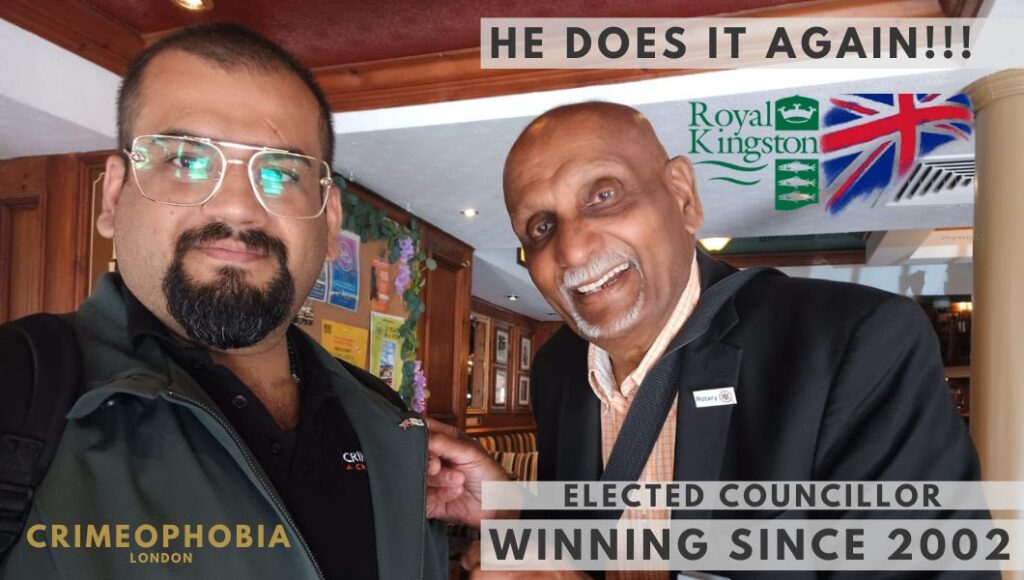
London series: Yogan Yoganathan MBE & Criminologist Snehil Dhall Reflect on 20+ Years of Association
England: Congratulations poured in for Yogan Yoganathan (M.B.E) after he once again secured victory in the 2026 United Kingdom Council Elections, the results of which were declared on 8 May 2026. Having continuously remained an elected councillor since the year 2002, Yogan will now continue serving in office for another four-year term, reaffirming his enduring political relevance, sustained grassroots support, and long-standing public confidence within Kingston upon Thames.
Yogan who also serves as the “Board of Advisor” to Crimeophobia – A Criminology Firm met its Founder, Criminologist Snehil Dhall inside the historic Coronation Hall in Surbiton, London — a landmark dating back to the coronation era of King George V. The two individuals sat across an English breakfast table revisiting more than two decades of mentorship, governance, and institutional evolution. Over the years Yogan Yoganathan continues to remain among the United Kingdom’s longest-serving councillors, twice elected Mayor, and honoured with the title of Member of the Order of the British Empire (M.B.E). While Criminologist Snehil Dhall, founder of Crimeophobia continues to remain the pioneer whose criminology-oriented institutional framework has increasingly drawn attention for attempting to position criminology beyond traditional academic or policing structures.
Their recent reunion in London carried both nostalgia and symbolism. As discussions moved between politics, governance, criminology, diaspora diplomacy, and youth development, both reportedly laughed at an unusual similarity that had emerged with time — the same signature French beard style, separated only by different shades of age and experience as Yogan approaches his eighties. In a gesture symbolising continuity and respect, Yogan presented Dhall with the official British Government pin representing Kingston upon Thames Council. For observers familiar with their journey, the moment represented far more than ceremonial goodwill. It reflected the continuation of a mentorship that quietly contributed toward shaping one of the world’s more unconventional criminology-based institutional concepts.
The venue itself carried historic symbolism. The Coronation Hall in Surbiton first opened in 1911 to commemorate the coronation of King George V. Originally built as a lecture hall and cinema, it later evolved through multiple identities before eventually becoming a public establishment while preserving much of its early twentieth-century British architectural character. The setting appeared fitting for a conversation centred around continuity, mentorship, governance, and public service. Originally a Sri Lankan Sanatani Tamilian, Yogan Yoganathan has occupied a distinctive position within British public life for decades. Unlike many contemporary political figures driven by visibility campaigns and media theatrics, Yogan built his reputation through accessibility, consistency, and direct community engagement. Within diaspora circles, he has often been regarded as one of the most youth-friendly councillors in the United Kingdom.
For Criminologist Snehil Dhall, however, Yogan’s role extended beyond politics. Over the years, he became an informal educational influence in British governance, electoral systems, diplomacy, public administration, and political strategy. Even after Dhall made the academically unconventional decision to shift from Honours in International Relations to Honours in Criminology, Yogan reportedly remained among the few individuals encouraging independent thinking and institution-building throughout the journey. At the time, few could have anticipated that such conversations would later contribute toward the conceptual foundation of Crimeophobia almost two decades ago when India hadn’t even heard about the subject of Criminology as a profession.
Today, Crimeophobia identifies itself not merely as a legal consultancy but as a “Criminology Firm” — a concept still considered highly unconventional within mainstream academia and professional practice. While criminology education globally continues to focus largely on policing, academic research, or institutional employment, Crimeophobia emerged with a different proposition: that criminology itself could evolve into an independent strategic, analytical, legal, and security-oriented enterprise. According to Dhall, one of the largest institutional gaps worldwide remains the absence of entrepreneurial pathways connected to criminology education. Universities continue producing criminology graduates, yet no one encourage students to think of criminology as the foundation for firms, advisory systems, predictive intelligence structures, or independent institutional ecosystems. In that context, Yogan’s encouragement represented one of the earliest forms of validation for an idea many initially viewed as unrealistic while Crimeophobia entered its 17th year of being initially registered in London as Crimeophobia Limited before it started its operations in Mumbai.
The roots of this association trace back more than two decades to a closed-door interaction connected to a Sri Lankan Prime Ministerial visit in London. The gathering reportedly involved only fifteen to twenty individuals. Dhall, then still a student, was perhaps the youngest participant present, while Yogan was already an established councillor and reportedly the only councillor from the United Kingdom attending the interaction. What followed was not a formal mentorship arrangement, but a gradual intellectual association built over years through dialogue, strategic guidance, and ideological exchange. Those interactions later contributed toward the evolution of Crimeophobia as an international criminology-oriented institution involved in transnational organised crime studies, predictive security frameworks, criminological analysis, legal advisory systems, and strategic intelligence perspectives.
During the recent London interaction, Dhall reportedly pledged unconditional institutional support toward initiatives connected with Yogan’s constituency, particularly in the areas of youth empowerment, mentorship, entrepreneurship, and sustainable development. According to preliminary discussions, Crimeophobia and its advisory ecosystem may work toward facilitating youth-driven enterprises, mentoring programmes, business guidance, and investor connectivity through its international network. While formal proposals are expected separately, the principle of long-term collaboration has reportedly already been acknowledged by both sides.
Observers described the development as a rare “reverse cycle of mentorship” — where a once-guided student now seeks to deploy institutional resources toward strengthening the ecosystem that supported his formative years. For Crimeophobia, the initiative aligns with its broader philosophy that mentorship and knowledge exchange should eventually evolve into sustainable societal infrastructure rather than remain confined to academic discussion. The reunion also coincided with congratulations being extended to Yogan following yet another successful councillor election victory in the United Kingdom, reaffirming his continuing political relevance and sustained public confidence after decades in office. Despite changing political climates and evolving diaspora dynamics, he continues to maintain a significant presence within local governance structures in Kingston upon Thames.
As part of the interaction, Yogan also shared a quick interview speaking about his Political journey, about Criminologist Snehil Dhall and the evolution of Crimeophobia. The testimonial has reportedly been archived within the “London Series” on Crimeophobia’s YouTube platform as part of the organisation’s institutional documentation surrounding mentorship, governance, diplomacy, criminology, and international public life. At a time when mentorships are increasingly transactional and political relationships often temporary, the association between Ex-Mayor (Cllr) Yogan Yoganathan M.B.E and Criminologist Snehil Dhall reflects a different model of engagement — one built patiently over decades through ideological trust, intellectual curiosity, public service, and long-term institutional thinking. In many ways, the story is not merely about a councillor and a criminologist, but about a success story of Britain’s Ex-Mayor of how quiet mentorship and sustained guidance can help shape unconventional ideas into enduring institutional identities.