
Manjusha Chaskar: The Tuition Teacher Who Taught Marathi and Quietly Mentored a Kidpreneur
Published: 05/09/2026; Author: Bureau
“She came into my life as a tuition teacher to teach me Marathi, but she gradually became much more than that. At a time when I was a young kidpreneur, still learning how to understand people, ideas and my own ambitions, she was among those who quietly encouraged me to think beyond the obvious. She never tried to take credit for the guidance she gave; she simply believed in me and offered the right words at the right time. Looking back, her role was not just that of a Marathi language tuition teacher, but of an early mentor who helped shape my confidence of a kidpreneur.” ~ Criminologist Snehil Dhall
Mumbai: There are teachers who teach subjects, teachers who prepare students for examinations, and then there are teachers whose influence quietly travels far beyond the classroom and remains embedded in a student’s life for decades. For Criminologist Snehil Dhall, Founder of Crimeophobia – A Criminology Firm and Founding Trustee of the Ministry of Happiness, Manjusha Chaskar is one such teacher. She entered his life when he was in the fifth standard, teaching him Marathi and other schooling subjects, and remained his teacher until the tenth standard, before he left for the rest of his schooling in Singapore and subsequently pursued his degree in the United Kingdom. Yet, to describe her simply as a Marathi tuition teacher would be to overlook the much larger contribution she made during some of the most formative years of his life. She taught a language, but she also helped shape a young personality, supported an emerging entrepreneur, provided psychological counselling and became a mentor and life coach long before such a role was formally recognised within the educational ecosystem.
The journey began when Dhall was a young schoolboy, approximately three feet tall, attending tuition classes to strengthen his understanding of Marathi and other subjects. By the time that chapter of his education ended, he had not merely acquired greater proficiency in a regional language; he had developed a relationship with a teacher who understood the person behind the student. From the ninth standard, when Dhall began stepping into an entrepreneurial lifestyle while still pursuing his schooling, Manjusha Ma’am became particularly important. He was attempting to balance mainstream education with an increasingly unconventional interest in entrepreneurship, and that required more than academic instruction. It required guidance, understanding and someone willing to support ambition without allowing education to be neglected. Manjusha Ma’am provided precisely that balance.
Her role gradually evolved into that of a teacher-cum-psychological counsellor. From the ninth standard onwards, she psychologically counselled Snehil, listened to him, understood the pressures and questions associated with his early entrepreneurial journey and helped him navigate the tension between being a school student and beginning to think like an entrepreneur. Decades before the formal conversation around psychologists and psychological counselling in schools acquired the prominence it has today, teachers such as Manjusha Ma’am were already undertaking these responsibilities organically. The formal recognition that schools require psychological support may have come much later, but the human need was always present, and individual teachers often became the first counsellors available to students.
What makes Manjusha Ma’am’s contribution particularly special is that she did not support entrepreneurship at the expense of education. She supported the young entrepreneur while ensuring that the student continued to pass school. That distinction is critical. It is relatively easy to encourage ambition once a person has completed formal education and established an adult identity. It is much more difficult to encourage a school student to explore entrepreneurship and/or family responsibilities while simultaneously ensuring that he remains accountable to examinations, schoolwork and education. Manjusha Ma’am understood that the two did not necessarily have to compete. She helped Dhall understand that entrepreneurship could develop alongside education rather than replacing it. In many ways, that lesson became one of the earliest principles of a journey that would eventually take him into criminology, legal research, investigation support, financial-crime analysis, security advisory and multidisciplinary research.
Her story also offers an important perspective on what the word “tuition fees” traditionally meant in India. In the educational context in which Dhall grew up, tuition was generally supplementary education outside the regular school classroom. A student attended school and then attended additional classes for a particular subject when greater attention, repetition, explanation or personalised teaching was required. Everything could not always be taught in depth within the limitations of a school timetable and a classroom containing many students. The terminology was markedly different from the common Western use of “tuition fees”. In countries such as the United Kingdom and the United States, tuition fees generally refer to the fees paid to a school, college or university for the formal education provided by that institution, particularly at the higher-education level. Understanding this distinction is essential to understanding Manjusha Ma’am’s generation of educators: her tuition was not the formal institutional price of education; it was additional human attention provided to a student who was already part of the school system.
In the recent past, Prime Minister Narendra Modi has spoken about introducing government-supported online tuition and making educational support available through digital platforms. The idea reflects the enormous possibilities of technology and the objective of making education more accessible. Yet Dhall’s memories of Manjusha Ma’am underline something that existed long before online tuition: a teacher who knew the student personally. Before apps, recorded lectures and digital classrooms, there were teachers who gave students something that technology cannot completely reproduce—personal attention, human understanding and continuity. For Dhall, Manjusha Ma’am’s classes represented that authentic form of supplementary education, where a teacher could simultaneously become an academic guide and a trusted adult in a student’s life.
The journey from approximately three feet to six feet therefore becomes more than a reference to physical growth. Manjusha Ma’am witnessed Dhall’s transformation from a young schoolboy into an adolescent and eventually into an adult with a professional identity of his own. She saw him before there was a title of “Criminologist”, before Crimeophobia had developed into the institution it is today and before entrepreneurship had become an established part of his identity. She encountered him at the stage when ambitions were still being formed and when there was no certainty about where those ambitions would eventually lead. Her willingness to support him during that period is precisely why Dhall regards her contribution as foundational.
The family environment surrounding Manjusha Ma’am also left a lasting impression on him. Dhall remembers observing a massive joint family in which her husband, Satish Chaskar, continued with his biotechnology-related professional work while her in-laws and other members of the family supported her in teaching students such as Snehil. Teaching was therefore not an isolated activity conducted without family support. It existed within a household where professional responsibilities, family responsibilities and the needs of students were accommodated together. For a young student observing that environment, the experience itself became an education in discipline, family support, professional commitment and the importance of creating space for another person’s development.
The years have brought significant changes to that family as well as to Dhall’s own life. Following the COVID-19 period, Manjusha Ma’am moved away from tuition teaching and began pursuing baking, creating extremely tasty cookies and other baked products. The transition from teaching children to baking may appear like a completely different professional chapter, but for Dhall it is another reminder that a teacher is also an individual with her own talents, interests and evolving journey. The person who once spent her days teaching Marathi and other school subjects eventually turned her creativity towards baking, while the former student she had taught continued along an increasingly specialised professional path.
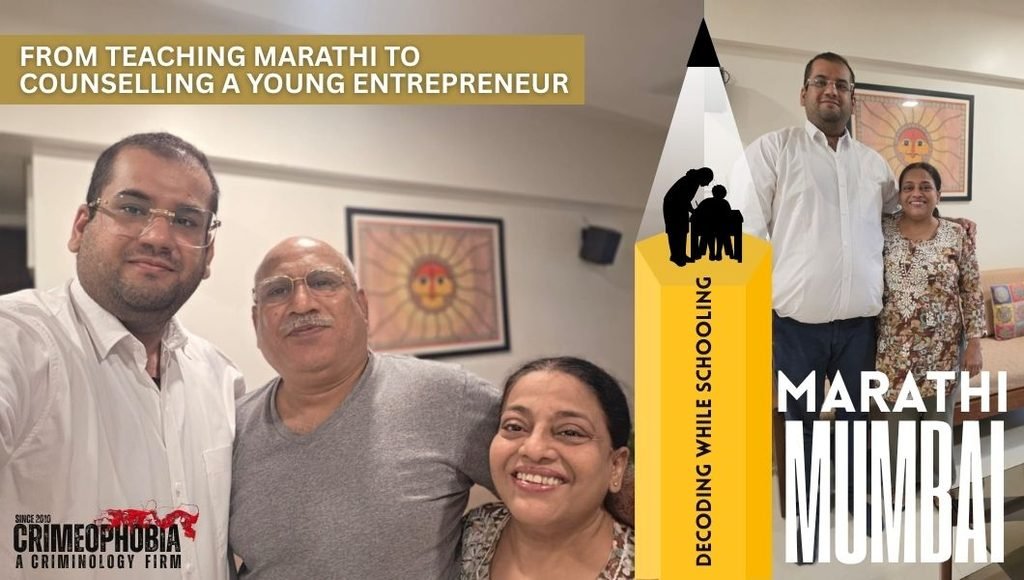
Dhall’s recent interaction with Manjusha Ma’am brought many of those old memories back. The former student and teacher were able to revisit the years of school, tuition, adolescence and the beginning of his entrepreneurial journey. Conversations that had been separated by decades suddenly became immediate again, bringing back memories of the young student she had once taught. Perhaps the most meaningful part of the reunion was also the simplest: they clicked a photograph in which her husband was present as well. He was extremely happy to meet Dhall, adding another layer of warmth to a reunion that connected the family’s memories of a schoolboy with the professional identity he carries today. She also made Dhall speak to her daughter who used to be in her kindergarten when he used to study and now married in New Zealand. The interactions further extended to Dhall speaking with Manjusha ma’am’s son-in-law as well.
Dhall also interacted with Manjusha ma’am’s own husband, Satish Chaskar and learnt more about the specialised professional journey he has subsequently built. He now runs a company focused on nuclear medicine and imaging solutions, operating as a specialised consultancy and project-management firm serving the medical cyclotron and radiopharmaceutical industry. He has managed major cyclotron projects, including India’s first medical cyclotron facility, and specialises in cyclotron technology, turnkey project execution, facility management and QA/QC operations. His company provides end-to-end technical, operational and management support covering project conceptualisation, planning and design, radiochemistry, commissioning, radiation safety, quality control, facility operations, workflow management and specialised software solutions. Its work also supports PET tracer production facilities, including radioactive-fluid management, hot-cell dispensing, plant monitoring and dose management.
For Dhall, however, the significance of Manjusha Ma’am cannot be separated from his own eventual journey. Today, as the Founder of Crimeophobia – A Criminology Firm, he operates in the fields of criminology, legal research, crime investigation support, financial-crime analysis, security advisory and multidisciplinary research. He is also the Founding Trustee of the Ministry of Happiness, an initiative through which his professional and social interests extend into areas including wellbeing, education, psychological support, victim assistance and crime prevention. The institutions may now carry names, structures and professional responsibilities, but their origins can also be traced to the formative years in which a young student was learning how to combine education with entrepreneurship.
That is why Dhall considers Manjusha Ma’am the first teacher who genuinely supported his entrepreneurial work while he was still in school. Her contribution was not to encourage him to abandon conventional education in pursuit of business; it was to demonstrate that ambition and education could coexist when supported by discipline. She helped him continue as a student while simultaneously allowing him to explore the entrepreneurial instincts that would eventually become an important part of his professional identity. In doing so, she became one of the early people who helped create the environment in which Crimeophobia could eventually develop from an adolescent outlook into a professional institution.
There is also a deeper significance to the Marathi she taught him. Dhall’s eventual professional life became closely connected with Maharashtra, particularly through his work in the legal sector. The language that began as a school subject became a practical tool for communicating, understanding people and sustaining himself within the State’s social and professional environment. What may have appeared to be an ordinary tuition subject in the fifth standard ultimately became part of the foundation that helped him function in the region where his professional journey developed. A teacher may not always know where a lesson will eventually take a student; in this case, a regional-language lesson travelled far beyond the classroom.
For most people, Manjusha Ma’am’s contribution might be described simply as that of a tuition teacher who taught Marathi and other schooling subjects through additional classes. For Snehil Dhall, that description does not come close to capturing her contribution. She taught Marathi, but she also taught communication. She provided tuition, but she also provided psychological counselling. She helped with school subjects, but she also taught life skills. She supported an emerging entrepreneur, but she also made sure that the student continued to pass school. Above all, she offered the kind of personal guidance that can fundamentally influence a young person’s confidence and direction.
Her contribution is therefore not merely a matter of nostalgia. It is an expression of gratitude towards a teacher who supported a student at a time when there was no guarantee of what he would eventually become. Before Crimeophobia had a name, she knew Snehil as a schoolboy. Before he became a criminologist, she knew him as a student learning Marathi. Before entrepreneurship became part of his professional identity, she was already helping him understand how to balance ambition with responsibility. She was present when the journey was still being formed, which is precisely why her contribution remains so significant in retrospect.
Teachers are often remembered for marks, certificates and lessons, but their deepest influence is frequently invisible. It exists in the confidence they give a child, the patience they demonstrate, the questions they encourage and the belief they place in a student before anyone else has evidence of what that student might become. Manjusha Ma’am’s contribution to Snehil Dhall belongs to that category. Her tuition classes may have occupied only a few hours each week, but the lessons she gave him travelled across decades. Her Marathi lessons became part of his ability to operate in Maharashtra State in India, her counselling became part of his understanding of balance, and her support for a young entrepreneur became part of the confidence with which he eventually built his professional life.
The reunion therefore carries an emotional significance that extends beyond a photograph between a teacher and a former student. It represents a moment in which a teacher could meet the grown-up version of the child she once taught, while the student could finally look back with the perspective of adulthood and acknowledge the people who helped him before his achievements became visible to the world. For Dhall, Manjusha Ma’am remains one of those people whose contribution cannot be measured through conventional professional metrics because her greatest contribution occurred before there was any professional success to measure.
The cookies she makes today may be enjoyed for only a few minutes, just as her tuition classes once occupied limited hours of a schoolboy’s week. But the lessons she gave Snehil Dhall have lasted considerably longer. She taught him a language, but also gave him a means of connecting with the society in which he would eventually build his professional life. She taught school subjects, but also life skills. She counselled an adolescent, but also helped an entrepreneur find balance. Most importantly, she believed that a student could dream differently without being allowed to forget the responsibilities of education.
For Snehil Dhall, that is the legacy of Manjusha Ma’am. She was not merely a tuition teacher who appeared in his childhood timetable. She was one of the first mentors to recognise an entrepreneurial instinct in a school student and help him carry it responsibly. She witnessed the journey from approximately three feet to six feet, from Marathi lessons to professional life, from schoolboy ambitions to Crimeophobia, and from an adolescent outlook to the responsibilities of the Ministry of Happiness. Her role may never be adequately captured by a designation, because the most important title she holds in Dhall’s story is the simplest one: teacher.
And sometimes, a teacher’s greatest achievement is not the lesson that a student remembers from the classroom, but the life that student is able to build because someone believed in him while he was still learning how to build it.