
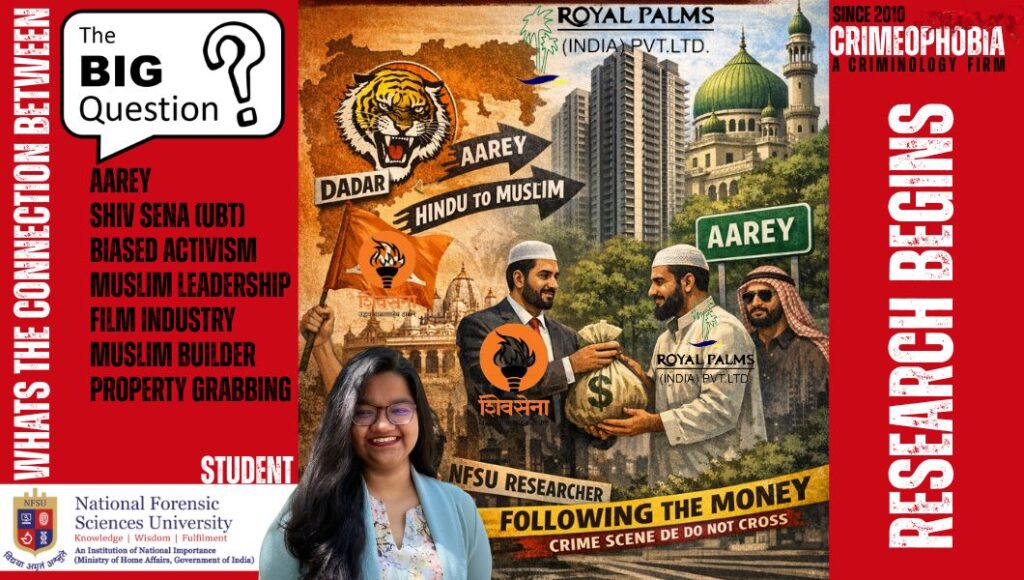
Shiv Sena (UBT)’s Political Empire Migrates from Dadar to Aarey and from Hindu to Muslim with Muslim Builder Investor Backing, Claims NFSU Student Researcher: Crimeophobia
Author: Saloni Chitnis (Crimeophobia Intern) | Published 20/02/2026
“Crimeophobia team has been assisting on a pro bono basis various victims, researchers, and students regarding their concerns towards Aarey for several years, and we are glad to support a National Forensic Science University (NFSU) student in her research, in which she is preparing her case study. The irony or concern is that she is a Marathi female studying in Gujarat after completing her MBA in Human Resources and is currently also conducting her research on female prisoners in Nashik, Pune, and Mumbai after securing permissions from the Maharashtra Police. While the below report is independently created by Ms. Saloni Chitnis, we continue to support her research as she continues to work with us as Crimeophobia’s intern,” – Criminologist Snehil Dhall
MUMBAI: Tamilians, perceived as anti-Hindi and strongly advocating for a two-language policy (Tamil and English) as encouraged by the DMK, and Muslims, characterized as anti-Hindu, have become the emerging partners of the Shiv Sena (UBT) faction as it migrates its political empire to Aarey after losing its traditional mainstay in Dadar. The Shiv Sena originating in Dadar with its iconic headquarters Shiv Sena Bhavan located in that neighbourhood. It was here that the party’s DNA was encoded. The party, birthed by the Honourable Hindu Hriday Samrat Balasaheb Thackeray to explicitly combat the perceived socio-economic dominance of Tamilians and later Muslims, is now seeing a total inversion of its founding logic.
Following the split of the party into the Shiv Sena (Shinde) faction—led by the Deputy CM of Maharashtra State, Eknath Shinde—and the Shiv Sena (UBT) faction, Balasaheb Thackeray’s son, Uddhav Thackeray, has been actively soliciting the patronage of these very same groups. Decades ago, the slogan “Lungi uthao pungi bajao” was established to oppose Tamilians taking jobs from the Marathi community. Today, the Shiv Sena (UBT) faction supplicates for the support of these same groups who hold an unofficial majority in the Aarey region. This shift from Dadar to Aarey, and from Hindu to Muslim, is a transparent attempt by the Shiv Sena (UBT) faction to try its luck with other communities, having already lost its mainstay in the traditional Marathi heartland. This is not an organic evolution but a strategic retreat that abandons its spiritual home in Dadar for a new, transactional empire in the Aarey Colony.
The faction has now migrated its political and financial capital to the controversial belt of Aarey Colony, executing a fundamental ideological shift from Hindutva to Islam, allegedly bankrolled by a controversial Muslim builder who operates a “state within a state” in the Royal Palms estate. They also seek support from the same Tamilians who have an unofficial majority. The migration is not an organic political evolution but an intentional, strategic retreat. Having lost control of the Brihanmumbai Municipal Corporation (BMC), key state institutions, and the traditional municipal wards that once guaranteed its dominance, the Uddhav Balasaheb Thackeray-led faction has sought a new mainstay. Dadar, with its shifting demographics and the faction’s weakened Marathi vote base, no longer guarantees power.
In its place, Aarey Colony has been identified as the new ground zero, comprising tribal hamlets, slum pockets, and the colossal gated empire of a Muslim builder—the 240-acre Royal Palms estate. The party ensures there are no Muslim religious setups inside Royal Palms, although it does have various temples. The party leadership has made a cold, hard calculation: trading the volatile loyalty of the “Marathi Manoos” for the consolidated support of a specific minority vote bank, cultivated under the protection of a builder-investor. This is the birth of a new political empire, one built not on ideology, but on a transaction.
At the center of this transition has also been Aaditya Thackeray, the MLA from Worli and former Minister for Environment, Tourism, and Protocol. His “Save Aarey” campaign serves as an example of political selectivity, but deep within it was a “Save Shiv Sena” campaign, since his party had started to lose its home ground. As Ex-Environment Minister, Thackeray became the prominent face of the movement opposing the Metro-3 Car Shed on public land, arguing that it threatened Mumbai’s biodiversity. He also mobilized Bollywood personalities and social media influencers, helping present the Metro shed project as a major environmental concern. However, he or his so-called activists took no efforts against the Muslim builder and property-grabbing gangs when they burned more than 20 acres of land for constructing film studios in Royal Palms or when illegal mosques were created on forest land after construction debris dumping that had destroyed the environment.
However, we cannot undermine reality: this environmentalism was a farce. While the administration obstructed critical public infrastructure projects, it facilitated the massive private exploitation of the very same ecosystem by the Royal Palms estate. This highlights a conflict of interest where the “Tourism” portfolio formerly held by Thackeray served the private interests of the builder lobby over his “Environment” mandate. Apparently, as per local residents, most of the illegal construction of mosques started during the tenure of Aaditya Thackeray.
The strategy was clear: force the state to acquire the builder’s land for the project, generating hundreds of crores in compensation or development rights. When this deal collapsed, the environmental facade disintegrated. The activists and groups who had zealously rallied behind the Minister remained silent as nearly 20 acres of dense forest were “burned” to clear land for film studios and the builder’s territory. The researcher concludes that the “Green” narrative was merely a camouflage for a “Grey” operation. The destination of this political migration is exposed as a “lawless enclave,” where the Indian Constitution holds no power, replaced entirely by the whims of its former owner, Amir Nensey, who has also reportedly been removed by his family. The report paints a definitive picture of a builder who operates with absolute impunity, shielded by the very political forces that claim to protect Mumbai.
It is documented in court records. A former diamond merchant–turned–filmmaker has been a victim of the Royal Palms underworld syndicate, for which he has also been accused in several other cases. According to FIRs filed with the Malabar Hill Police, the filmmaker purchased 25 acres of land in Royal Palms in 1993. When he attempted to fence it, he was physically barred by the builder’s security. His complaint alleged that he received death threats from the underworld in Dubai, warning him to abandon his 25-acre claim or face consequences. The filmmaker’s legal team termed this as Royal Palms’ standard modus operandi to silence land/property claimants. The dark underbelly of this alliance is the intersection of the builder lobby with the criminal underworld. The same machinery of intimidation is now at the disposal of the Shiv Sena (UBT), providing the muscle required to enforce its new political dominance in the suburbs. Recently, a formal criminal complaint was also filed with the Aarey Police Station, Deputy Commissioner of Police, Additional Commissioner (North Zone), and the Inspector General of Maharashtra Police (Prevention of Atrocities against Women), but it was silenced with political phone calls allegedly made to Aarey Police Station, which does not even listen to its senior officials whatsoever.
This lawlessness extends to the physical destruction of national assets. Reports from Mid-Day and DNA India confirm that Royal Palms encroached inside the boundaries of the Sanjay Gandhi National Park (SGNP), in which even certain court orders were overturned by ministers during the Congress period who are now partners with Shiv Sena (UBT). The builder lobby treats federally protected wildlife zones as personal property, constructing illegal floors in malls like Orchard Mall without essential fire brigade pathways or water supply. Illegal construction has cut off natural sewage and rainwater drainage, causing artificial landslides that threaten the fragile ecology the UBT faction pretends to champion. Yet, the bulldozers that are quick to demolish slum dwellings elsewhere in Mumbai are paralyzed here by political patronage.
This physical migration is underpinned by a calculated ideological surrender, a complete transition of the party’s core beliefs to service its new mainstay in Aarey. The recent political developments highlight a rapid dismantling of the party’s hardline identity to appease its new base. In February 2026, the Shiv Sena (UBT) crossed a definitive ideological rubicon in Parbhani. The party defended its decision to elect Syed Iqbal, a Muslim corporator, as the Mayor with Congress support. When questioned, the party mouthpiece Saamana launched a defense that would have been unthinkable in the Bal Thackeray era, arguing that if the BJP could support APJ Abdul Kalam, they should not object to a “Marathi-speaking Muslim mayor.” This move serves as a litmus test for the new alliance, proving the party is willing to hand over key administrative posts to solidify its new demographic coalition.
Simultaneously, the party has begun attacking its traditional base. In August 2025, UBT MLA Bhaskar Jadhav sparked controversy by allegedly calling the Brahmin community “cunning,” while explicitly stating, “I knew the Muslim community would vote for me.” This blatant alienation of the upper-caste Hindu voter base, coupled with an open embrace of the Muslim vote, confirms the researcher’s thesis of a deliberate “Hindu to Muslim” shift. In August 2024, Uddhav Thackeray publicly committed to safeguarding Waqf Board properties, promising that “no one can touch” them and vehemently opposing the central government’s Waqf Amendment Bill. This promise aligns with the allegations of a “Sharia Zone” taking root in Aarey, providing political cover for the expansion of religious properties on encroached land.
To normalize this shift, senior leader Sanjay Raut asserted in 2024–2025 that Muslims are an integral part of India who have celebrated festivals like Holi for thousands of years, stating it is “wrong to repeatedly question their loyalty.” The party even praised the RSS chief for meeting Muslim clerics, framing it as a step toward national unity and integrity. The consequences of this “Muslim Builder–UBT” pact are visibly altering the demographic and social fabric of the region. Aarey is being strategically converted into a religiously exclusive zone through a process of “Land Jihad.” The modus operandi is specific, destructive, and unchecked: construction debris is dumped on fertile land, intentionally killing the soil to prevent reforestation. On this dead land, illegal mosques and kabristans (graveyards) have spawned rapidly. Islamic religious structures are strategically placed next to existing Hindu temples. This is designed to provoke communal tension and assert dominance over the land, while the Muslim builder who holds 240 acres is not even questioned by Muslim leaders for not providing land space for a mosque, nor are there any fatwas.
Shiv Sena (UBT)’s reliance on this network has compromised national security. The ultimate proof of this betrayal was witnessed in May 2024, when the BJP accused UBT candidate Amol Kirtikar of campaigning with Iqbal Moosa (alias Baba Chauhan), a convict in the 1993 Mumbai serial blasts. The sighting of a terror convict—a man involved in the single greatest act of war against Mumbai—on the campaign trail of the Shiv Sena sends a chilling message: the migration to Aarey has come at the cost of embracing elements linked to the forces that sought to destroy the city. On the other hand, his father, Gajanan Kirtikar (formerly a Member of Parliament), was seen repeatedly sitting with the Royal Palms builder in public meetings, especially in the same hotel which allegedly gave chills to more than 500+ Jammu & Kashmir girls who experienced human and sex trafficking activities while they were on a field trip in Mumbai.
The migration attempt from Dadar to Aarey is progressing rapidly and appears to be taking definitive shape in due course. Balasaheb Thackeray was known for opposing Muslims strongly due to the 1991 riots and 1993 bomb blasts, a period when Hindus were protected by his leadership. By pivoting to solicit the very support its founder, the late Balasaheb Thackeray, spent a lifetime opposing—specifically the consolidated Muslim vote bank—the Shiv Sena (UBT) faction has done more than just shift its geographical focus. While the senior Thackeray’s early opposition to Tamilians eventually shut down as the party recognized them as fellow Hindus, the current leadership’s open embrace of elements linked to the 1993 blasts marks a total ideological surrender.
By abandoning the hallowed ground of Shiv Sena Bhavan for the transactional alliances of Aarey, the faction has not just moved its headquarters; it has systematically dismantled the foundation of its founding father. Under this new patronage, the “Green Lung” of Mumbai is being forcibly converted into a “Grey Zone” defined by organized crime, administrative paralysis, and communal dominance. Ultimately, this transition leaves the party unrecognizable to the very people who encoded its original DNA, signalling the terminal fracture of a once-uncompromising political legacy.