
The Education Race in India: Cambridge’s Courtesy, York’s Marketing and the Gurukul’s Quiet Revolution
Published: 13/09/2026; Author: Crimeophobia Education Desk
“The education sector is increasingly becoming a competition of marketing, but my experience revealed three very different approaches. Cambridge University approached me positively, inviting & admitting me to become a learner without needing to diminish another education system. My Cambridge journey was postponed because of the American–Iran war, while, almost paradoxically, the same geopolitical turbulence coincided with York University Mumbai moving ahead with its Indian campus. My concern with York arises from the negative marketing attributed to its representatives—primarily portraying Indian higher education as insufficiently research-driven and suggesting that Indian parents seek Return on Investment, thereby positioning York Mumbai as the preferred choice for admission compared to others. Meanwhile, Gurukuls are quietly modernising and computerising Vedic education through Shastra and Shaastra. The real winner should be the learner.” ~ Criminologist Snehil Dhall
Mumbai: There is a certain irony in the fact that this discussion comes from an organisation whose Founder, Criminologist Snehil Dhall, himself pursued international education at a time when several of the courses he wanted to study were not easily accessible in India. Decades ago, Dhall completed the International Baccalaureate in Singapore and subsequently pursued an Honours degree in Criminology in the United Kingdom. He later established Crimeophobia Limited in the United Kingdom before returning to India because of family commitments. For more than 15 years, he has nevertheless continued teaching Crime and Criminology in India completely free of cost or on a pro bono basis, helping establish the very market in which Crimeophobia operates today as a research-based Criminology Firm. It is therefore important to understand that Crimeophobia’s position is not anti-foreign education. Dhall himself is a product of international education. His position is that international education must come to India as a partner to Indian intellectual traditions, not as a competitor that needs to demean them to attract students & parents.
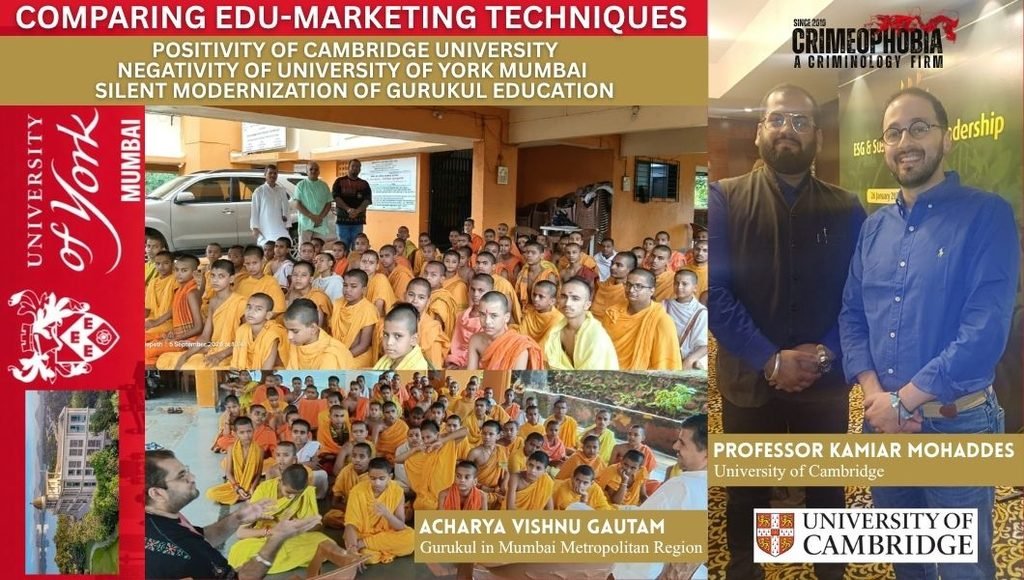
It is also merely a coincidence that Dhall has had the opportunity to meet members of the top management of both the University of Cambridge and the University of York Mumbai, while also meeting Acharya Vishnu Gautam, who heads one of the Gurukul in Mumbai. These encounters have created an unusual triangle: Cambridge, York and the Gurukul. All three represent very different approaches to education, yet all three ultimately face the same fundamental question—how do they attract the next generation of students?
Professor Kamiar Mohaddes of the University of Cambridge provides, in Crimeophobia’s view, an important example of how that competition can be conducted with dignity. Professor Mohaddes is an Iranian origin, Associate Professor in Economics and Policy at Cambridge Judge Business School, Director of the Global Executive Master of Business Administration Programme, Deputy Director of the Cambridge Executive Master of Business Administration Programme, Fellow in Economics at King’s College, Cambridge, and Co-Founder and Director of the King’s Entrepreneurship Lab. He holds a Bachelor of Science from the University of Warwick and a Master of Philosophy and Doctor of Philosophy from the University of Cambridge. His research spans climate change, energy economics, the economics of the Middle East, applied macroeconomics, external shocks and sustainability. He has worked with institutions including the United Nations, World Bank, Asian Development Bank and International Monetary Fund, and his research has appeared in leading academic journals.
His engagement with India, including the Cambridge–Dhirubhai Ambani University Global Environmental, Social and Governance and Sustainability Leadership Programme and the Environmental, Social and Governance and Sustainability Leadership Dialogue in Mumbai, demonstrated that a globally prestigious university can promote its academic programmes while simultaneously treating India with courtesy, decency and respect. Professor Mohaddes has also spoken positively about India’s journey towards Viksit Bharat 2047 and the opportunities for India and the Global South to shape the global sustainability agenda. For Crimeophobia, this is what internationalisation should look like due to which he was also admitted to Cambridge University to study but the American-Iran war got the course tenure rescheduled.
The contrast becomes particularly significant when viewed alongside the University of York Mumbai and Professor Lindsay G. Oades who is an accomplished academic in his own right. The University of York identifies him as Provost of the University of York Mumbai and an internationally recognised wellbeing scientist, researcher, educator and author. Before joining the University of York Mumbai, he served as Deputy Dean of the Faculty of Education and Associate Dean (International) at the University of Melbourne and Director of the Australian Institute for Business Wellbeing at Sydney Business School. His collaborations have included the United Nations Educational, Scientific and Cultural Organization, the Australian Research Council and the New South Wales Department of Education, and he received the Positive Education Research Impact Award in 2025.
The University of York is a respected British research university and member of the Russell Group. Its Mumbai campus has received approval from the University Grants Commission and is preparing to welcome students, with proposed programmes including Computer Science with Artificial Intelligence and Cyber Security, Business, Economics and the Creative Industries. Its research ambitions encompass sustainability and food security, responsible business, culture and creativity, health and wellbeing, and future technologies.
Crimeophobia therefore has no objection whatsoever to the University of York establishing itself in Mumbai. India should welcome serious international universities. Competition can improve education. International faculty can enrich Indian academia. International research partnerships can expand India’s knowledge economy. Indian students should have the opportunity to access the world’s best educational institutions without necessarily leaving India.
The problem begins when that competition is accompanied by negative marketing about the very educational system from which those students come. During Dhall’s interaction with Professor Oades, he questioned statements attributed to University of York marketing representatives suggesting that Indian higher education had not sufficiently focused on research and had instead focused on rankings. Another proposition presented was that Indian students and parents seek “Return on Investment” from education whereas Western students and parents supposedly do not.
If accurately represented, Crimeophobia believes such messaging requires immediate reconsideration. There is nothing intellectually inferior about an Indian parent asking what value, professional opportunity and future benefit an education will provide. Indian families have historically treated education as a serious responsibility. They evaluate employability, professional opportunities, family circumstances, international mobility and long-term sustainability. To characterise this simply as an obsession with “Return on Investment” risks confusing responsibility with commercialism.
Indeed, asking whether education produces meaningful intellectual, professional and social value is accountability—not recklessness. Nor can India’s higher-education ecosystem reasonably be reduced to rankings. India’s system is vast and imperfect, but it contains institutions and researchers of international significance, including the Indian Institutes of Technology, Indian Institute of Science, Tata Institute of Fundamental Research, All India Institute of Medical Sciences, Indian Statistical Institute, Jawaharlal Nehru University, University of Delhi, Banaras Hindu University, Jamia Millia Islamia, regional University of Mumbai/Delhi along with many other Management Universities like Indian Institute of Management and numerous other institutions that have produced generations of scientists, academics, administrators, entrepreneurs, engineers, lawyers, doctors and public intellectuals.
India is fully aware that its higher-education system requires reform and greater research capacity. Its own policy framework recognises the need for research-intensive universities, teaching-intensive universities and autonomous institutions. But acknowledging challenges is very different from permitting a foreign university’s marketing machinery to portray Indian higher education as intellectually deficient in order to attract Indian admissions.
There is an even deeper historical issue. As an Indian who has studied or worked in India, Singapore, the United Kingdom, the United States of America, Sweden and other jurisdictions, Dhall has experienced both Indian and Western educational environments. He has never accepted the assumption that intellectual progress travels only from West to East. India possessed sophisticated traditions of mathematics, astronomy, medicine, philosophy, linguistics, statecraft, architecture and education long before the modern Western university emerged in its present form.
Nalanda and Takshashila remain powerful reminders that intellectual civilisation is not owned by one geography. The destruction and disruption of India’s historic centres of learning represented an enormous loss of accumulated knowledge. Modern India must not become complacent about its past, but neither should Indians be expected to approach foreign universities with intellectual inferiority. Rather most western universities have focused on research of Indian inventions in which they had to research by using reverse engineering to decode and then implement their research using Indian civilization inventions and innovations.
And this brings us to the Gurukul. Dhall’s meeting with Acharya Vishnu Gautam, who heads a Gurukul in Mumbai with a comparatively small number of students, presents an entirely different educational proposition. The Gurukul is not attempting to replicate a foreign university. It represents an indigenous educational tradition in which the relationship between teacher, student, knowledge, discipline, character and life itself is fundamentally different.
The irony is that a race has now begun. On one side are foreign universities establishing campuses in India. On another are India’s existing universities and research institutions. And alongside them stands the Gurukul—an ancient Indian or Bharatiya educational model attempting to retain relevance in a modern world. All three are competing for the same most valuable resource: the student.
Crimeophobia does not believe that this competition should be feared. It should be welcomed. But it should be conducted fairly. Foreign universities can bring research, technology, international faculty, global networks and new academic opportunities. Indian universities can provide indigenous expertise, enormous intellectual capacity and a rapidly evolving research ecosystem. Gurukuls can offer an entirely different understanding of education, character and knowledge. The student should ultimately decide. But the student should decide on the basis of academic quality—not because one institution has successfully convinced the student that another civilisation’s educational system is inferior.
Apparently, Gurukul education in the current era is itself evolving into modernised patterns of learning, combining traditional knowledge with practical, digital and technology-driven methods. Various Gurukuls across India continue to provide Vedic education through different branches of Shaastra, encompassing Veda Shastra, Dharma Shastra, Artha Shastra and Yoga Shastra, alongside the study of Shastra in the martial tradition, including Indian martial arts, weapons and historical warfare techniques. What has changed significantly is not necessarily the underlying knowledge but the mode of transmission: contemporary Gurukuls are increasingly incorporating practical instruction, digital learning, computers and modern technology into their educational environment, much like international educational institutions. In this sense, the modern Gurukul need not be viewed as an institution trapped in the past; it can be understood as an evolving educational model in which ancient Indian knowledge systems are being taught through contemporary practical and technological approaches, creating a bridge between traditional Shaastra and modern education.
Professor Oades, when questioned by Dhall regarding the marketing messaging, indicated that the statements were attributable to marketing representatives and that he had been pushed towards that messaging against his own preference. Although the interaction between Oades and Dhall were formal, but the disagreement of Oades against its own university’s negative marketing approach is more of an independent opinion and not on behalf of the University of York Mumbai. If that account is accurate, the issue becomes even more serious: why should an academic leader have to defend marketing language that does not represent his own position?
This is where Crimeophobia believes the University of York Mumbai should learn from institutions such as the University of Cambridge—and perhaps from the dignity demonstrated by Professor Mohaddes during his engagement with India. A university with confidence in its scholarship does not need to make another country’s universities look small.
Its research should speak for itself and their courses should be their credibility instead of creating negative marketing for Indian Higher Education to sell their York courses in Mumbai.
Crimeophobia’s position is therefore clear. It does not endorse the University of York Mumbai’s positioning if it continues to rely upon marketing that demeans Indian higher education, Indian universities or Indian students and parents. This is not opposition to York’s British identity, its faculty, its academic credentials or its decision to establish a campus in Mumbai. It is opposition to a marketing philosophy that, if accurately represented, seeks to attract Indian students by portraying Indian education negatively.
If such statements were indeed made, Crimeophobia believes the University of York should immediately review its marketing strategy, remove inappropriate messaging and consider an apology to the Indian higher-education community. If the University’s own leadership did not intend such messaging, then the obvious question is whether the marketing agency responsible should continue representing the institution.
And if any foreign university operating or seeking to operate in India is demonstrably found, after due process, to have used materially misleading, discriminatory or disparaging representations concerning Indian higher education to secure admissions, Crimeophobia believes the Government of India should examine whether its permissions remain appropriate and whether corrective measures, including remedies available under applicable law, are warranted.
India should not invite foreign universities merely to become markets for their admissions campaigns. India should invite them to become partners in knowledge.
There is also no reason why Indian parents should apologise for asking questions about the value of education. Perhaps they should be applauded for doing so. The Western assumption that students should not necessarily evaluate educational outcomes through responsibility, employability or long-term value deserves examination just as much as the Indian system deserves reform.
At the same time, Crimeophobia rejects the simplistic suggestion that Western societies’ social or legal problems can be attributed to an absence of educational Return on Investment considerations. Crime, unemployment, indebtedness and legal conflict have complex causes. Education cannot be reduced to a single variable. But equally, Indian responsibility towards education should not be caricatured as an intellectual weakness.
The larger question is therefore not Cambridge versus York, nor foreign university versus Indian university. It is what kind of education does India want to become? Perhaps the answer should not be decided by marketing departments. Perhaps it should be decided by students, parents, teachers, researchers and institutions. Perhaps Cambridge can teach India something. Perhaps York can teach India something. Perhaps Indian universities can teach Cambridge and York something. And perhaps the Gurukul can teach all of them something that modern universities have gradually forgotten.
Crimeophobia’s Founder has personally benefited from international education. He studied the International Baccalaureate in Singapore, pursued Honours in Criminology in the United Kingdom, established Crimeophobia Limited in the United Kingdom and later returned to India. Yet for more than 15 years, he has taught Crime and Criminology in India without charging students, often entirely pro bono, while building Crimeophobia as a research-based Criminology Firm. That history makes Crimeophobia’s position particularly simple.
International education is valuable. Foreign universities are welcome. Global academic competition is healthy. But respect for India is not optional. The race between Cambridge, York, Foreign or Indian universities and the Gurukul has already begun in a new Bharat that is increasingly confident about its place in the world. Dhall merely hopes that, when the race is eventually judged, the Gurukul wins—not because it is Indian, but because it proves that indigenous knowledge, discipline, character and intellectual tradition can stand confidently alongside the finest education the world has to offer.
And if foreign universities genuinely believe they are better, they should not need to say so through negative marketing. Let the research compete. Let the students decide. Let the scholarship speak. That, in Crimeophobia’s view, is the dignity that Indian higher education deserves.